“Agriculture education is big.”
That was not the theme but it was the message for the fourth Cultivating Connections in Agriculture, an event celebrating agriculture education and FFA in the Sauk Valley and the larger northern Illinois region.
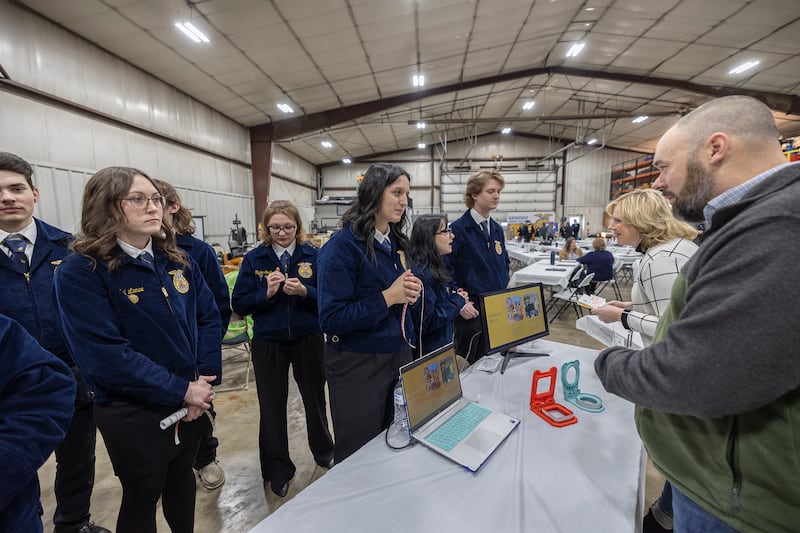
The conference and networking event, held at Tettens Grain in Nachusa, brought together FFA members, educators, school administrators and members of the local business community to learn about agriculture education, FFA and how programs can be supported.
:quality(70)/cloudfront-us-east-1.images.arcpublishing.com/shawmedia/SQINTTGQHNH6ZLYMP5BI4TF27M.jpg)
:quality(70)/cloudfront-us-east-1.images.arcpublishing.com/shawmedia/ZNN2UB7WTJDSNMLGZIDZRGGCQI.jpg)
:quality(70)/cloudfront-us-east-1.images.arcpublishing.com/shawmedia/5BR6CU6PZNABNBWAOEDFQGJYT4.jpg)
:quality(70)/cloudfront-us-east-1.images.arcpublishing.com/shawmedia/C33B7SBKJZDKPPUU6ZIAL3RJGA.jpg)
:quality(70)/cloudfront-us-east-1.images.arcpublishing.com/shawmedia/IWVSWTKFW5FZZITGZPJG7FJEVY.jpg)
:quality(70)/cloudfront-us-east-1.images.arcpublishing.com/shawmedia/UYJ6ECP7ARBWLEA7ZTKEPQTQ7M.jpg)
“A lot of learning happens outside of the classroom and that is what we are excited to showcase today. Our goal for you is to learn who your ag ed family tree is. Who can I reach out to? How can I support my program more?” Katie Pratt, Lee County agricultural literacy coordinator and manager of the Lee County Ag in the Classroom program said as she welcomed over 100 guests, including students clad in the familiar blue corduroy jackets of the FFA.
The event was directed at educators at the local level, including teachers, counselors, principals and superintendents.
One of those attending the event for the first time was Kelly Mandrell, superintendent of Polo Schools.
“We have an incredible ag department in Polo, with Stephanie Schultz and Alec Wetzell. They work well together and I want to find out, with the hard work they put in, is there anything we’re missing? What can the district or the alumni do to help support them and continue to grow our program?” Mandrell said.
Fifteen FFA chapters from across northern Illinois had displays showcasing their chapter and agriculture education program’s highlights and specialty areas.
“We asked them to showcase something about their chapter so we have chapters showcasing community service, their career development events, leadership development and their school’s agriculture curriculum. The showcase gives our attendees a very well-rounded look at what agriculture education looks like in schools,” Pratt said.
The chapter showcase was one part of the event that Mandrell, a graduate of Franklin Center High School and a former member of the Franklin Center FFA, said she was excited to see.
“I feel it’s important we see the whole picture, seeing what other kids and other FFA chapters are doing. It gives us another piece of the puzzle when we are looking at finances and state funding,” Mandrell said.
One of the messages of the event, conducted during National FFA Week, a national weeklong observance to recognize FFA and the benefits of FFA programs and agriculture education, is that agriculture education and FFA is larger than the traditional “farm kid” and “cows, sows and plows” images and mindset.
“We feel like there still is the stereotype that ag is still just for the kids who aren’t pursuing a four-year degree, that it’s still just for the kids where you just need to find a place to put them, the students who need to be in school and ‘we know in the ag shop they are going to keep their hands busy and they’re going to work.’ We still fight that stereotype,” Pratt said.
The FFA members who talked with teachers, principals, superintendents and others about their chapters are helping to break those stereotypes.
“The chapters and FFA members who are here today really showcase the diversity of what agriculture education is. We have chapters today that really focus on horticulture, we have chapters who are big into animal science and plant science, and we do have what people think of as ‘traditional’ ag education, the mechanics, the industrial arts-type activities,” Pratt said.
Mandrell echoed the need to change the way that agriculture education and FFA is viewed in the public sphere and in the education community.
“This is not just who’s going to college and who’s not. We need to stop that stereotype. It is all about the different activities, the different areas and specialties,” Mandrell said.
Mandrell said one common theme she was happy to see among the chapters represented at the event was a focus on community service.
“Every chapter I visited today talked about community service. Teaching our kids at a young age about being part of their communities and contributing to their communities is so important because when they start that young, chances are they are going to keep doing that for the rest of their lives,” she said.
The event also was designed to educate educators by offering six different break-out sessions. Speakers included ag teachers and FFA advisers, agriculture industry professionals and others connected to agriculture education and FFA, on topics ranging from how agriculture and FFA can build industry partnerships to getting students to participate in agriculture classes and FFA to engaging, attracting and managing FFA alumni groups.
The 15 chapters attending included Ashton-Franklin Center, Amboy, Bureau Valley, Dixon, Eastland, Forreston, Fulton, Geneseo, Kewanee, Morrison, Oregon, Polo, Rochelle, Sterling and Stillman Valley.
:quality(70)/s3.amazonaws.com/arc-authors/shawmedia/45a20eef-b8d1-4d42-b8b1-b5f9fb81a1b3.png)