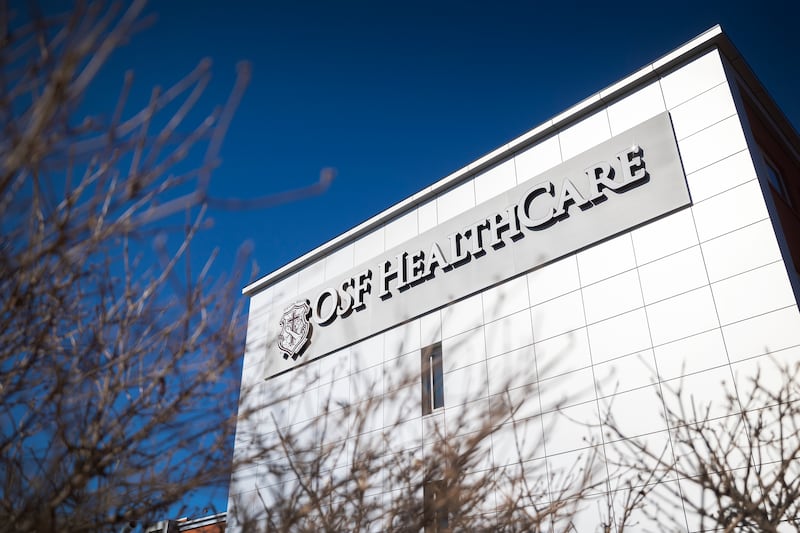
“It was a big year of change,” OSF Saint Katharine President Jackie Kernan said when reflecting on the Catholic health system’s Jan. 1, 2025, takeover of KSB Hospital in Dixon.
In February 2024, KSB’s board of directors announced it was seeking an affiliation – because of escalating costs and changes to health care financing – after almost 130 years of operating independently. The hospital signed an agreement with OSF in May 2024 that included $40 million over five years to renovate facilities and improve access to care.
[ Ceremony marks completion of Dixon’s KSB Hospital, OSF HealthCare merger ]
Transitioning from a single hospital to a large integrated health system, “was a lot of change when we’re used to being able to do things in the moment, but it also allowed us to implement some really good best practices around quality, safety and mission partner [employee] engagement,” Kernan said.
“One of the beautiful things with the transition is the culture,” Dr. Glenn Milos, OSF Saint Katharine vice president and chief medical officer, told Shaw Local.
It’s “full of richness and passion and kindness and empathy. It was an easy transition ... because that’s our culture, and that was their [KSB’s] culture, too,” Milos said.
:quality(70)/cloudfront-us-east-1.images.arcpublishing.com/shawmedia/7OQXVDYRWRFTTNNFTUOXGGLE54.jpg)
:quality(70)/cloudfront-us-east-1.images.arcpublishing.com/shawmedia/6S6MNFOYJZAQVEKSLNP2DOYD7U.jpg)
:quality(70)/cloudfront-us-east-1.images.arcpublishing.com/shawmedia/H4EV4ZHVHBC5NINXR6YNN5YA44.jpg)
:quality(70)/cloudfront-us-east-1.images.arcpublishing.com/shawmedia/EU3S4O5QHBHY7J54RWGLCQATZQ.jpg)
:quality(70)/cloudfront-us-east-1.images.arcpublishing.com/shawmedia/NTBYBRZQFJEF3DS2OHSKDL7QL4.jpg)
:quality(70)/cloudfront-us-east-1.images.arcpublishing.com/shawmedia/WEGKPIXH7FAOXC2TCTIDK7JFNY.jpg)
:quality(70)/cloudfront-us-east-1.images.arcpublishing.com/shawmedia/C6CFDBFVKVHG5H35SRS5CTDD2A.jpg)
:quality(70)/cloudfront-us-east-1.images.arcpublishing.com/shawmedia/QYJQPBKO2FGF3AQQ45MZZKDRWI.jpg)
:quality(70)/cloudfront-us-east-1.images.arcpublishing.com/shawmedia/HBQSLVZ3RJDJLAU6SBCSTVBOJ4.jpg)
Rich Boysen and Colleen T. Henkel, members of OSF Saint Katharine’s community council and former KSB board members, told Shaw Local they were impressed by OSF’s ability to retain the majority of KSB’s staff, attributing that to OSF’s quality leadership and investment in salaries.
The council was established as part of the transition and is made up of community members who provide guidance and feedback to hospital leaders on the development of local strategies and management of facilities, according to a January 2025 news release from OSF.
“I really felt that we were there to bridge the gap between the old and the new, advise the new folks [OSF] about things that they were unaware of,” Boysen said.
Boysen became a KSB board member in 2018, served as chair of the board’s finance committee for four years and was part of the search committee that ultimately selected OSF for the merger. Henkel spent 16 years on KSB’s board and also was part of the search committee.
“It’s been very rewarding to work with the leadership team. They work extremely hard and genuinely care about their mission and the needs of our community,” Henkel said.
“The important thing to me is being out in the community and talking to people,” Boysen said, adding that he relays that information to OSF, whose leaders have “been great listeners.”
Kernan said that what she’s been hearing from community members about the change “is that they’re so thankful to still have a hospital in town, especially knowing that hospitals in our area have closed and the impact on the communities that that’s had.
“They want to know that we’re here and that we’re going to be here for the long haul. That’s one thing that our sisters are very committed to is making sure that we provide health care in our rural communities,” Kernan said.
Catholic reproductive care policy concerns
After KSB announced the merger with OSF in 2024, some Dixon residents told Shaw Local they were concerned about new restrictions on reproductive health care services.
[ Dixon’s KSB Hospital merger with Catholic organization sparks reproductive healthcare concerns ]
As a Catholic health care organization, OSF Saint Katharine abides by the directives set forth in the Ethical and Religious Directives for Catholic Health Care Service, a document that guides provider practices based on the teachings of the church. It includes several limitations to reproductive care, specifically within medical birth control and contraceptive practices, terminating a pregnancy, infertility treatments and alternatives.
“Whenever we do an integration with a new hospital, there’s always concerns about the Catholic health care policies,” Kernan said. “Until you can kind of dig into it and feel comfortable and ask the right questions, it causes some anxiety.”
In response to the concerns, Lee County Health Department Administrator Cathy Ferguson told Shaw Local that the health department is a resource for the community. Notably, the department can provide various types of medical birth control and basic infertility services.
“We’ve seen an increase in patients, but the staff is doing a great job keeping up,” Ferguson said.
In 2025, the department’s family planning program saw 571 patients, 94 of whom were new patients, and the number of visits increased by 164 compared with 2024, LCHD Director of Community and Personal Health Jenny Conderman told Shaw Local.
Ferguson said the LCHD has seen an increased demand for Nexplanon, an implant that prevents pregnancy for up to five years.
“I don’t see that this change has negatively impacted us financially,” Ferguson said. “All in all, I feel really good about how things have panned out.”
At OSF Saint Katharine, Dr. William P. Long, an OB/GYN who worked at KSB for a long time, is “the anchor in our women’s services,” Kernan said.
Kernan said “we’ve hired a lot”, specifically many new family practice doctors, two OB/GYNs and are recruiting for a third OB/GYN.
OB/GYNs are important because they can perform cesarean sections, a surgical procedure to deliver a baby when vaginal birth poses risks, and more complicated gynecological procedures, Kernan said.
OSF also offers women’s health classes and support groups throughout the year, led by its OB/GYN team. A new one coming up focuses on menopause, Kernan said.
“We’re really excited about what we can grow our women’s services to be,” Kernan said. “It’s not just birthing your baby, it’s that care all the way through your lifespan.”
In 2026, Kernan said, renovations of the OSF Saint Katharine OB unit will be completed, and the hospital will continue recruiting.
Financial investment
Kernan said OSF paid off all the debt that KSB had, which “was a pretty large chunk of change.” They’ve also invested a lot of money into the building itself, completing needed maintenance projects “that had been neglected because there wasn’t the dollars to do that.”
Another big investment from OSF was standardizing its wages so, for example, a nurse at OSF Saint Katharine is making the same amount of money as a nurse at another OSF hospital, Kernan said.
“That was an over $5 million increase,” Kernan said.
Those investments were “sorely needed because KSB, in our last couple of years, was very cash constrained,” Boysen said.
Following the COVID-19 pandemic, KSB’s expenses increased and it could not cover that extra cost due to serving a large portion of patients on Medicare and Medicaid, and, like other rural hospitals, it was reimbursed at lower rates than commercial insurance would pay. As a result, KSB operated with negative margins in 2022 and 2023. In January 2024, the hospital’s cash on hand dropped to five days, according to an August 2024 Dixon City Council resolution.
Money also has been spent to open a clinic in Sterling to improve access to care for patients coming from that area, Kernan said.
The clinic, OSF Saint Katharine Center for Health at 1840 First Ave. in Sterling, opened Oct. 13 and offers primary care, general surgery, OB/GYN services and specialty foot and ankle care.
[ OSF HealthCare to open first clinic in Sterling on Oct. 13 ]
They opened clinics for urology and neurology in January at the main Dixon location and have plans to open an OSF OnCall urgent care office in summer 2026 within Dixon’s major economic development at the intersection of Keul Road and South Galena Avenue, Kernan said.
Future planning
“We feel very blessed and fortunate to be able to provide all these services to the community. We’re very committed to not only continuing every service that we have, but also adding additional services, and then fine tuning on optimizing the patient experience,” Milos said.
In 2026, Kernan said, OSF Saint Katharine plans on continuing to recruit family practice and specialty doctors, implementing an electronic health record system called Epic that features a digital patient portal, expanding inpatient and outpatient behavioral health services, and working to make outpatient testing easier.
Milos said they ask themselves one question every day and will continue to do so: “How can we be better tomorrow than we are today?”
:quality(70)/s3.amazonaws.com/arc-authors/shawmedia/0e4ec010-1273-46f1-8fc4-c5fe7fe40794.png)