It was shortly after 1:30 p.m. Saturday, Jan. 17, when the call came in to Dixon police: A 77-year-old man was reported missing. It was only 18 degrees outside, and nightfall was a few hours away.
Dixon police knew they had to work quickly to find the missing man, Michael McLaughlin, who had last been seen walking south in the 400 block of South Dixon Avenue about a half hour earlier.
:quality(70)/cloudfront-us-east-1.images.arcpublishing.com/shawmedia/GIMOP5LD7VBIPO5RCJPMVL32GQ.jpg)
They quickly elevated their search plan, bringing more Dixon officers and a Lee County sheriff’s deputy in to supplement the five Dixon officers already on the clock that afternoon, getting drones – some equipped with thermal cameras to detect body heat – in the air and shuttling Dixon Police K-9 Vesuc out to the scene to grab a scent and begin tracking. It was so cold that officers were told they could take breaks to warm up and to prevent getting burned out during the search.
They didn’t, instead deciding to press on to find McLaughlin, who, 10 hours later, was out in overnight temperatures quickly dropping to 4 degrees.
:quality(70)/cloudfront-us-east-1.images.arcpublishing.com/shawmedia/M4TQL4OJERFJLHKSQZXVS4RFRE.jpg)
It was around the 13-hour mark that a community member who was aware of the search stepped into the backyard of his home near Countryside Lane to have a cigarette. Hearing a cry for help, the resident notified authorities of what he had heard about 100 yards from his home.
It was McLaughlin yelling for help from a wooded area in Dixon’s Oakwood Cemetery. The terrain was rough; officers walked into the wooded area and retrieved McLaughlin, with four of them lifting him up and carrying him out of the cemetery.
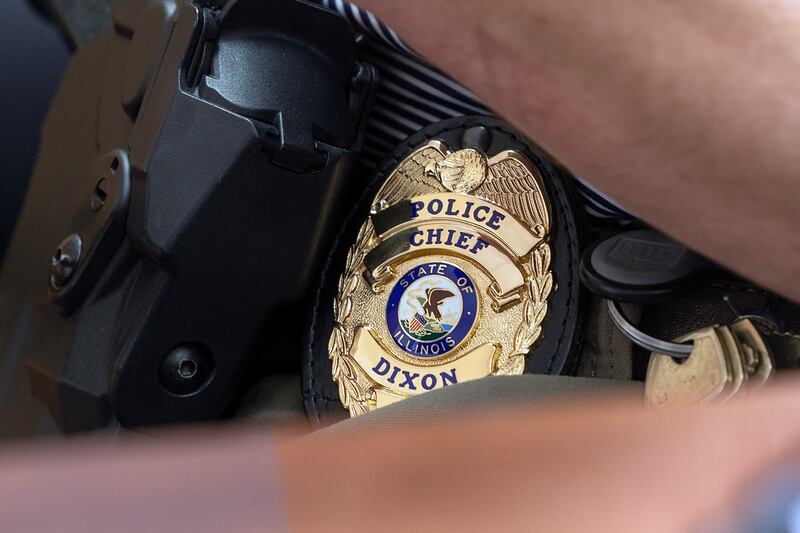
McLaughlin, checked by medical personnel, had experienced a health issue and is OK, Dixon Police Chief Ryan Bivins and Dixon Deputy Police Chief Aaron Simonton said Tuesday, Jan. 20, during an interview with Shaw Local.
Bivins said the department normally gets a missing person call – often in regard to kids, such as when one hasn’t come home from school at the usual time – about once or twice a month.
But this case was different: McLaughlin wasn’t found right away; he was older, it was cold out, and nightfall was coming.
McLaughlin couldn’t be tracked by cellphone; he wasn’t carrying one, officers said. And no luck was to be found when checking neighborhood video cameras.
The decision to level up to an all-out search came relatively soon.
“We were following up right away,” Bivins said. “You never want to have to say ‘I wish I’d have done this earlier.’”
How a search works
Bivins and Simonton explained that when a person is reported missing, the police officer dispatched to the call often goes to the person’s home, which in many cases turns out to be the last location the missing person was seen.
A chain of events then begins to unfurl: The house is searched, and more officers are brought in to be an extra set of eyes. They look for clues that could point to where the person is or give officers important information on what to do next.
The property is searched, supervisors are called, and more officers are dispatched to the scene. Simonton said the house and property continue to be searched on and off until the person is found, pointing to how missing children sometimes show up later or can be found hiding out of fear of being in trouble.
As the missing case progresses, calls continue to be made up the chain of command, and law enforcement officers canvass the area by going door to door.
In this particular case, Lee County Sheriff’s Deputy Kyle Kellen was brought in because of his specialization in search and rescue, Simonton said. The Dixon City Fire Department joined in, as well.
A computer program, CalTopo, helped Bivins and Simonton manage the search. By calculating how long McLaughlin had been missing and how far he could have traveled on foot, which is determined using factors such as his age, mobility, and health condition, they could go back to a city map on CalTopo and determine how far he could have traveled. By pinpointing on the map where he was last seen and mapping out the estimated distance in all directions, they were able to establish a search zone, which was then divided into regions on the map.
Simonton and Bivins numbered those regions, assigned crews to each area, and kept track of which areas had been searched and when. Tracking all that allowed them to know where the searchers had been, whether it was time to hit the area again, and to know which searchers were where. That becomes important for two reasons: to make sure the search is efficient and that those looking are not immediately duplicating efforts, and to ensure that searchers are safe, Simonton said.
Drones were used over areas that were difficult to get to, and thermal drones were sent up to detect sources of heat, such as those emitted by a person’s body.
Dixon Police Department’s K-9 was vital in the search. Bivins said Vesuc had been introduced to the missing man’s scent, and during the early part of the search was tracking it. However, Bivins said, the wind and weather conditions hampered the K-9’s ability to follow it.
Interestingly, when McLaughlin was found, he was discovered in an area near where Vesuc had hit on a scent earlier and had begun tracking it. Bivins believes that shows McLaughlin most likely was on the move, even as the search was happening.
The duo said they are proud of their officers, assisting law enforcement, firefighters, volunteers, people who shared the information about the missing man on social media, and the community that worked together to bring McLaughlin home.
“When someone needs help in our community, people step up,” Bivins said.
Dixon City Council member Mary Oros reiterated that stance at Tuesday night’s Dixon City Council meeting.
“It was a culmination of the spirit of this community and really what makes Dixon so incredibly unique,” she said. “It warms my heart to see that we take care of our neighbors, that our first responders show up and go above and beyond that call.
“It was pretty powerful. Thank you to everyone who assisted. Thank you to everyone who shared that post. We’re really happy to have that gentleman home.”
:quality(70)/s3.amazonaws.com/arc-authors/shawmedia/9bb5f897-be4a-42b8-9507-9193a7f43c2d.png)