Of all the great leaders of the early history of the Dixon area, Leonard Andrus belongs near the top.
Like “Father” John Dixon’s pivotal relationship with Dixon, Andrus was the founder of Grand Detour, its first ferry operator and its first stagecoach operator.
:quality(70)/cloudfront-us-east-1.images.arcpublishing.com/shawmedia/QI7QZEC6OZC53J3ZZ2PKG5T64I.jpg)
But Andrus was much more. He was the first commissioner of schools in Ogle County, the first manufacturer in Ogle County and the county’s first state representative.
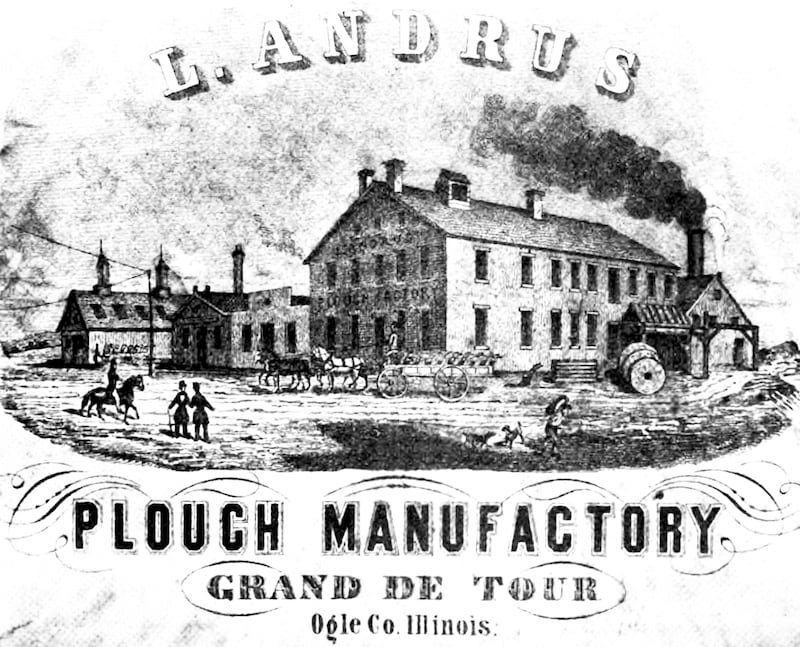
His most famous achievement was his partnership with John Deere to start the “L. Andrus Plough Manufactory,” which produced the revolutionary self-scouring steel plow.
Setback and bounce back
Andrus’ story begins in Vermont, where he was born in 1805. He was fortunate to attend Middlebury College there, but when his father died suddenly, he returned home to help the family. He soon found two partners and entered the mercantile business.
That’s when he first learned two life lessons. A setback must be followed by a bounce-back. And in order to move forward, you must work together.
After the partners moved the business to Rochester, New York, Leonard met Delia Linsley there. They soon married and had a daughter in 1830. But Delia died in January 1831, and his daughter died five months later.
Discovering ‘the great bend’
Determined to make a fresh start, he sold his share of the business, left Rochester and headed west. “Having heard something of the beauty of the (Rock River) country,” he arrived at the tiny village of Dixon’s ferry in 1834 at age 29. There he met the venerable John Dixon.
Andrus wanted to start a new community and build something. So, he asked John Dixon for advice on where he could sink down roots. Dixon suggested that he head upriver a few miles.
So, Andrus did just that “in a canoe paddled by Indians.” When he came to “the great bend” in the river, he was captivated by this unique location unlike any spot along the river’s 300-mile trek. On this striking peninsula, he could start a village and harvest water power for manufacturing.
Building a community
After staking out a claim for the land, Andrus returned east to settle some business and urge some cousins and others to join him in his new paradise. With the others, Andrus came back in 1835 and paid the government $1.25 an acre for 640 acres at a place that was soon called “Grand Detour.”
Their first task was to build a cabin in which all of them would reside. In order to move forward, they worked together.
Two of the new Grand Detour residents were Amos and Susan Bosworth of Vermont. Their 20-year-old daughter, Sarah, remained in Vermont to attend school. But in late 1836, she came to Grand Detour for the winter.
Leonard took a liking to Sarah, and they married 18 months later, in June 1838. He was 32; she was 23. In time, she produced three children: Caroline, Leonard Jr. and William.
Connected with every enterprise
In the village, Andrus did whatever was needed to build a productive community. Within the first few years, he collaborated with several others to dig the town’s first well, erect the first general store, build the first church, saw mill, dam, and create a hydraulic company.
As the 1899 Ogle County history said, Andrus “was connected with almost every enterprise that was introduced into the village.”
The ferry and the stagecoach
Besides these many cooperative ventures with community members, Andrus operated the Dixon-Andrus stagecoach line with John Dixon or perhaps his son, James P. Dixon. Both Dixons engaged in stagecoach operations out of Dixon, but the records do not indicate which Dixon partnered with Andrus.
Work together. Move forward.
The stagecoach started in 1837 and ran for many years, delivering the mail and passengers through Grand Detour to Dixon, Rockford, Freeport and other stage stations in that area.
In a river town like Grand Detour, a reliable ferry was a critical service for the stagecoach and for all travelers. Who started it? Leonard Andrus, of course. Even though Grand Detour eventually had an upper ferry and a lower ferry further downstream, Andrus’s ferry was the upper ferry on the town’s east side.
His famous joint venture
But by far, Leonard Andrus’s most significant joint venture was a plow company that emerged from his partnership with John Deere, another Vermonter. Deere, a 32-year-old blacksmith, had arrived in Grand Detour in 1836.
Initially, his projects included horseshoes, nails and iron work for wagons and stagecoaches. But Deere’s claim to fame was inventing the first commercially successful, self-scouring steel plow in 1837.
The role of Andrus in developing this plow has been variously described by historians, but there is no doubt that Andrus was significantly involved. According to the 1901 History of Ogle County, “Mr. Deere would forge the steel into shape, and the rough mold-board would then be taken by Mr. Andrus across the river to where there was the one grindstone of the locality, where it would be ground smooth.”
Historians also cite different years for the beginning of their partnership. Although Deere’s first plow was likely formed in 1837, their partnership to mass produce them likely began in 1839 or perhaps as late as 1843.
A prominent role
The first name of the company has been cited as “L. Andrus Plough Factory” or as “Andrus & Deere” company. Either way, Andrus held a prominent role. In Grand Detour’s centennial celebration of the invention of their steel plow in 1937, newspapers even called Andrus “the father of the steel plow industry.”
By the end of 1855, the company was producing 40 to 50 plows per day. According to the 1909 History of Ogle County, more manufacturing was done in Grand Detour between 1840 and 1855 than in any other town in Ogle County.
But for some reason, Andrus and Deere stopped working together. The exact reasons for the dissolution of their partnership are unclear, but Deere left the company in 1847 or 1848, moved to Moline and began his own plow factory.
But in spite of the split, Andrus continued the company in Grand Detour with various partners, eventually manufacturing under the name of “Grand Detour Plow Company.”
Setback and bounce back
The factory burned down in 1857, but it was rebuilt in 90 days. His wife, Sarah, died in 1858, but he pushed on. In 1854, Andrus ran the company in partnership with Sarah’s brother, Amos Bosworth. But Bosworth went off to fight as a Lieutenant Colonel in the Civil War in 1861 and tragically died of illness in 1862.
In spite of these heart-rending setbacks, Andrus continued to bounce back.
In 1855, when the railroads finally reached this area, they bypassed Grand Detour, opting instead to come to Dixon. The lack of rail access hindered the Grand Detour Plow Company’s ability to ship product quickly and efficiently. Nonetheless, Andrus kept the factory in his village of Grand Detour.
The end of Andrus
In February 1867, Andrus contracted pneumonia and died unexpectedly at age 61. The Lee County Journal newspaper then called him “one of the most esteemable and enterprising citizens of Rock River Valley.”
The 1881 Lee County history said, “Few men pass away more deeply and sincerely lamented than was Mr. Andrus.” He was buried in the cemetery at Grand Detour, the town he founded, built and loved.
Within a year of his death, his successors moved the Grand Detour Plow Company to Dixon, next to the Illinois Central and the Chicago & Northwestern railroads in Dement Town. There, it soon employed “several hundred men” and continued to thrive for more than 60 years.
But Grand Detour’s heyday had ended. It soon transformed into a quiet and quaint village known for its unique geography and rich history. And virtually all of that history is connected to the resilient and enterprising Leonard Andrus.
- Dixon native Tom Wadsworth is a writer, speaker and occasional historian. He holds a Ph.D. in New Testament.