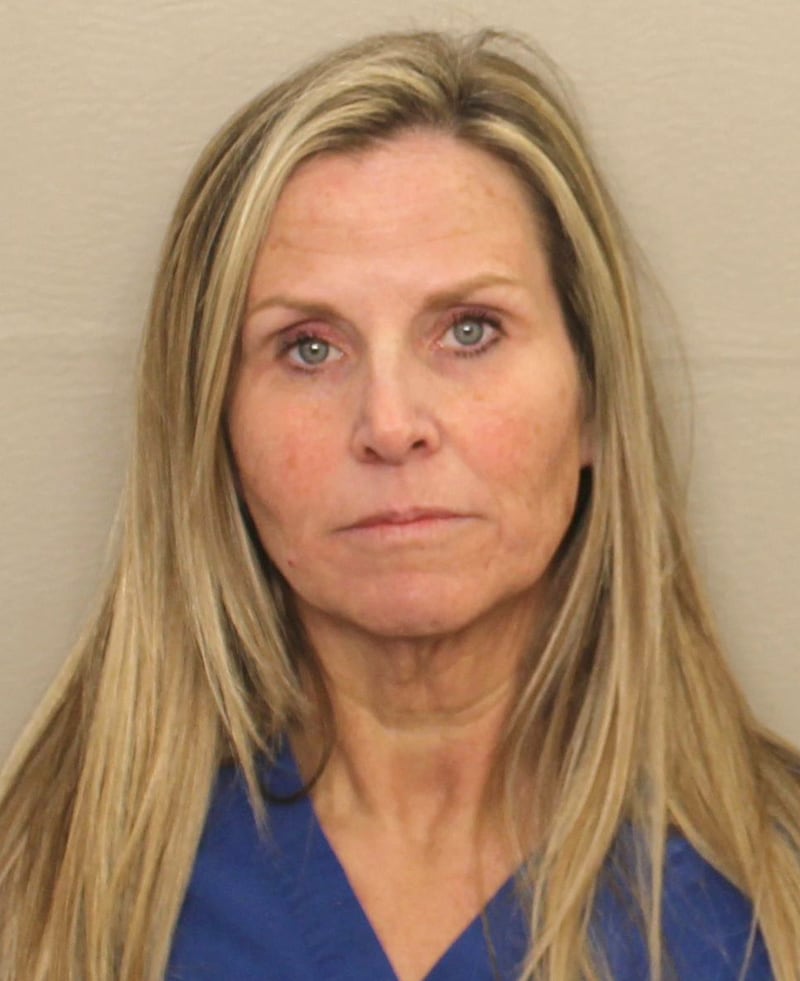
A Creston woman who was sentenced in March to five years in prison for causing a 2022 fatal crash that claimed the life of an Addison man has filed motions to withdraw her guilty plea and have her sentence reconsidered.
Amy Anthenat, 50, pleaded guilty in October to the Class 4 felony of aggravated driving under the influence, with cocaine detected in her urine, and was sentenced by Ogle County Judge Clayton Lindsey to five years in the Illinois Department of Corrections through an open plea – without a negotiated plea agreement.
The charge stemmed from a June 19, 2022, crash at the intersection of Mulford Road and state Route 64, when Anthenat, who was traveling north on Mulford Road, pulled out in front of Richard Andrews, 61, of Addison, who was driving his motorcycle east on state Route 64.
By admitting to the offense through an open plea, Lindsey was left to determine her sentence based on testimony, arguments and information presented during a Feb. 11 sentencing hearing.
At that sentencing hearing, Assistant State’s Attorney Heather Kruse argued that Anthenat should be sentenced to prison as a deterrent to others.
Anthenat’s attorney, Eric Arnquist of Rochelle, argued for a sentence of probation, citing Anthenat’s remorse and arguing that she was not under the influence of cocaine when the crash occurred and had no criminal history.
Anthenat testified she had used cocaine at a wedding the weekend prior to the crash. During her allocution – her right to speak before sentencing – Anthenat turned to Andrews’s family and friends who were in the courtroom and tearfully apologized.
She was ordered to report to the Ogle County Jail on April 19 to await assignment to a state prison. She had no credit for time served and must serve 85% of the sentence and 12 months of mandatory supervised release (parole) following her release.
But on April 10, Anthenat’s new attorney, Brendan Caver of Rockford, filed motions to withdraw Anthenat’s guilty plea, vacate the judgment of guilt, and reconsider the sentence.
In those motions, Caver argues that Anthenat’s guilty plea was entered through a “misapprehension by the defendant of the law as it related to her sentence,” resulting in a “manifest injustice” – defined as clear and obvious unfairness in a legal proceeding.
Caver argues Anthenat would not have pleaded guilty to a reduced charge – offered in October 2025 – choosing instead to proceed to trial on the initial charges filed, if she had known “how the court would misapply the law.”
Anthenat was originally charged in January 2023 with aggravated driving with a drug, substance, or compound in breath, blood, bodily substance or urine resulting in a death – a Class 2 felony punishable by 3 to 14 years in prison.
On Oct. 28, 2025, Anthenat pleaded guilty to a new charge filed by the state’s attorney’s office of aggravated driving with a drug, substance, or compound in breath, blood, bodily substance or urine resulting in a great bodily harm – a Class 4 felony punishable by 1 to 12 years in prison.
Caver argues in the motion to withdraw the guilty plea that “misapprehension of the law is well recognized as a reason for vacating a guilty plea”.
“Leave to withdraw a plea of guilty is not the right of every defendant, but is required to correct a manifest injustice,” the motion states.
In the motion to reconsider the sentence, Caver argues that “extensive” mitigating testimony given during Anthenat’s sentencing hearing included her being a survivor of domestic violence; her attempts to assist Andrews following the crash; her role as the primary caregiver to her 18-year-old son who suffers from injuries in an unrelated, severe 2025 auto crash; and a diagnosis of complex post-traumatic stress disorder.
He argues that complex PTSD causes Anthenat to have “flashbacks, nightmares, and dissociation horror from the collision giving rise to the charge to which the defendant pled guilty”.
Caver argues Lindsey gave “insufficient weight” to those mitigating factors and gave “undue” weight to arguments made in aggravation by prosecutors. He said Anthenat was considered to be “low risk” to repeat an offense and should have been sentenced to probation.
And Caver claims that Anthenat believed by pleading guilty to the “less serious offense,” the court would sentence her to probation “consistent with the evidence presented” at the sentencing hearing.
At that sentencing hearing, Lindsey said the sentence had nothing to do with level of impairment because state laws create an “absolute bar” in driving a motor vehicle with any amount of illegal drug detected in a person’s blood or urine.
Lindsey said cocaine is one of those illegal drugs and Anthenat had admitted that cocaine was in her blood or urine at the time she drove her vehicle on June 19, 2022. He said it made no difference if she ingested that cocaine on June 19, the night before, or the week before the crash.
And he said that although he believed Anthenat was remorseful, understood the “gravity of her misjudgment” and was unlikely to commit any other “significant crime in the future,” there was “no question” her conduct resulted in Andrews’s death and a prison sentence was needed to deter others from driving with illegal drugs in their system.
During an April 20 hearing, Caver asked Lindsey to grant an emergency motion to extend Anthenat’s stay from custody for an additional 4 to 6 weeks so she could continue to make arrangements for her son’s medical care.
Kruse argued against the extension, telling the court that Anthenat pleaded guilty in October 2025 and had already been given another 30 days since her sentencing to make arrangements for her incarceration.
“The issues with her son are not new,” Kruse said. “And it does appear that these issues will not be solved in the next few months.”
Kruse said Anthenat has known for five months that a prison term was possible.
Lindsey denied the extension, stating he had sympathy for the defendant and had already delayed Anthenat’s deadline to report to jail by more than a month.
“The court denies the motion and the defendant shall remain in custody at the Ogle County Jail,” Lindsey said, giving Kruse until June 8 to respond to the new defense motions.
Arguments will be heard on those motions at 2 p.m. July 7.
Feb. 11 sentencing testimony recap
Anthenat testified she was driving a “farm truck” from one field to another when she didn’t see Andrews on his motorcycle. She said she was trying to block the sun with her hand and started to go through the intersection when Andrews saw her vehicle and she saw Andrews.
“He saw me, and I saw his scared face. He laid it [the motorcycle] down … falling backwards, so I stopped. I didn’t want to run over him if he was close to the truck,” she tearfully testified.
She said she ran to Andrews, who was lying in the middle of the road, but she could not find a pulse. She called 911 while two passersby performed CPR on Andrews.
“If I could have saved him, I would have. I didn’t want that to happen to him,” Anthenat said, choking back tears. “I close my eyes and I see [the crash] every day. I see Mr. Andrews. I see his face. I can’t get over that vision in my head.”
Anthenat said she is fully employed as an instructor at Kishwaukee College and also works part-time in the radiology department for UW Health.
Arnquist said Anthenat had led her entire life as law-abiding and had not used cocaine since the crash.
:quality(70)/author-service-images-prod-us-east-1.publishing.aws.arc.pub/shawmedia/c70d24f0-1332-4244-8446-e91288029474.jpg)