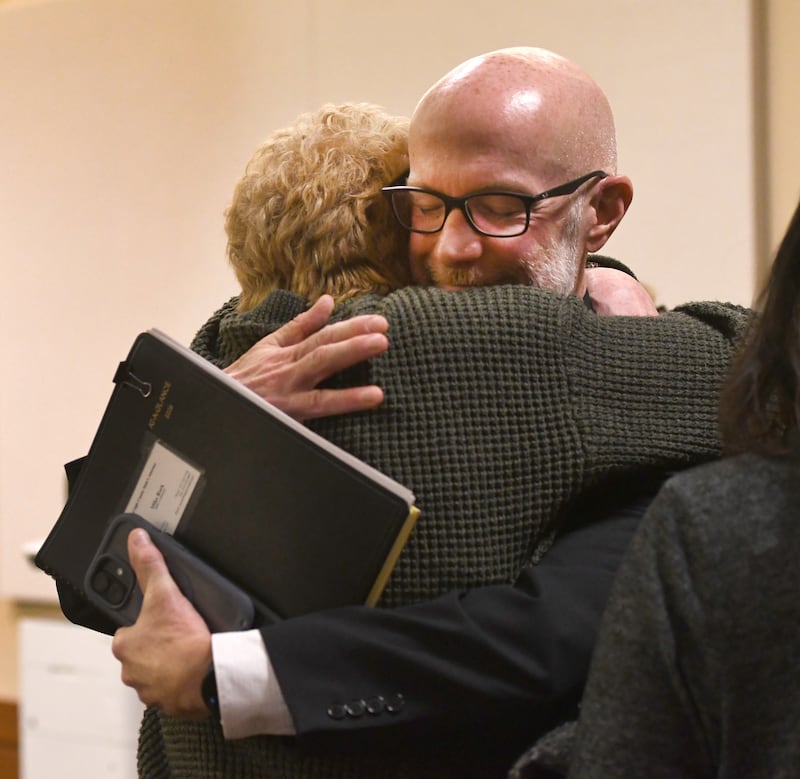
Family and friends of an Ogle County school teacher embraced and wept outside the courtroom just minutes after jurors found Duane “DC” Meyer, 43, guilty of the 2016 murders of Maggie (Rosko) Meyer, 31, and their 3-year-old son Amos in their Byron home.
Inside the courtroom, family and friends of Meyer also wept and embraced after the 8-woman, 4-man jury returned guilty verdicts for first-degree murder, aggravated arson, and concealment of a homicidal death.
:quality(70)/cloudfront-us-east-1.images.arcpublishing.com/shawmedia/TJBZR5YBD5GLFHBHANSWBXWF2Q.jpg)
Those verdicts followed a trial that took 17 working days to complete, consisting of five days of jury selection, eight days of testimony and arguments, and four days of deliberations.
“I can’t tell you how just pleased and happy we are that both Maggie and Amos will get some justice and their loved ones will get some closure on this horrible situation,” Ogle County State’s Attorney Mike Rock said after the verdicts were announced.
:quality(70):focal(343x287:353x297)/cloudfront-us-east-1.images.arcpublishing.com/shawmedia/FHQI344KJVYWXD4SNNX5A65P4A.jpg)
Maggie was a teacher at the Chana Education Center at the time of her death. She filed for divorce in 2014, and court records show the divorce was finalized in September 2016.
Her charred body was found on a couch in her living room the morning of Oct. 19, 2016.
Pathologists determined her death was “highly suspicious for homicide,” testifying she was strangled to death before the fire spread upstairs and killed Amos from carbon monoxide poisoning, as evidenced by soot in his airway and lungs.
No soot was found in Maggie’s airway or lungs, but pathologists said there were signs of strangulation and “some type of blunt force trauma” on other parts of her body.
They said they could not determine an exact cause of death because the condition of her severely charred body – with no distinguishing features remaining – could have masked other injuries that made the forensic case challenging.
:quality(70)/cloudfront-us-east-1.images.arcpublishing.com/shawmedia/F6AGEUWBSZDONNXMGPSZ6THY7E.jpg)
Rock and his trial team of First Assistant State’s Attorney Matthew Leisten, Assistant State’s Attorney Allison Huntley, and Victim Service Provider Marisol Esparza, experienced a variety of emotions as testimony, attorney arguments, and deliberations culminated at the end of the trial in courtroom 302 at the Ogle County Judicial Center in Oregon.
Ogle County Judge John “Ben” Roe presided over the trial and he waited with defense attorneys, court staff, and family and friends of both the defendant and the victims, as jurors continued deliberating late Thursday night before reaching their verdicts at 8:28 p.m. on the fourth day of deliberations.
“I’ve done a number of jury trials in my career. I’ve never had a jury out that long with all the ups and downs you could imagine during it,” Rock said. “But again, the jury never indicated they were deadlocked and they worked hard the whole week, and we certainly believe they did come to the right decision.
“Anytime a jury’s out, there’s nervousness. As lawyers, we certainly thought we proved the case, but it took them a period of time to get to what we believe is a just verdict.”
Rock praised all members of his office and all the law enforcement agents who worked on the case before and after Meyer was charged on Oct. 9, 2019 – three years after Maggie and Amos died.
“It did take a period of time for the case to get filed. I was not in office at that time, so this case was pending when I came in 2020. Since that time, I’ve been blessed to have a great group of lawyers working for me. We’ve litigated a number of matters during that time, right up until we got to trial this month,” Rock said.
:quality(70)/cloudfront-us-east-1.images.arcpublishing.com/shawmedia/PYDH3AURSVH4NAXTLJNX42HRMU.jpg)
Rock said the nature of the Meyer case generated a lot of public interest.
“There was a lot of publicity on it and that certainly complicated jury selection, so jury selection took longer than otherwise would, but ultimately, we were able to pick a fair and impartial jury and they came to the right decision,” he said.
The Meyer case marks the fourth Ogle County domestic violence homicide handled by investigators and Rock’s office. One case remains pending.
“Unfortunately, in Ogle County, we’ve had a number of domestic violence-related homicides recently. We’ve tried a couple of them already successfully,” Rock said. “Unfortunately, it’s just how things are in society right now.”
Rock said his team wanted to bring closure to Maggie and Amos’s family.
“Two dear loved ones were taken from them. We definitely felt the pressure to do as good a job as we could for them and we wanted nothing more than to bring justice for them,” he said. “I feel great. I’m very happy and again not as much for myself and my office, but for the Roskos. What they have suffered these years, no one should have to go through what they’ve gone through.”
Rock thanked the Illinois State Police, Ogle County Sheriff’s Office and the Office of the Illinois Fire Marshal who conducted and contributed to the investigation.
“I want to thank our law enforcement partners for their work on this investigation. I am proud of my team for their hard work and dedication on this case. Our thoughts remain with the victims and their family,” Rock said.
Meyer, who did not appear to react to the verdicts, was remanded to the Ogle County Jail, where he has been held since his arrest in 2019. He is scheduled to appear in court again at 2 p.m. March 13 for a status hearing.
First-degree murder is a Class M felony punishable by 20-60 years in the Illinois Department of Corrections, with truth-in-sentencing applying at 100%.
“Natural life imprisonment is a mandatory punishment when a defendant is convicted of killing two victims,” Rock said.
Aggravated arson is a Class X felony punishable by 6-30 years in prison with truth-in-sentencing applying at 85%. Concealment of a homicidal death is a Class 3 felony punishable by 2-5 years in prison.
During the trial, prosecutors argued that Meyer strangled Maggie to death and set her on fire in her home to clear the way for him to pursue a new life with his girlfriend.
They said text message exchanges between Meyer and his girlfriend – extracted from their phones by investigators and analyzed by FBI agents – showed Meyer was “obsessed” with his girlfriend, “hated” Maggie, and promised to “eliminate” Maggie and Amos from his life.
Defense attorneys argued that Meyer was innocent and that police unfairly targeted him instead of trying to find out who really was responsible for the deaths of Maggie and Amos.
And they argued that text messages about Maggie and her family that were sent before the deaths were “cherry-picked” by prosecutors and taken out of context.
:quality(70)/cloudfront-us-east-1.images.arcpublishing.com/shawmedia/YAK67BTOBBDRLAYRVF2XANXX3A.jpg)
:quality(70)/author-service-images-prod-us-east-1.publishing.aws.arc.pub/shawmedia/c70d24f0-1332-4244-8446-e91288029474.jpg)