As Flock cameras come to Woodstock Square, residents who oppose them are still working to get the city to reverse course.
Woodstock Police Chief John Lieb confirmed the cameras are expected to be installed before the end of June. Here is what to know as that timeline approaches.
Why Flock cameras?
Those cameras, which are not Flock, did not yield the same level of public pushback that the Flock cameras did.
Lieb has said previously the idea of cameras was in response to a homicide in 2017, adding that investigators had to go business to business to get footage to use as evidence.
Lieb cited an increasing number of public events that take place on the Square, and the reality that tragedies happen, for which surveillance footage is useful.
When did the City Council approve the Flock cameras?
:quality(70)/cloudfront-us-east-1.images.arcpublishing.com/shawmedia/WVOMMGNC4ZODXDOPIIOTPCG5OM.jpg)
Council members Darrin Flynn, Natalie Ziemba and Melissa McMahon voted no in February, while Gregg Hanson, Tom Nierman and Bob Seegers, as well as Mayor Mike Turner, voted yes.
The City Council added several conditions to the approval, including that the contract will be terminated if the Council did not allocate funding for the cameras in the next budget. The city also added a 120-day opt-out clause for the cameras. Using the 120-day clause would ultimately be up to the City Council, City Manager Roscoe Stelford said.
Turner said in February that the conditions were in response to the public comments, which were almost all opposed to the cameras, mainly out of concerns about privacy and the potential misuse of data collected.
Other conditions placed on the Flock contract include a detailed review of data ownership, access and related issues, as well as bans on the use of facial recognition and AI training.
While the cameras have not yet been installed, the mechanism to cancel the contract by not funding it is off the table for this year. The city council passed its fiscal year 2027 budget in April- and funding for cameras was included.
What are people’s concerns about Flock cameras? What does Flock say?
In February, residents who spoke against the cameras cited reasons including privacy, mass surveillance and security.
A Flock representative at the meeting was asked to respond to the public’s concerns. Dan Murdock said Flock’s goal is to eliminate crime and that the city can choose not to share data from Flock’s system with third parties.
He defended the security of Flock’s system in preventing hackers. Murdock also said Flock has the most robust audit trail in the industry and is the only company in the industry that had not taken money from the Department of Homeland Security and the Department of Justice.
Lieb said the department places a lot of trust in its officers when they take the street. Lieb said the department has a policy that police department data will be protected but released as needed. He said every officer has their own login and two-factor authentication.
Flock has been criticized for data sharing practices, including purported sharing data with ICE. Flock Safety denies sharing data with ICE and the Department of Homeland Security.
Local push to oppose Flock
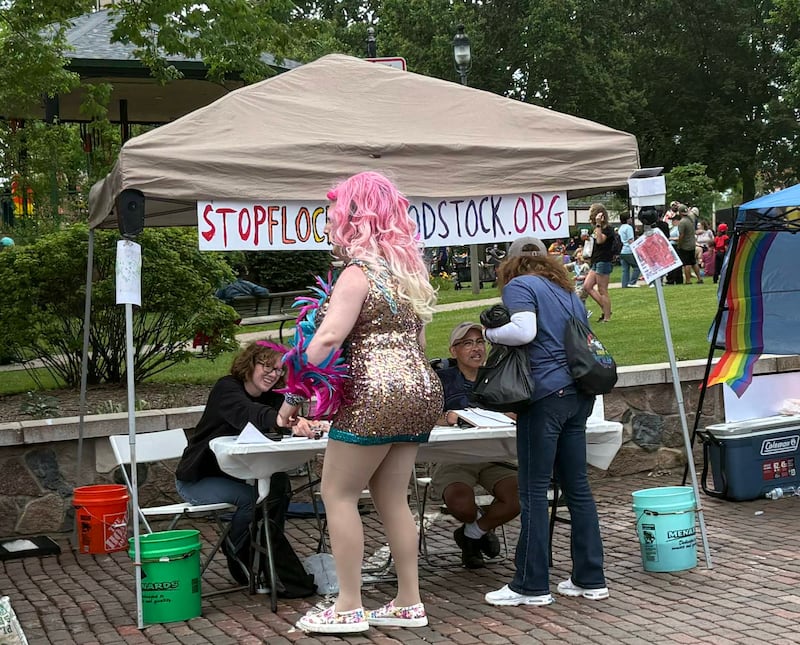
A group calling itself Stop Flock in Woodstock had a booth at Sunday’s local PrideFest.
Don Francis, who helped staff the booth, said it’s also been set up at Woodstock’s Saturday farmers markets and any other festival they can get into to spread the word about Flock.
Out of everyone the group has talked to, “nobody’s been excited” about the cameras, Francis said. He said the cameras are bad for groups like the LGBTQ or Latino communities, but it doesn’t just affect them.
“It’s not good for anybody,” Francis said. He also cited reports of the misuse of Flock technology across the country.
Francis also appeared at Tuesday’s City Council meeting to cancel its Flock contracts, asserting Flock cannot be trusted to keep data safe or tell the truth.
“We’re not anti-safety” or anti-police, but rather pro-people, Francis said Sunday.
He said if the city needs cameras, there better options than Flock. He said there are closed-circuit options available.
What about PrideFest?
The surveillance landscape in regards to LGBTQ people has shifted recently. According to Bloomberg Government, in early 2025, the Department of Homeland Security eliminated policies preventing surveillance solely on the basis of sexual orientation and gender identity. That came weeks after President Donald Trump was sworn in for his second term.
McMahon, the Council member who is also a Woodstock Pride board member, said the Pride organization explored other locations for this year’s PrideFest because of Flock cameras but found out the cameras would be going up later in June.
She said the leadership of Woodstock Pride would assess early next year where the cameras stand and whether the organization is comfortable proceeding on the Square next year.
McMahon said most visitors to town might not be aware of the cameras but residents are more aware of them.
Woodstock PrideFest attendee Audrey Raden said her son told her about Flock. She called the technology an invasion of privacy. She said the less of the cameras the better and people will often give up bits of freedom for a sense of safety.
“That’s a slippery slope,” she said.
Rick Bellairs, chair of Woodstock Groundhog Days – one of the biggest events held on Woodstock Square – said the Groundhog Days Committee does not have an opinion on the cameras.
What about license plate readers?
Flock also manufactures automatic license plate readers, which Woodstock has had for several years. City officials have said Flock license plate readers have helped police solve crimes. Stelford said the license plate readers are a valuable tool for police.
Flock cameras were instrumental in the quick apprehension of Adilyn R. Monette, 21, of Woodstock, in connection with the Walmart fire on New Year’s Eve. Monette, charged with aggravated arson, is accused of setting baby cribs on fire inside the store, according to the complaint in McHenry County court.
Just Thursday, the police chief of Holiday Hills was charged with official misconduct after authorities said he used a Flock license plate reader in Prairie Grove, where he also was employed as a police officer, to track the movements of personal acquaintances, including multiple women he dated.