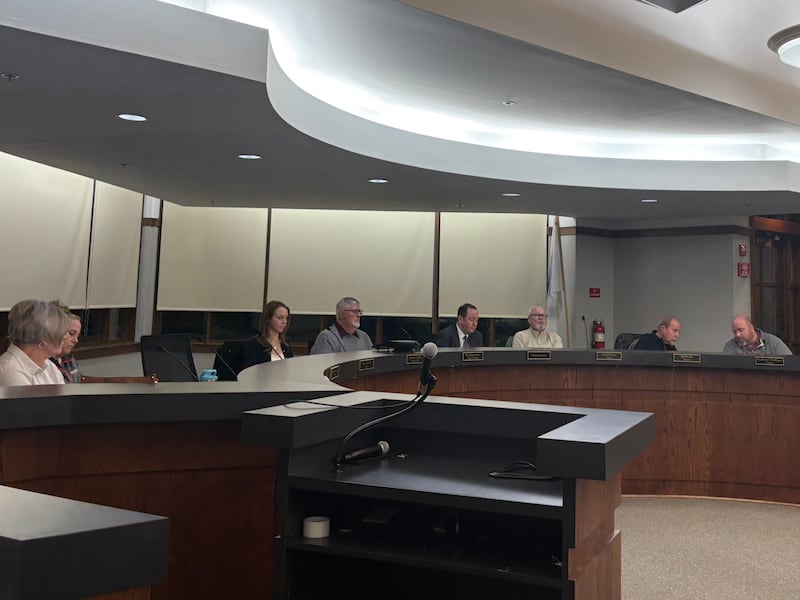
Lake in the Hills officials have approved a solar farm and battery storage plant.
The solar farm is slated to go in at 9000 Pyott Road, about a mile south of Lake in the Hills Airport and a little north of Imhoff Drive.
[ Can McHenry County impose fee on solar developers for road impact? ]
The site is about 59 acres and is a former quarry, John Svalenka, the village’s community development director, said.
The battery storage system is meant to store electricity generated by the panels before it gets released when demand is higher, Svalenka said.
The system would be installed at the bottom of the quarry and thus well-screened, he said. But because parts of the system are within 150 feet of Pyott Road, developers will need to submit landscape plans and show they are complying with village rules.
Svalenka noted people often worry about what’s called thermal runaway with a battery storage system.
According to village documents, “As indicated by this term, an incident (i.e., a hazardous electrical, thermal, or mechanical event) causes a cell or cells within the battery bank to overheat and can lead to an escalating thermal event that damages the BESS and can result in fire.”
Svalenka said battery systems got a bad reputation when they first came out, but there are regulations in place. He recommended that the village require the developers to get their plans approved by the fire department and to follow Illinois Department of Natural Resources recommendations, among the conditions approved.
The site falls in the boundaries of the Crystal Lake Fire Rescue Department, which has reviewed the plans.
Board member Stephen Harlfinger asked about the fire department’s ability to handle a potential fire at the battery storage site.
Svalenka said the battery system is designed so batteries are in pods and have sensors meant to shut off the system if something goes wrong. The batteries are separated from each other and the pods are also separated.
Harlfinger said he wanted to make sure Crystal Lake Fire Rescue officials had the resources needed to fight a fire should one break out.
“That’s not a dealbreaker, but it’s definitely a concern,” he said.
He recognized there are safety features in the plans but said he wanted to account for things like a lightning strike or the shutoff system malfunctioning.
Evan Carlson of Enterprise Energy, who proposed the project, said he couldn’t speak to the fire department’s capabilities. But he said the department reviewed the plans and that he’s required to get its approval.
He said the design of the battery storage is intended to address the risk of thermal runaway.
Every battery has its own insulation, and if one catches fire, it is supposed to eject and burn out on its own, he said.
“The instructions to the fire department are to allow that to happen before interfering,” Carlson said.
He said because it’s a former quarry, if something were to happen, the site a safer location for that.
Carlson also said the company is employee-owned, buying the land and owning the project.
“We will remain accountable throughout the project,” he said.
Board member Suzette Bojarski asked about the inverters and their volume.
Carlson said the sound comes from the fan on the inverter, and it sounds like a computer fan. He said they were not loud and he can easily talk to someone while standing next to one of the fans.
No members of the public spoke about the solar farm Thursday.
Following the vote, Village President Ray Bogdanowski said the approved location is perfect for a solar farm and that the situation shows why local zoning control needs to remain.
Bogdanowski said the new state law would leave the village with very little say if a solar developer wanted to set up in a residential or commercially zoned area. He said he didn’t know of any developers looking to do that.
Local control has come up at Lake in the Hills recently. Officials have expressed opposition to the proposed BUILD Act that would limit their ability to regulate issues like parking minimums, impact fees or accessory dwelling units. Leaders in other communities have also opposed the proposal.
Lake in the Hills officials said uniform standards proposed don’t account for Lake in the Hills’ differences to other municipalities or local planning efforts. The legislation would override the village’s home rule authority, officials said and that local planning and zoning decisions are not causing housing affordability issues.
There are other solar farms in Lake in the Hills, including one slated to go in at the Lake in the Hills Airport that recently was granted a construction extension. There is also a solar farm at the District 158 Reed Road campus and some residents have solar panels at their homes.
Svalenka said the village supports solar farm systems and they can help lower energy costs. He also said Lake in the Hills is in full compliance with state law because it allows solar farms.
The battery storage portion of the solar facility is the first one in Lake in the Hills and only permitted because it is an accessory use to the solar project, Svalenka said.
Carlson said the developer is hoping to break ground next summer.