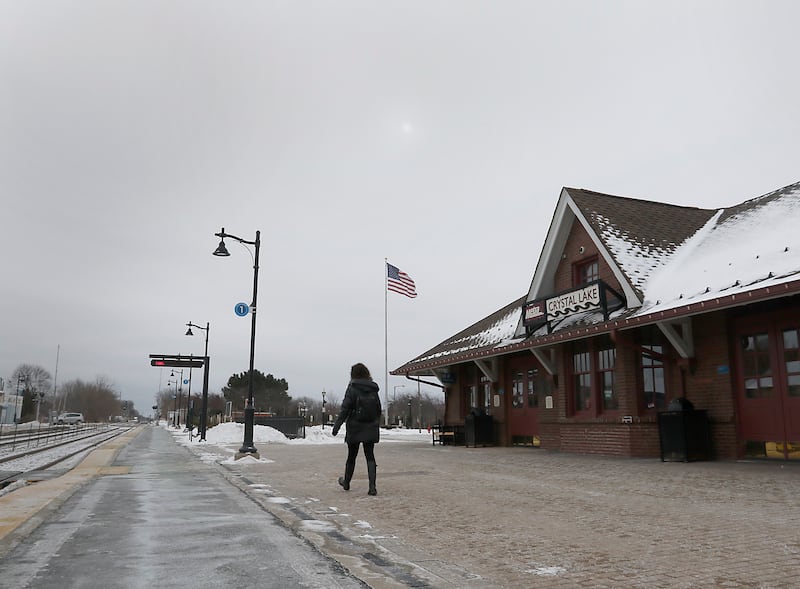
The People Over Parking Act takes effect in Illinois on Monday and will prohibit local officials from enforcing parking minimums for McHenry County developments near Metra stations.
The law passed as part of last year’s transit bill, but some local officials have expressed opposition to potential local control restrictions on issues such as parking or housing.
The law prohibits municipalities from enforcing their parking minimums for development projects within a half mile of a public transportation hub or an eighth of a mile of a public transportation corridor. The latter is defined as a street with one or more bus routes with a combined service frequency of 15 minutes or less during the morning and afternoon peak commute times.
While Pace operates several bus routes in McHenry County, their frequency is not enough to trigger the law.
In McHenry County, developments near the Metra stations in Harvard, Woodstock, McHenry, Crystal Lake, Cary, and Fox River Grove, as well as the Pingree Road Metra station in Crystal Lake, are subject to the law.
Woodstock officials said the local parking minimum is about 1.1 spaces per unit. Under the law, the village can’t enforce that minimum for the project because it is less than half a mile from the station.
But developers plan to have about 1.5 spaces per unit, which they said is driven by market necessity.
The law says that if a developer voluntarily provides parking, the local government can require spaces for car-share vehicles, the public or parking, available for a fee. The law prohibits a municipality from requiring voluntarily provided parking to be provided for free. Developers can voluntarily provide parking that is not public.
The law does not apply to projects where the requirements conflict with a contract or site plan executed or approved before it takes effect. However, it does apply to amendments or extensions to agreements or site plans if they increase parking requirements.
The law says development projects include those that get a permit for construction or reconstruction, a housing development or a commercial development. But its definition excludes projects for hotels, motels, bed and breakfasts or transient lodging, except for projects where a part of a housing development is designated as a “residential hotel.”
The law states it is not meant to prevent local governments from regulating access to on-street parking, and they can enact or enforce laws establishing parking maximums. Local governments can have parking minimums for bicycles, including electric-assisted models.
Kownick spoke about potential legislation that could substantially limit the village’s ability to regulate issues such as housing and parking at a March business roundtable.
“Our main thing right now is loss of local control,” Kownick said. “They want to take away all of our authority, and that just can’t happen.”
The proposed BUILD Act is Gov. JB Pritzker’s plan that would limit local authority on what types of housing structures can be built on land zoned residential.
Many local officials have expressed opposition, citing local control issues.
Cary’s current village code calls for a maximum density of 3.4 units per acre.
“If this passes in May, that goes up to 26 units per acre,” Kownick said. “What are we going to do? It’s going to completely change the look of our communities.”
Many communities have come out against the legislation, including Lake in the Hills. Officials there argued local planning or zoning decisions are not the cause of housing affordability issues.
Rather, they said, state mandates applying to residential construction costs, state policies pushing up property tax rates and rising construction costs are driving those issues.
Some McHenry County officials also have expressed opposition to the BUILD Act, and the county itself is exploring whether to ask voters in the November election to grant them home rule powers.
When asked about the timing during a discussion at county law and government committee meeting, County board member Joe Gottemoller said, “Springfield’s in the middle of taking away our rights.”
County officials recognize that laws can be written to override home rule authority. The BUILD Act would override home rule authority, and People Over Parking does, too. Lake in the Hills is home rule, while Cary voters turned it down in a 2024 referendum.