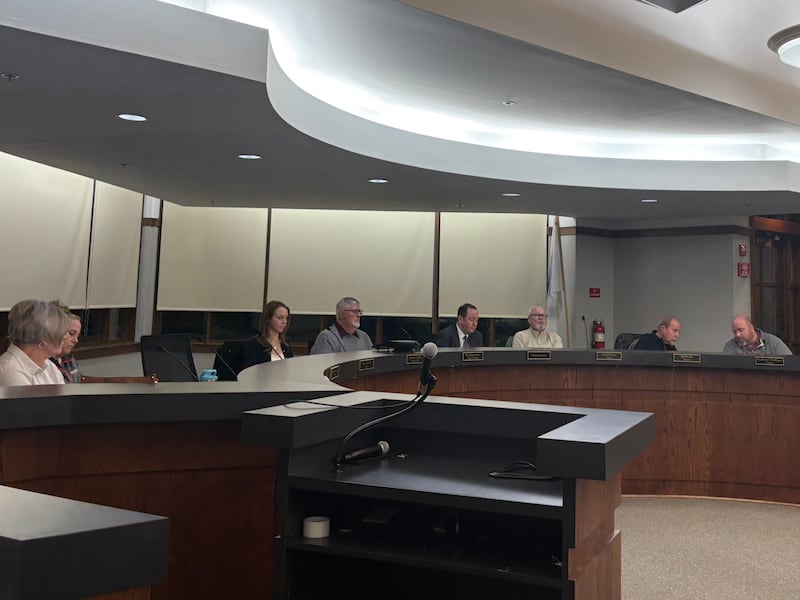
Lake in the Hills officials have formally opposed pending state legislation that would limit their ability to regulate issues like parking minimums and accessory dwelling units.
Village officials have said that Lake in the Hills is different from other Illinois municipalities and that proposed uniform standards don’t account for those differences or local planning efforts. Leaders in other suburbs have also criticized the proposal.
John Svalenka, Lake in the Hills community development director, said village planning or zoning decisions are not the cause of concerns about housing costs and availability.
Rather, Svalenka argued, state mandates applying to residential construction costs, state policies pushing property tax rates up and rising construction costs are driving those issues.
Svalenka also said the legislation would override the home rule authority that Lake in the Hills has.
Svalenka said the proposed legislation would require officials to use a state formula to calculate impact fees and allow accessory dwelling units, among other things.
The BUILD Act “broadly preempts the village’s local authority on issues that are entirely local,” Svalenka told the Village Board, which approved a resolution formalizing its opposition to the legislation.
Officials defined accessory dwelling units in a memo as a “residential unit on a lot containing a single-family dwelling, with provisions for sleeping, eating, cooking, and sanitation.”
Some of the concerns officials brought up included no parking minimums for such units, no square footage requirements and no clear direction about utilities for the units.
Lake in the Hills would also be required to allow “middle housing” like duplexes and triplexes, among other things. Municipalities could not require minimum lot areas of more than 2,500 square feet for detached single-family homes in zoning areas that permit them. They also cannot restrict middle housing more than single-family homes, among other things.
The proposal also would cap parking spaces at 0.5 spaces per unit for multifamily units and one space per single-family home. Developers could construct additional nonpublic parking.
Lake in the Hills currently requires two parking spaces per multifamily unit, and two more spaces for every four units, as well as two spaces per single-family unit, according to village records. Officials said Lake in the Hills already has parking problems in areas where single-family homes have two parking spots for the garage and two on the driveway.
While provisions of the People Over Parking Act, passed last year as part of the state transit bill, would likely not apply to Lake in the Hills, the BUILD Act would.
The bill would prohibit parking minimums for lots within a half-mile of public transit, which includes fixed-route bus service and thus would apply to parts of Lake in the Hills. Pace runs a bus line on Randall Road that offers fixed service, though its frequency is not enough to trigger People Over Parking requirements.
Lake in the Hills could not, under the BUILD Act, require parking for dwellings smaller than 1,500 square feet, affordable housing projects, assisted living facilities, mixed-use buildings or buildings converted from nonresidential to residential uses, according to the memo.
The resolution argues in part local zoning authority is not causing housing affordability issues and “is essential for the continuing community vitality of the Village.”
Gov. JB Pritzker convened an ad-hoc committee that concluded in 2024 “the state needed to take a coordinated, multi-pronged approach to address the shortage of housing for middle-income households,” according to Capitol News Illinois, which also reported many proposed solutions are part of the package.
Pritzker administration officials said a “patchwork of local barriers” impedes housing development and has driven up costs statewide and a statewide solution is needed, Capitol News Illinois reported.
“We have municipalities that are going above and beyond now, but if it’s one out of hundreds, it’s not attracting the capital, and they’re unable to get housing built there because it’s such a piecemeal approach,” the Pritzker administration official said. “So that’s really the point of the statewide approach here.”
The BUILD Illinois legislation was first announced by Pritzker in his State of the State address in February but has not yet become law.
Among the other area local leaders who have come out against state mandates over local zoning issues recently is Cary Mayor Mark Kownick, who criticized the plans at a State of the Village event.