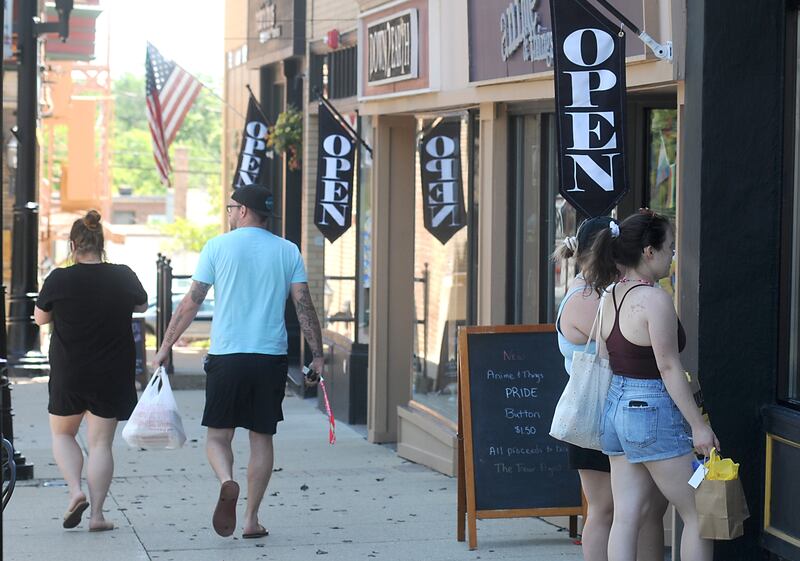
Woodstock is considering a city cost-sharing sidewalk repair program. But questions remain over how much property owners should pay for the program.
The Woodstock City Council recently took up a proposal for the program, but did not formally vote on it.
City staff members who brought the proposal before the council said they were thinking of setting a parameter that something had to be wrong with the sidewalk before the city would pay anything for repairs.
But there are questions surrounding what constitutes a “hazardous” sidewalk, and the city would cover 100% of costs related to repairing those. According to city documents, a hazardous sidewalk is defined as “a vertical displacement or unevenness of 2 inches or more between sections, and is the city’s responsibility.”
Brent Aymond, the city’s public works director, confirmed a hazardous sidewalk would be 100% covered by the city.
Council member Darrin Flynn felt the hazardous criteria could be sticky, and council member Melissa McMahon wanted to make sure what counts as hazardous is clearly stated.
Flynn said if his neighbor’s sidewalk had a 2-inch vertical gap and was hazardous, it would be replaced for free. If his sidewalk had a 1-inch vertical gap, he would pay 25% of the cost. However, It was quickly clarified that Flynn’s case was proposed to be a 50%-50%, city-property owner split.
“That’s where you’re going to have a little bit of, in my opinion, you’re going to have some discourse. You know, it’s like between neighbors when somebody gets it for free and somebody gets- has to pay 25% or 50% or whatever,” Flynn said.
Christensen said he wasn’t sure staff had a solution for the point Flynn raised.
Aymond recently told the City Council that Woodstock’s first priority is infill areas where there are breaks in the sidewalk network or no sidewalk.
“We all know we have lots of areas here in town that are lacking sidewalk,” Aymond said.
He added city staff is proposing to split the cost with property owners, with the city paying 75% and the property owner 25% for such projects. It’s something officials want to do quickly in order to get sidewalks up to par and increase the city’s walkability score, he said.
Mayor Mike Turner asked how the costs would shift if the city went to a 60-40 split. Turner said there’s places in town where the sidewalk stops in front of a lot or several lots before picking back up. City staff didn’t address the financials, but said they were looking for feedback, and the mayor’s suggestion was fine.
Paul Christensen, deputy city manager and executive director of strategy and planning, said the example the mayor gave was what staff envisioned would be a 75/25 split. Filling gaps in the sidewalk network and building a sidewalk and connecting it to an existing one are among higher priorities, he said.
Flynn later suggested splitting the cost 40/60 on a nonhazardous sidewalk, with property owners paying 60% and the city paying 40%.
Officials’ second priority is additional areas where the city needs new sidewalks. For instance, a sidewalk in the back of a cul-de-sac that isn’t used as much is a lesser priority for the city, Aymond said. The staff is proposing a 50/50 split for that.
If there’s money left over in the budget, the city would move on to nonhazardous sidewalk, which would also be a 50/50 cost share, Aymond said. In response to a question from council member Tom Nierman, Christensen said mud jacking might be a 50/50 split. Nierman said mud jacking is more cost-effective. Mud jacking is defined in the Merriam-Webster dictionary as “the raising of a pavement or railroad subgrade by means of mud pumped under it through drilled holes.”
Christensen said the program wouldn’t apply to new construction where sidewalk installation is required. Aymond confirmed it also would not necessarily apply to people redoing their driveway and touching the sidewalk.
Aymond said the staff proposed having the application process from January to May 31. That time frame would give the city time to prioritize projects and find out if there are funds left over in the budget.
Flynn suggested doing a two-round program, focusing on the infill areas in the first round and maybe skipping the second round if the first one is successful.
Council member Gregg Hanson asked how the city would market the program and if the city would send a letter to those in highly desired infill areas.
City staff said they would utilize the marketing department, but weren’t necessarily thinking of a letter.
“Not everybody’s on the internet,” Hanson said.
Turner said he didn’t think the city would want to take on the expense of mailing letters to every household, but Hanson clarified he wanted to limit it to the high-priority properties.
City staff said they could include something in water bills. Flynn also suggested an insert in water bills for high-priority areas.
“Something that falls out would probably be much better,” Flynn said.
McMahon asked what happens if someone in a high-priority area doesn’t want to do the 25% cost share or do a new sidewalk.
“Then we wait,” Aymond replied. Christensen said the city isn’t trying to force the program on residents and that person might get lucky and get a new sidewalk if there’s funding left over that year.
Christensen said the city’s goal is to fix all the hazardous sidewalks by April 30. That’s the end of the fiscal year. He said the city didn’t have the full inventory but believed there was enough funding to fix those sidewalks. Officials are also putting together an infill map that would identify high-priority areas.
Turner requested staff give the City Council a final review of program criteria before bringing the proposal back.
The city is proposing $40,000 in motor fuel tax dollars for the program in fiscal 2027, according to city documents. City staff believes that would be enough to address hazardous sidewalk. City officials propose an additional $175,000 in next year’s budget to improve downtown sidewalks and then the rest of the sidewalk network.