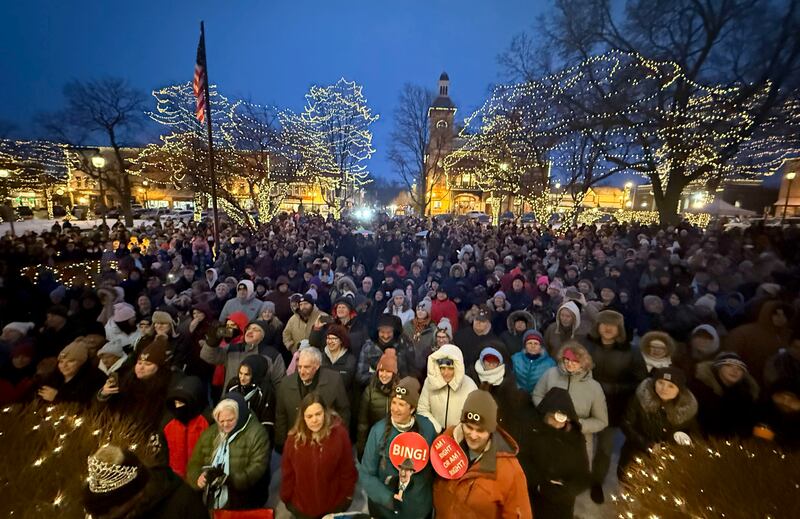
A deeply divided Woodstock City Council agreed early Wednesday morning to install Flock surveillance cameras on Woodstock Square – a vote that came after five hours of discussion and public comments that were overwhelmingly against the plan.
The City Council voted 4-3 to approve the cameras. Mayor Mike Turner and Council members Bob Seegers, Gregg Hanson and Tom Nierman voted for cameras, while Natalie Ziemba, Melissa McMahon and Darrin Flynn opposed them. Turner cast the final, tie-breaking vote for the cameras.
:quality(70)/cloudfront-us-east-1.images.arcpublishing.com/shawmedia/32HQOTNYANDEVETKQR6UQFY6PM.jpg)
Seegers said it would be a “foolish decision” not to have cameras, and they are necessary to prosecute illegal acts. He said not having cameras could invite bad people into the Square to commit crimes.
He also said he deferred to the police department, which has advocated for the cameras. He said they’re necessary for the large events that take place on the Square – like the Groundhog Day festivities that took place Monday – which he called “the fabric of the community that we live in.”
Turner acknowledged the cameras come with privacy and data-sharing concerns, which were cited by several speakers from the audience. The mayor also said he’s a libertarian and doesn’t like government overreach, but it’s “unfortunate” that the surveillance is needed. He said safety is one of the city’s top priorities.
“I view them as a valuable tool,” like fingerprints, Turner said of the cameras.
McMahon acknowledged cameras would happen, but how, where and who uses them would be the biggest questions.
McMahon is involved in planning some of the largest events on the Square and said they would lose some attendees if the cameras go up.
“There is no way on God’s green earth that I can accept either of these proposals,” McMahon said.
She also said cameras don’t keep people safe, to which the audience applauded.
In the hours-long public discussion that preceded the vote, residents raised concerns about privacy, mass surveillance and security, among other things.
Several speakers called for the Council to delay a vote, and some asked for a town hall meeting for residents to be able to work through their concerns.
Some said they had a technology background and pointed out cybersecurity and other concerns with the system. A few speakers indicated that if the Square cameras are approved, they would be taking their business elsewhere.
Resident Eva Baker said she had so many concerns she didn’t know where to start.
“We are adamantly opposed to setting in place the infrastructure of mass surveillance in our community for many reasons,” Baker said.
She questioned how far the public surveillance would go. She said she doesn’t have a criminal record but is concerned about the cameras being used against her because of her political views. Baker said the funds for the cameras could instead be used for deescalation training and investments in community-based policing, among other things.
Resident Don Francis said the public doesn’t “have to accept that all of our movements are going to be tracked 24/7, to be able to locate us at any time for anybody who has access to Flock systems.”
Francis said people have come to understand they’re being tracked to an extent, but the Square cameras would be a new level.
The Council first took up the Flock Safety camera proposal in November. But amid public and Council pushback, that vote ended in a 3-3 tie, which was not enough to pass. Turner was not at the November meeting, but the breakdown otherwise was the same.
Some who opposed the cameras had issues specifically with Flock, the company behind the license plate readers stationed around town.
Woodstock officials previously OK’d security cameras at the north end of Benton and Main streets. The cameras point south toward the Square. They are not Flock cameras, and their approval in 2024 did not yield the same level of public pushback.
Flock has been criticized for data sharing practices, including purported sharing data with ICE. Flock Safety denies sharing data with ICE and the Department of Homeland Security.
A Flock representative at the meeting was asked to respond to the public’s concerns. Dan Murdock said Flock’s goal is to eliminate crime and that the city can choose not to share data from Flock’s system with third parties.
He defended the security of Flock’s system in preventing hackers. Murdock also said Flock has the most robust audit trail in the industry and is the only company in the industry that has not taken money from DHS and the Department of Justice.
Police Chief John Lieb said the department places a lot of trust in its officers when they take the street. Lieb said the department has a policy that police department data will be protected but released as needed. He said every officer has their own login and two-factor authentication.
“I can vouch for [the officers’] integrity,” Lieb said, adding if there was a bad decision made, the officers would be held accountable.
Woodstock officials, in response to Council feedback, included a proposal from Modern Media Tech, LLC, which handles the security cameras at McHenry County College, according to city documents. A representative was not at the meeting. City officials confirmed the data for both systems would be stored in the same place, but some residents felt like the other system wasn’t much better.
Lieb said there wasn’t much of a difference between the two systems and the decision was up to the Council.
Under the Flock proposal, the city will lease six cameras from the company for a three-year term. The contract carries a $21,800 price tag in the first year and $21,500 for each of the next two years.
But the Council added several conditions to the contract, including a 120-day opt-out clause and a clause where, if the Council chooses not to fund the cameras in its next budget, the contract will be canceled.
Other conditions include a detailed review of data ownership, access and related issues, no facial recognition and no AI training.
Turner said the conditions were added in response to the public comments.
Under the Modern Media Tech proposal, Woodstock would purchase eight security cameras. The cost of the cameras would have been around $44,900 with an additional cost of $9,600 per year if a storage option was selected.
City officials said they could get $9,000 of the security camera cost reimbursed from the state under a grant the city was awarded.