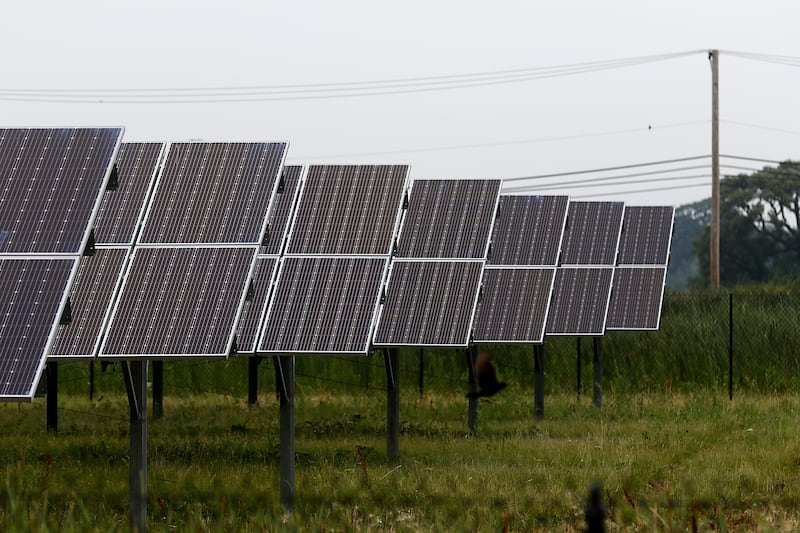
While a new state energy law aims to make it easier to expand renewable options, Huntley officials gave a lukewarm response to a potential solar farm in town.
The Huntley Village Board recently reviewed, but did not vote on, plans for a proposed solar farm near Charles H. Sass Parkway and Route 47.
The property is across the street from the Regency Square development, which was approved in 2024. Board members indicated they did not like the proposed solar farm for reasons including aesthetics, its proximity to the new development and the prospect of having to make several amendments to things like the newly adopted comprehensive plan.
Trustee Vito Benigno said he supports “solar parks” but felt the proposed spot “couldn’t be a lesser desirable location.”
Among other concerns, Benigno said the solar farm would negatively affect existing and new residential property and overall tax revenue. He said it would “have minimal job creation” versus commercial and retail development.
In response to Benigno’s comments, Forrest Howk, a project development director for OneEnergy Development, the company behind the proposed farm, asked for suggestions on locations that would work.
Village President Tim Hoeft expressed serious reservations about solar farms in town, saying he has never really liked them.
He made the distinction between building large-scale solar farms and having solar panels on one’s roof, saying he was having them installed at his own home. But he said that’s an individual preference.
Hoeft also said there was a reason solar farms weren’t in the new comprehensive plan, except one on the campus of Huntley High School. He suggested that OneEnergy look in that area.
Some of the regulations Huntley has around large solar farms are related to that.
The property currently being eyed for the new solar farm proposal is just over 27 acres, but the farm itself would take up about 11 acres, Huntley Director of Development Charlie Nordman said.
The solar farm would produce enough electricity to power up to 500 average Illinois residences and has an estimated lifespan of 30 years, Nordman said. Hoeft said 500 homes wasn’t a big number to him.
Some of the property falls in flood plains, and the company is working around that, Nordman said.
Vegetation would be planted to screen the solar farm on the west, south and east sides, with the exception of a 16-foot wide access road, Nordman said.
The plan includes what Nordman described as a “wildlife-style” fence, with wooden or metal posts and galvanized mesh. Howk said the company liked the look of the fence better than other styles, and it makes for a simpler review process at the Illinois EPA.
But Trustee Don Walz said the fence “looks trashy” to him. Walz said he didn’t like the location and asked why the company chose it.
Howk said the company looks for a landowner willing to sell or lease the property for the project. The company reaches out to landowners with property adjacent to ComEd infrastructure that can accept the electricity, and the company usually has to ask for a rezone or zoning text amendment, so the Huntley property makes sense.
Trustee JR Westberg said the fence was “atrocious.” Westberg said he wasn’t against solar but doesn’t want it there. He added Huntley has made a lot of concessions over the years and that the village should stop doing so because it needs to follow the comprehensive plan.
Huntley recently adopted a new comprehensive plan, and officials have generally been against requests that don’t fit into the plan.
Trustee Marilynn Berendt said she opposes the solar farm because it would require updating the newly passed plan. She said if a project is not aligned with the plan, she would need a very good reason to support it.
The solar plans would require officials to sign off not just on changes to the comprehensive plan but to rezoning the property.
Howk said solar offers a low-intensity use with low traffic demands and more property taxes for local taxing bodies. He added solar is a quiet neighbor that offers a buffer use.
Howk also said the project would come with a $7,000-per-megawatt property tax incentive, which would go mainly to the school district. The 500 homes that could sign up could get savings on their energy bills. He estimated the total financial benefit would be $1 million over 30 years.
There would still be about 12 acres to the west on the site, Howk said, adding he sees a few uses for it.
He said solar farms typically take six to nine months to be constructed, and if the company moves ahead, it hopes to start construction by the end of 2026. The project could be energized as soon as summer 2027.
But local officials might be limited in how they can regulate things like solar farms, because of the new state law energy bill signed into law by Gov. JB Pritzker recently.
Village Attorney Betsy Gates-Alford told the Village Board it has the authority to regulate the solar development like it does other zoning items.
The new law, which goes into effect June 1, says municipalities can’t prohibit solar energy systems and can’t make regulations that “effectively prohibit the development” of such uses.
But the law has “no meaningful effect” on Huntley’s zoning authority over the development, and it doesn’t override home rule, Gates-Alford said. Huntley can regulate solar facilities through zoning and other powers, Gates-Alford said.