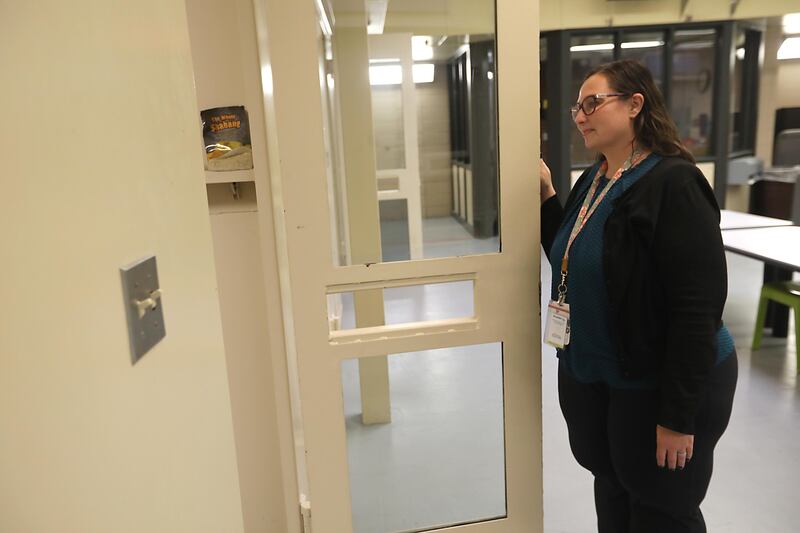
McHenry County jail detainees deemed unfit to stand trial are receiving specialized psychiatric care while waiting for an open bed in a mental health facility.
Since July, a pilot program – the second of its kind in the state – has helped ensure that the most severely mentally ill inmates get the critical care they need quicker.
The initiative addresses the “critical statewide backlog” since the COVID-19 pandemic, according to Illinois State Police. And those delays left many inmates with serious mental illnesses “waiting months in county jails unequipped to provide specialized psychiatric care.”
Finding a bed in an Illinois Department of Human Services facility can take several weeks, if not months, said BreeAnn Kaczmarczyk, who is a licensed social worker at Thresholds in Woodstock and the program team leader in the jail.
:quality(70)/cloudfront-us-east-1.images.arcpublishing.com/shawmedia/AEM7YQSXN5EE7J2F5Y4ILH2BHA.jpg)
During that wait, a defendant with a severe mental illness can see their condition further deteriorate from isolation, frustration or because they might not be properly medicated, and that can sometimes lead to committing new offenses in jail and getting into more legal trouble. People with severe mental illness are also left to advocate for themselves, which they often won’t do, the counselor said.
And treating inmates’ mental health isn’t just for their own benefit. Defendants have to be considered mentally fit to stand trial, so helping them reach that stage sooner can also provide justice to crime victims and their families.
Thresholds works in the jail in addition to WellPath, which provides medical care.
Kaczmarczyk said recently she has worked with five McHenry County inmates. She also treats inmates transported to the Woodstock jail from other county jails.
“This program is incredibly important,” she said. “I am so passionate about this work because I see a difference in each one of these people, and making that change for one person is huge. What we are doing for them could be the thing that supports them through their future decisions.”
When someone is close to being fit to stand trial and she can start working on relapse prevention, “it is a beautiful thing to see them get excited about the possibility of not getting wrapped up in this correction system again.”
Kaczmarczyk said she feels safe working in the jail, and the detainees she has worked with are not violent offenders. Many who wind up in the county jail have a mental illness and are unhoused, and they “break the law to live,” she said.
Such crimes include retail theft, violation of an order of protection or trespassing.
But, she also has treated detainees who are charged with aggravated battery and unlawful use of a weapon. In these cases, the person was often in a state of psychosis when committing their alleged crimes. For many, the first time they are jailed is linked to mental illness or substance use disorder, Kaczmarczyk said.
Treating the inmate earlier in jail takes some pressure off jail staff. It also helps in learning and relaying information about the person to the staff at the facility they will be transferred to, program supporters said.
The initiative, which has beds for 12 people, is paid for by a $442,000 grant and is an intergovernmental partnership among the McHenry County Sheriff’s Office, the Illinois Department of Human Services’ Division of Behavioral Health and Recovery and Thresholds.
“Safety and compassion aren’t opposites,” McHenry County Sheriff Robb Tadelman said in a news release. “In McHenry County, they walk hand in hand.”
In Kankakee County, the jail works with Wellpath in providing mental health treatment for those deemed unfit to stand trial while they wait for a bed with IDHS. In southern Illinois, Franklin County Sheriff Kyle Bacon is finalizing contracts to designate 10 to 12 beds for IDHS use, with Centerstone providing mental health services, according to Illinois State Police.
Defense attorney Brian Stevens said that in the last year, 10% to 15% of his clients could have benefited from earlier intervention.
”Getting them help right away in the jail, I think, curtails a lot of the other issues that come up when they don’t get help," Stevens said.
When someone commits infractions in jail, that can prohibit them from participating in mental health and self-improvement programs in the future, Stevens said.
One of Stevens’ clients, a former U.S. Marine with post-traumatic stress disorder, was charged with aggravated battery of a child. While he was detained pretrial, Stevens said, “He really needed some help.” And because his client did not get the specialized care he needed, he “ended up getting in more trouble,” Stevens said.
Stevens told his client to get involved in some programs, such as anger management. But his client was told he could not because of his past infraction.
“He just floundered in there, and he really needed help,” Stevens said.
The client’s infractions in county jail also limited what programs he could participate in while in prison, Stevens said.
Daisy Contreras, spokesperson for IDHS, said the “main goal” of the pilot program is to “provide defendants with mental health services and to ensure that their illness doesn’t worsen while they are waiting for an IDHS inpatient restoration bed.”
Contreras added that while the “expressed goal” of the program is not to restore individuals to mental fitness, that has happened in about 20% of participants’ cases.
After the McHenry County Sheriff’s Office had been in the program for about a month, there were participating inmates who were “restored to fitness in our custody and returned to their home counties to stand trial.”
Kaczmarczyk provides multiple forms of therapy, including talk therapy and art therapy, and she checks in to make sure participants’ medications are at therapeutic levels.
“Every case is different, but we are there for them every day,” she said.
She also provides education so the person understands what’s going on in the courtroom to help bring them back to fitness. She makes sure they know the roles of the judge, jury, prosecutor and their own lawyer.
“They cannot move forward with a hearing and have a fair trial” if unfit, she said. “They have to be able to understand. For some people, this is their first time in jail, their first arrest, the first time an episode led to an arrest.”
Kaczmarczyk sees someone the same day they are found to be unfit.
“The minute they are found unfit, they are provided this daily support system, and we start easing their symptoms.”