- A federal judge on Tuesday OK’d the release of highly anticipated and extremely rare transcripts from a trio of grand jury sessions in October, showing alleged prosecutorial misconduct by assistant U.S. attorneys seeking an indictment against a group of protesters who’d later become known as the “Broadview Six.”
- The transcripts detail how former Assistant U.S. Attorney Sheri Mecklenburg, who, at the time was the lead prosecutor on the case, dismissed grand jurors for disagreeing with the government’s case.
- Mecklenburg’s portions of the transcripts also reveal what the judge in the case had previously called “putting her personal credibility and trustworthiness on the line in support of the charges” — also known as improper prosecutorial vouching. The prosecutor also admitted to speaking to two grand jurors outside of the grand jury room, which she acknowledged she’s “not supposed to do.”
- The transcripts’ release comes just one day after more than 100 former federal prosecutors published an open letter denouncing Boutros’ leadership for having “tarnished the reputation” of the U.S. attorney’s office.
This summary was written by the reporters and editors who worked on this story.
CHICAGO — In the days following a marked escalation in the Trump administration’s “Operation Midway Blitz” mass deportation campaign in early October — including the shooting of a U.S. citizen by a federal immigration agent and the National Guard’s deployment to Chicago — a panel of grand jurors gathered once again behind closed doors in the Dirksen Federal Courthouse.
That particular group was nearing the end of its 18-month grand jury service, which began in June 2024, and had so far spent hundreds of hours hearing evidence brought by various federal prosecutors and signing off on indictments. Assistant U.S. Attorney Sheri Mecklenburg, a near two-decade veteran of the Department of Justice, had appeared in front of that grand jury enough times to develop a sort of bond with the group.
That bond, she told the grand jurors on Oct. 9, 2025, led her to ask her superiors if she could wait to present “a very interesting case” to them.
“I said I want to go in front of the Thursday grand jury because I know you and I trust you, and you know me and you trust me, and I would never ask you to charge somebody if I didn’t think there was probable cause,” Mecklenburg told the grand jury. “And you know you’ve asked me before, ‘Well, what about this person?’ And I said, ‘I don’t charge people unless I’m absolutely sure.’”
With that, Mecklenburg introduced the case against a group of Democratic activists, local elected officials and candidates that would come to be known as the “Broadview Six.”
[ Read more: ‘Broadview Six’ plead not guilty to charges of ‘impeding’ agents outside ICE facility ]
But the afternoon did not go smoothly, as laid out in grand jury transcripts released Tuesday in an extremely rare move as part of an inquiry into how the now-imploded case came to be in the first place.
Mecklenburg and her partner, newly minted Assistant U.S. Attorney Matthew Skiba, played video footage for the grand jury from a protest two weeks prior outside of a federal immigration facility in Chicago’s near-west suburb of Broadview. During the demonstration on the morning of Sept. 26, 2025, a U.S. Immigration and Customs Enforcement vehicle advanced toward the ICE facility, driving slowly through the crowd, which responded by closing in on the SUV and banging on its sides. The encounter left the vehicle with broken windshield wipers and the word “PIG” scratched into its side, the grand jury was told.
But during that first session, grand jurors declined to indict the six protesters at the end of their session, handing up a rare “no bill” indicating members of the grand jury did not believe prosecutors presented enough evidence to establish probable cause for a crime.
Nevertheless, Mecklenburg and Skiba appeared in front of the grand jury again the next Thursday, Oct. 16, 2025. She began the afternoon session telling grand jurors that she “did not do my job” the previous week and didn’t explain the law “well enough” to secure an indictment.
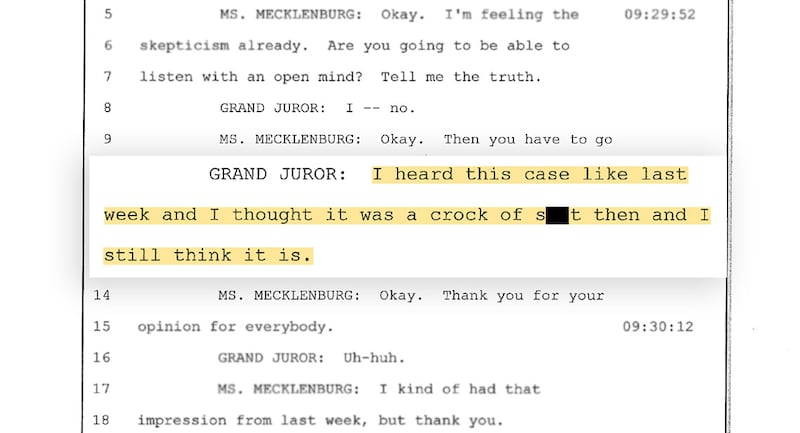
Not long into the presentation, however, one grand juror made clear their feelings on having to hear the same case again.
“I heard this case like last week and I thought it was a crock of s--- then and I still think it is,” the grand juror said.
Mecklenburg then dismissed the grand juror, telling them to “have a good evening.”
Case collapse
U.S. District Judge April Perry OK’d the release of the grand jury transcripts nearly three weeks after the case fell apart in dramatic fashion in her courtroom just days before it was set to go to trial.
[ Read more: Remaining ‘Broadview Six’ protesters set for rare federal misdemeanor trial next week ]
[ Read more: Charges dismissed for 2 of ‘Broadview 6’ ICE facility protesters ]
Lawyers for the protesters had been pushing to see the transcripts for months, but their calls got louder in March after prosecutors suddenly dropped all charges against two of the six defendants in the face of pressure to clarify the indictment.
Then in late April, on the same day Perry called a hearing to ask prosecutors for the unredacted transcripts, prosecutors made another surprise announcement: They’d decided to drop the felony conspiracy charge. While defense attorneys framed it as a win for their clients, they also suggested the feds’ move was a strategic way to avoid having to hand over unredacted grand jury transcripts.
Read more: Conspiracy charge dismissed for ‘Broadview 6’ as other ICE protesters sue over DNA collection | ‘Broadview 6’ defense accuses feds of keeping grand jury transcripts secret, reneging on dropping conspiracy charge | Feds say they’ll drop conspiracy charge against remaining ‘Broadview Six’ protesters
In the days leading up to the four remaining defendants’ rare federal misdemeanor trial in late May, defense attorneys made a final plea for Perry to review the grand jury transcripts. And after she did, the consequences came swiftly.
After a closed-door hearing in which the judge rebuked prosecutors for both apparent misconduct in front of the grand jury and for having previously obscured parts of the transcripts that would have revealed the misconduct earlier, she canceled the trial.
According to minutes of that May 21 sealed hearing, Perry characterized Mecklenburg’s opening statement urging trust of the case as “putting her personal credibility and trustworthiness on the line in support of the charges” — also known as improper prosecutorial vouching.
[ Read more: ‘Broadview 6’ trial canceled as prosecutors acknowledge misconduct before grand jury ]
That same day, U.S. Attorney Andrew Boutros, President Trump’s highest-ranking deputy in Chicago, took the extraordinary step of appearing in Perry’s courtroom, moving to drop the remaining charges and taking responsibility for the alleged prosecutorial misconduct. Soon after, Mecklenburg was fired from her new job while other cases she’d previously overseen have come into question.
:quality(70)/cloudfront-us-east-1.images.arcpublishing.com/shawmedia/FFDILVVUZZAUXMVWUNCU6QCMKU.jpg)
And Boutros has locked into a public battle with those who have called for his resignation, including Democratic members of Illinois’ congressional delegation, and those who have launched serious criticisms of his leadership, including more than 100 former federal prosecutors from the Northern District of Illinois.
In an open letter published Monday, 111 signatories, including two of Boutros’ predecessors who’ve held the job of Chicago’s top federal prosecutor, bemoaned that in the 14 months since Boutros was confirmed as U.S. attorney, “actions taken by leadership ... have tarnished the reputation” of the office.
The letter alleged that “once-forbidden political considerations are infecting prosecutorial decisions” and urged Boutros to develop “the courage to stand above and apart from political fealty.” The accusations come just a few days after defense attorneys filed a motion seeking any possible evidence of pressure from White House officials on the U.S. attorney’s office in Chicago to secure an indictment in the case.
Read more: Now-cleared ‘Broadview 6’ immigration protesters seek evidence of White House pressure to indict
In response, Boutros shot back in a social media statement boasting that in his time as U.S. attorney, his office has dramatically increased the number of indictments over previous years, despite the extraordinary turnover in prosecutors leaving the office.
“In every metric, we’ve vigorously brought the full weight of this Office and the federal government against dangerous criminals and serious fraudsters who previously got a pass,” Boutros wrote. “That’s because irrespective of factionalism, tribalism, or politics, the duty of a prosecutor is to charge good cases against worthy targets and to bring enough cases to discourage the public from committing crimes and to incapacitate specific offenders from re-offending.”
The U.S. attorney also claimed that when he began his job in April 2025, he “found an Office that was not well,” having “fallen to last place in virtually every metric tracked by the Department of Justice and the federal courts, including indictments per prosecutor, charged defendants per prosecutor, criminal cases per federal judge and case processing time.
But Boutros did not address the ethical concerns voiced by the 111 former federal prosecutors who signed the letter, including their claims that the “special report” the U.S. attorney’s office published last week that revealed Boutros had spoken to the Broadview Six grand jury “raises more questions than answers.”
“He took the extraordinary step of questioning the grand jurors about whether they were ‘struggling’ with immigration cases after they had previously rejected charges in the Broadview Six case,” the letter read. “The message he delivered effectively signaled that the head of the U.S. Attorney’s Office is unhappy with us and we did something wrong. That message is inappropriate.”
Dismissed grand jurors
The transcripts released Tuesday didn’t include Boutros’ approximately four-minute speech to the grand jury at the beginning of their Oct. 23, 2025, session, but Mecklenburg’s first recorded remarks echoed them.
“If you still feel like you are operating from feelings that prevent you from deliberating fairly with your fellow Grand Jurors and from applying the facts — the law to the facts here, then tell your fellow Grand Jurors that you can’t deliberate,” she admonished.
Mecklenburg then launched into a public acknowledgment of having talked to two grand jurors outside of the grand jury room prior to the beginning of the session, which she said “I’m not supposed to do.”
In both cases, she claimed the grand jurors apologized to her for their comments the previous week. It’s unclear whether either of the men Mecklenburg referenced were the same grand jurors she dismissed during the Oct. 16, 2025, session.
“The Grand Juror apologized to me from last week, and I told the Grand Juror that I accepted his apology,” Mecklenburg said of a grand juror she ran into in the elevator. “I wasn’t mad. I understand people have feelings. The Grand Juror said at that time that he did have feelings, and he’s sure that he’s right, but he shouldn’t have walked out the way he did.”
:quality(70)/cloudfront-us-east-1.images.arcpublishing.com/shawmedia/BUATHORJGBCVPBCD73HEQWHN2E.jpg)
Transcripts from that previous week’s session detail both dismissals.
Before characterizing the case as “a crock of s---,” the same grand juror asked Mecklenburg if she was “actually presenting any new actual facts or just a different viewpoint on your side?”
The prosecutor responded that she was “feeling the skepticism already” and asked the grand juror whether they were “going to be able to listen with an open mind,” urging them to “tell me the truth.”
“I — no,” the grand juror replied.
“Okay,” Mecklenburg said. “Then you have to go.”
Later, another grand juror told Mecklenburg, “I don’t think I can vote” on the indictment.
In contrast to her earlier dismissal of the other grand juror, Mecklenburg merely said, “Okay,” and then asked the foreperson if the grand jury would still have 16 members after the second departure, the minimum number of grand jurors needed for a quorum.
In his May 21 appearance in front of Perry, Boutros said he was aware of Mecklenburg’s dismissal of grand jurors at the time, telling the judge that “as soon as I became aware of it, I called off that grand jury session,” he said.
Indeed, the Oct. 16, 2025 session’s transcript ends abruptly in the middle of testimony from the ICE employee who drove the SUV into the crowd of protesters.
But Boutros claimed that he was unaware of Mecklenburg’s alleged prosecutorial vouching nor her communications with grand jurors outside the grand jury room until late April. When he found out, he said, he made the decision to drop the felony conspiracy charge.
‘It was not luck’
From the beginning, grand jurors made clear their doubts about the case. During the first session on Oct. 9, 2025, members of the grand jury only heard from an FBI agent, and not the ICE employee who drove the SUV.
“Couldn’t he have stopped?” one asked, to which Mecklenburg reminded the grand jury of an FBI agent’s testimony to the group that the driver, an ICE employee, was “afraid to stop” for fear of the crowd breaking the vehicle’s windows and pulling him out.
“So if the person comes and stands in front of my car, do I have the right to drive against him?” a grand juror asked a little later, sparking a back-and-forth with Mecklenburg.
“We are not going — we don’t need to address that today because it didn’t happen,” she said. “It did not happen that he drove into any of them such that any of them were actually knocked over, hit.”
When the grand juror retorted that the reason no one was injured was “just luck,” Mecklenburg vehemently disagreed.
“No, it wasn’t luck. Oh, no, it wasn’t — sir, it was not luck,” she said. “It was his calmness and his judgment to drive as slowly as possible as he could and not hit anybody. It wasn’t just luck,” she said, according to the transcript.
Later this week, Perry is also likely to release the portion of the Oct. 9, 2025, grand jury transcript in which that FBI agent testified. The judge said she “was a little surprised” to see the agent’s testimony included in the parties joint filing Friday laying out the redactions they agreed to.
“The FBI agent is laying out the government’s case against you,” Perry said during Tuesday morning’s hearing. “If it’s released, it’s out there in the world forever.”
Without making explicit reference to it, the judge alluded to Boutros’ statements in open court late last month just moments after he said his office would be dropping the entire case — a few days before it was set for trial.
Though the U.S. attorney took responsibility for the apparent prosecutorial misconduct from his deputies on the case, Boutros also said the just-cleared defendants’ alleged actions were “unacceptable in a civilized society.” At the time, Perry told Boutros that he was “significantly undercutting your mea culpa here by standing behind the charges and continuing to vilify these particular defendants.”
The former prosecutors’ Monday letter characterized Boutros statement that day of violating “DOJ protocol and basic considerations of fairness” and criticizing his office-wide email that was quickly obtained by the Chicago Tribune.
“By portraying the episode as a courageous effort by individual prosecutors, himself, and top supervisors, and by reaffirming his personal belief that a crime was committed, it sent an entirely wrong message to impressionable and inexperienced AUSAs,” the letter said.
On Tuesday, Perry warned that the agent’s testimony “will perhaps be used” against the former defendants “if the government continues to persist that crime was well-founded and charges were just.”
But defense attorneys said they were in favor of releasing the FBI agent’s testimony, while Terence Campbell, a lawyer for Andre Martin, one of the Broadview Six defendants, even advocated for the release of audio recordings from the grand jury proceedings.
“Let’s release the audio,” he said. “Let’s let everyone hear what was said.”
“Let’s start with the transcript,” Perry replied.
Capitol News Illinois is a nonprofit, nonpartisan news service that distributes state government coverage to hundreds of news outlets statewide. It is funded primarily by the Illinois Press Foundation and the Robert R. McCormick Foundation.