SPRINGFIELD — Illinois lawmakers gave hospitals and community health centers much of what they wanted this session by passing a bill that prohibits drug manufacturers from interfering with their access to discounted medications through a federal drug pricing program.
But they also gave drug companies what they wanted by passing another piece of legislation that calls on the Illinois Department of Insurance to conduct an audit to find out how much money these hospitals and clinics are making off that program, and what they are doing with the profits.
Both bills focus on the federal 340B drug pricing program. Although it is established under federal law, with tens of billions of dollars’ worth of healthcare revenue at stake nationwide, it has increasingly become the subject of state-level political battles as well.
Launched in 1992, the 340B program requires drug manufacturers that participate in Medicaid to provide outpatient medications at substantial discounts to providers that serve large numbers of uninsured, underinsured and Medicaid patients.
Those providers, in turn, typically mark up the price they charge their patients for the drugs and use the difference to support their operations.
As the Medicaid program has grown in recent years, so too has the 340B drug program. According to an analysis by KFF, a nonprofit health policy research, polling and news organization, the 340B program has mushroomed in size in recent years, growing from $2.4 billion in drug purchases nationally in 2005 to $66.3 billion in 2023.
That growth has resulted in heightened tensions between hospitals and clinics on one side, and the pharmaceutical industry on the other, with each side accusing the other of abusing or manipulating the program for their own benefit.
The 340B-eligible hospitals and clinics have accused drug companies of unfairly restricting their ability to contract with outside pharmacies to dispense the discounted drugs to their patients. That limits the volume of 340B-discounted drugs.
Drug manufacturers, meanwhile, have accused hospitals and clinics of profiting off the system instead of passing the savings on to their patients or using the profit they make from the program to offset their cost of providing charity care.
The battle in Illinois over the 340B program began last year when, at the urging of federally funded community health centers, the Senate adopted an amendment to House Bill 2371. It was sponsored by Rep. Anna Moeller, D-Elgin, in the House and Sen. Dave Koehler, D-Peoria, in the Senate.
Passed in the final week of the 2025 session, it called for prohibiting drug manufacturers or any other party from interfering with the ability of a 340B-qualified hospital or clinic to acquire the discounted drugs.
That bill also prohibits drug companies from interfering with the hospitals’ and clinics’ ability to dispense the drugs through contract pharmacies. And it shields them from any requirement to disclose any of their cost or income data related to the program beyond what is required under state or federal law.
The bill passed the Senate on a 55-0 vote on May 29 and was sent back to the House for concurrence. But amid strong opposition from the industry lobbying group Pharmaceutical Research and Manufacturers of America, or PhRMA, it was initially not called for a vote, even though hospitals and clinics continued pushing for its passage.
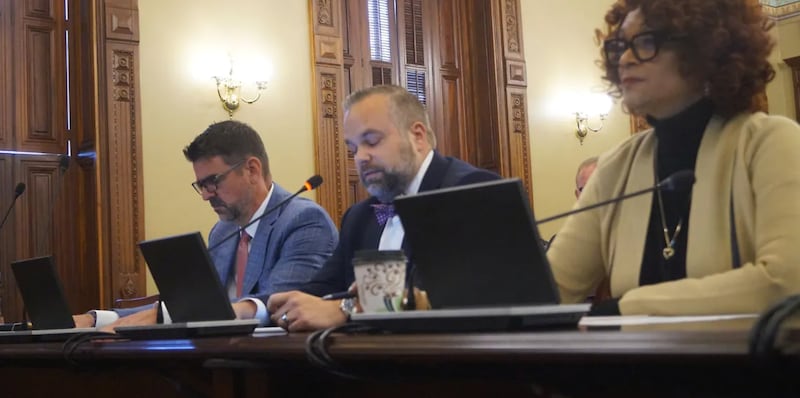
Testifying before a House committee May 26, PhRMA lobbyist Peter Fotos said the bill effectively made it “illegal to ask for receipts.”
“Lawmakers should demand real transparency, real accountability, and a full understanding of the financial impact on state programs,” Fotos said. “We believe those questions must be mentioned before considering a bill to prohibit guard rails.”
It took the inclusion of a bill creating greater transparency around the program to bring the main bill over the finish line in the House by a vote of 113-1 in the waning hours of the session.
‘Transparency’ bill
House Bill 4327, which was described as a “transparency” bill, calls on the Illinois Department of Insurance to conduct an audit of the 340B program in Illinois to determine how much revenue hospitals and clinics are earning through the program and how that money is being used. It was sponsored in the House by Rep. Camille Lilly, D-Chicago, passing 106-8, and Koehler in the Senate, where it passed 57-0.
Specifically, it directs the department to gather information from the 340B-eligible hospitals and clinics about how much they pay and how much they’re reimbursed for the medications they acquire through the 340B program. The audit will also examine how much of the money they earn through that price spread is used to fund charity care or any other program that provides unreimbursed or subsidized care.
The bill also calls on those hospitals and clinics to provide demographic data about their patient population, including the percentage of people they serve who are members of “vulnerable communities.”
Those are defined in the law as uninsured, underinsured and Medicaid patients, people who are billed on a sliding fee scale, racial and ethnic minorities, residents of rural or medically underserved areas, populations with high rates of chronic diseases or poor health outcomes that are linked to social determinants of health, and individuals who are elderly, disabled LGBTQ+ or “justice involved.”
The bill also calls for an examination of how the 340B program affects the cost of other healthcare programs such as Medicaid and state employee group health insurance plans.
And it calls on manufacturers covered by the program to report the aggregate amount of discounts they have provided under the program each year since 2020.
Both bills cleared their final legislative hurdles during the final hours of the session. Afterward, groups representing hospitals and federally funded community health centers claimed victory.
“Today, our legislative champions stood strong in the face of intense industry pressure, to put patients first,” Ollie Idowu, president & CEO of Illinois Primary Health Care Association, a group that represents federally funded clinics, said in a statement. “Because of their courage and leadership, 1.5 million Illinoisans who rely on community health centers will continue to have access to the affordable medications and comprehensive services they need to live healthy lives.”
A.J. Wilhelmi, who leads the Illinois Health and Hospital Association, also issued a statement praising passage of HB 2371.
“Illinois now joins more than 20 other states that have enacted protections for the 340B program, safeguarding patients’ access to 340B medications and the healthcare services those savings support in communities across the state,” he said.
But PhRMA, which had urged passage of HB 4327 on its own, without HB 2371, issued a statement suggesting the 340B program needs broader national reforms.
“Across the country and here in Illinois, 340B is driving up costs for patients, taxpayers and employers instead of ensuring that these savings reach those who need them most,” PhRMA spokesman Will May said in a statement. “PhRMA will continue working with policymakers to advance solutions that protect patients.”
Capitol News Illinois is a nonprofit, nonpartisan news service that distributes state government coverage to hundreds of news outlets statewide. It is funded primarily by the Illinois Press Foundation and the Robert R. McCormick Foundation.