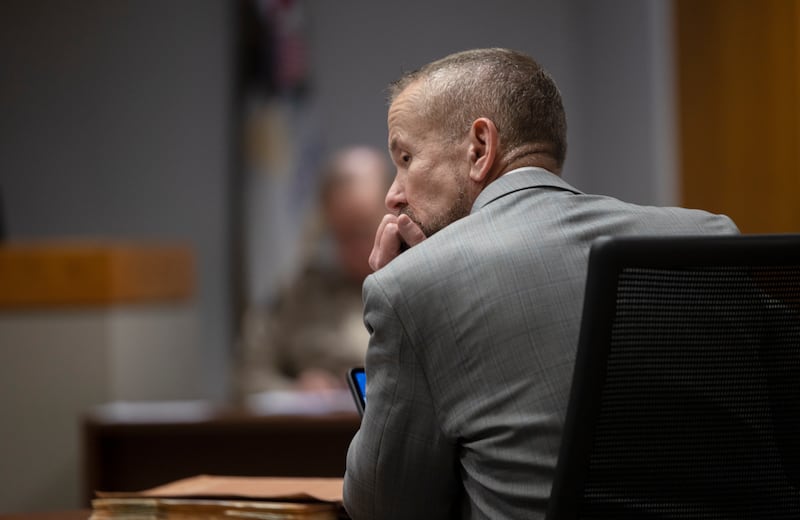
A defense attorney’s curiosity about how Whiteside County selects jury pools has called into question a process that, for several years, applied what a judge calls “wrongful” exclusionary criteria without the guidance of a jury commission.
A judge has ruled that Whiteside County may have been improperly excluding jurors for years, raising questions about whether the county’s jury selection process violates state law and defendants’ constitutional rights.
After two days of hearings initially presided over by Whiteside County Judge James Heuerman, who recused himself, 14th Judicial Circuit Judge Hany Khoury on March 11 ruled in favor of defendant Michael Cover’s challenge to the county’s jury venire selection process.
Cover’s attorney, James Mertes of Sterling, argued the county’s Circuit Clerk’s Office – using a jury venire selection process handed down verbally for at least 33 years – has been systematically excluding qualified jurors based on age, economic status, pending civil cases and prior criminal charges.
Khoury agreed, ruling to postpone Cover’s March 11 trial to April 14. A pretrial conference is set for Thursday to allow the prosecution and defense team to talk about the jury venire selection process for Cover’s trial.
The Legal Challenge
Cover, 32, faces charges connected to a September fight inside the Whiteside County Jail between inmates and corrections officers. Cover has been held in jail since mid-2024 in a case accusing him of sexual assault, sex abuse and home invasion earlier that year.
In the days leading up to the Feb. 10 trial date, Mertes visited the Whiteside County Circuit Clerk’s Office to ask questions about how jury venires are selected. What he learned, according to a motion he filed on Feb. 10 and arguments in front of the Heuerman, was that Whiteside County does not have a jury commission and is not following the Jury Act. The Feb. 10 trial was stricken.
In an amended motion filed Feb. 13, Mertes sought to have the jury panel scheduled for the Feb. 10 trial discharged so it would not be used in Cover’s trial, which was then rescheduled for March 10 and then later for March 11. A new venire was then selected.
But Mertes continued to argue the exclusions the Circuit Clerk’s Office has been applying to the master list of potential jurors – provided by the Administrative Office of the Illinois Courts – violate both state and federal law and undermine the constitutional right to a jury drawn from a fair cross-section of the community.
According to the motion, the Whiteside County Circuit Clerk’s Office removes prospective jurors from the jury pool under six exclusions.
Age-Based Exclusions: The removal of jurors under 22 and over 79. Mertes argued the exclusions violate Illinois’ Jury Act, which allows anyone 18 or older to serve unless disqualified by law.
Economic Status: The exclusion of jurors who owe money to the Clerk’s Office or are defendants in small claims cases violates the express prohibition in the Jury Act against excluding jurors based on economic status. Mertes cites the landmark U.S. Supreme Court case Thiel v. Southern Pac. Co. (1946), which held that systematic exclusion of daily wage earners violated constitutional principles.
Pending Civil Cases: The motion argues that excluding all persons with pending civil cases exceeds the narrow statutory exception, allowing challenges only for parties to suits pending in the specific court. Mertes argued those decisions should be made during jury selection, not automatically by the clerk’s office.
Criminal History: The exclusion of all persons ever charged with misdemeanor or felony crimes – regardless of conviction. Mertes said that goes beyond federal law, which disqualifies only those convicted of or facing felony charges. Mertes argues that Illinois law contains no such blanket disqualification and that such exclusions unfairly advantage the prosecution.
The jury venire assembled for Cover’s trial contained 80 people with no one under 22 or over 79 years old, according to the motion. Testimony from Circuit Clerk’s Office employees indicated that a computerized disc containing thousands of county residents’ names is uploaded annually, and an employee prints a 500-name report.
Questionnaires are mailed to prospective jurors, and exclusions are applied when responses are returned.
Circuit Clerk’s Office staff also testified that one person, a deputy clerk in that office, has overseen the jury selection process for 11 years and was verbally trained by then-Whiteside County Circuit Clerk Susan Ottens.
Mertes argued that these exclusions violate the Sixth Amendment’s requirement that juries be drawn from a fair cross-section of the community. He also contends they violate Illinois law, specifically the Jury Act, which prohibits excluding jurors based on race, color, religion, sex, national origin, sexual orientation or economic status.
“The systematic exclusion of prospective jurors, if they have any upcoming court dates in Whiteside County in any small claims, civil, family, or divorce case, violates Illinois law,” Mertes wrote in his motion.
Whiteside County’s Jury Commission problem
The motion also reveals a procedural issue: Whiteside County appears to lack a functioning jury commission.
Under Illinois law, counties with populations under 75,000 – Whiteside County has approximately 55,700 – may form a jury commission only if the county board passes a resolution and the circuit judges appoint three qualified electors.
Mertes produced a timeline that outlines how the three-member Jury Commission came into being in 1967, when an Illinois statutory amendment allowed county boards in a county with less than 40,000 inhabitants to determine by resolution that three jury commissioners shall be appointed by circuit judges.
Records show Whiteside County once had a three-member jury commission, but it appears to have stopped functioning years ago.
Mertes said no commission has existed since about 2020.
Mertes said that without a jury commission, the Jury Act requires the county board to compile and approve a jury list at its September meeting each year. Neither the September 2024 agenda nor the September 2025 minutes of the Whiteside County Board reflect such action, according to the motion.
Relief sought
Khoury, in his ruling, agreed with Mertes’ claim that the exclusionary process in which the Whiteside County Circuit Clerk’s office has been selecting its jury pools does not ensure his client’s right to a fair trial, discharged the jury panel for Cover’s March trial, and for any subsequently scheduled trial using a new jury venire.
In his decision, Khoury said the jury list came from the AOIC in the spring of 2025. For roughly nine to 11 months since the jury list was received from the AOIC, jury panels of 500 have been randomly drawn from this list, and then exclusions were applied.
He said an unknown and most likely substantial number of potential jurors have been removed and excluded from the AOIC jury list over the last nine to 11 months since this list was provided by the AOIC.
He said he could not find that the jury panel of 500 selected from the remainder of the AOIC list was sufficiently random to “ensure that we have protected the Defendant’s right to a fair, impartial and representative jury.” The court therefore granted the defendant’s motion.
:quality(70)/s3.amazonaws.com/arc-authors/shawmedia/9bb5f897-be4a-42b8-9507-9193a7f43c2d.png)