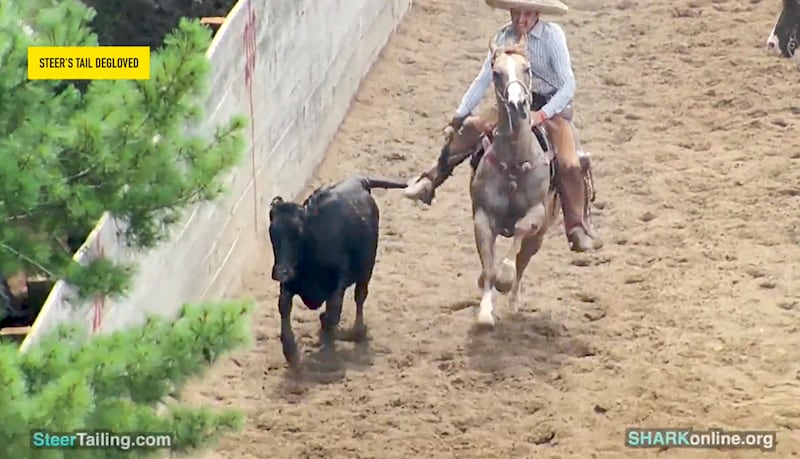
Officials in several northern Illinois counties say regulating steer-tailing events at backyard rodeos is up to state legislators, but charges filed in McHenry County could prove otherwise.
After an investigation by the McHenry County Sheriff’s Office of a Mexican-style rodeo Aug. 16, 2025, at 18316 Kishwaukee Valley Road in Woodstock, five participants were charged Oct. 15 with one count of animal cruelty. The charge against four of those participants alleges they violated the Illinois Humane Care for Animals Act during a steer-tailing event by pulling a steer’s tail so hard that they tore the animal’s skin off its bone, court records show.
Steer tailing, or coleadero, is when a horseback rider chases a running steer, grabs onto its tail, and wraps the tail around the rider’s leg to slam the animal to the ground. It’s banned in Nebraska and in parts of California and Colorado.
Over the past three years, Chicago-based animal rights group Showing Animals Respect and Kindness has urged officials in Will, Boone, Ogle, DeKalb and McHenry counties to shut down rodeos holding these events.
SHARK provided officials in each county with footage the group captured of the events, reviewed by Shaw Local, that appears to show animals being hit in the face, tripped, prodded, animals having their legs or horns broken, and tails severed during steer-tailing events, and injured or overworked animals being used in events.
Officials in Will, Boone, and DeKalb counties have taken different types of action against the rodeos and have had various degrees of success. In Ogle County, officials filed false reporting and harassment charges against a SHARK advocate.
But one thing those four counties all have in common: Officials say the root of the problem is that Illinois law doesn’t specifically outlaw steer tailing.
What are Illinois’ animal protection laws?
In Illinois, it’s illegal to “beat, cruelly treat, torment, starve, overwork or otherwise abuse any animal” under the Humane Care Act. It also says anybody with animals in their care must provide each animal with a sufficient amount of “good quality, wholesome food and water” and “veterinary care when needed to prevent suffering.”
“The difficulty is [that] there’s not a specific statute when it comes to steer tailing,” Ogle County State’s Attorney Mike Rock told Shaw Local.
Will County Assistant State’s Attorney Toni Renken and DeKalb County State’s Attorney Riley Oncken agree.
“It’s a legislative problem,” Oncken said.
Renken explained that without that specific statute, prosecutors must prove beyond a reasonable doubt that the event qualifies as animal cruelty.
A bill that would ban steer tailing in Illinois was introduced Jan. 13, 2025, by state Sen. Rachel Ventura, D-Joliet. It was referred to assignments that day and has not been voted on.
:quality(70)/cloudfront-us-east-1.images.arcpublishing.com/shawmedia/QCXBG2DEMVCHFHSBIIWBP6KXPA.jpg)
The Senate passed a resolution by Ventura on Oct. 15, 2025, that condemns steer tailing, declaring it cruel to animals, and establishing April 23 as Animal Welfare Day.
Unlike a bill, passing a resolution expresses the Senate’s opinion and does not become law.
“There’s plenty [under] our current law that could stop these practices if those in those positions just took the avenues to do so,” Ventura said, explaining that groups such as SHARK asked her to write the bill because of inaction from local officials.
In McHenry County, four participants of the August rodeo in Woodstock were charged with animal cruelty, court records show.
For each of them, the charge alleges they violated the Humane Care Act during a steer-tailing event at the rodeo by knowingly pulling the tail of a steer so hard that it caused a degloving injury, meaning the animal’s skin was torn off its bone, court records show.
McHenry County State’s Attorney Randi Freese declined to comment on the pending cases when contacted by Shaw Local.
Another participant of that Woodstock rodeo also was charged with animal cruelty, accused of kicking a steer in the head more than 10 times with his boot while the animal was on the ground and not posing a threat, court records show.
Other counties have prosecuted people in connection with similar rodeos, but all of those charges stemmed from actions that weren’t directly related to the steer-tailing events.
Renken said she believes action by the Will County Sheriff’s Office in 2024 deterred rodeo activity in the area.
In May of that year, Will County sheriff’s Detective R.J. Austin hand-delivered a letter to the owner of Meyer Livestock Co., which was supplying animals to a Joliet rodeo, that said the Iowa company would be held responsible for every animal in its care crossing state lines.
The Illinois and federal departments of agriculture require animals to have specific health records when crossing state lines.
“[The company] was afraid of being in trouble with the USDA,” Austin said.
Why rodeos keep happening, even after charges are filed
In DeKalb County, Cristofer Perez, 24, of Kirkland was charged Oct. 11, 2024, with violating animal owner duties under the Humane Care Act, court records show.
That charge stemmed from two rodeos on a property in Kirkland in summer 2024. As the permit holder for those rodeos, Perez was considered responsible for the animals for the duration of the events, DeKalb County records show
Perez pleaded guilty on April 18, 2025, and was ordered to pay a $514 fine and is under court supervision until April 17, court records show.
But that didn’t stop Perez from being issued another rodeo permit and holding the event at that same Kirkland property on Aug. 2, 2025, DeKalb County records show.
Perez rented steers from Meyer Livestock for both events, DeKalb County records show.
[ DeKalb County administrator issued rodeo permit to man who pleaded guilty to animal abuse: Records ]
DeKalb County Community Development Director Derek Hiland, who issued the permits, told Shaw Local that he can’t deny Perez a rodeo permit until the law says he can.
A judge hasn’t ruled that Perez can’t hold a rodeo. The only conditions of his court-ordered supervision are that he can’t break any laws and must pay the fine before Jan. 30, DeKalb County court records show.
The permit issued to Perez for the Aug. 2, 2025, event had several conditions, many related to the care of animals. The two permits issued in 2024 had significantly fewer conditions and none that related to the animals, DeKalb County records show.
SHARK footage of that rodeo, reviewed by Shaw Local, appears to show steer-tailing events resulting in injuries to animals, such as severed tails and injured animals being stepped on in crowded pens.
DeKalb County Sheriff Andy Sullivan previously told Shaw Local that his office has an open investigation into the event.
No subsequent charges related to the rodeo have been filed against Perez as of Jan. 19, court records show.
Even after investigations and charges, rodeos continue, largely because of how local permits work.
What is a rodeo permit?
In all counties, these rodeos are able to be on private properties with a type of land-use permit issued by county officials. However, the type of permit and the process for issuing it vary.
In Ogle County, a rodeo near Rochelle operates under a permit issued in 2012 after a County Board vote approved it. The permit is not subject to any routine review process and remains intact as long as an event takes place there at least twice a year, even if the property is sold. It can be revoked only by a board vote if permit conditions are proved to be violated, Ogle County Zoning Administrator Mark Miller told Shaw Local.
In DeKalb County, a rodeo requires a temporary permit, which is issued by the community development director and is not voted on by the County Board. Those permits are issued for each individual event, and properties are limited to two per year, the DeKalb County code says.
McHenry County, similar to DeKalb County, requires a temporary use permit for rodeos issued by the county director of planning and development. The permits are not voted on by the County Board, but board members and the county director of planning and development can impose conditions, according to McHenry County code.
:quality(70)/s3.amazonaws.com/arc-authors/shawmedia/0e4ec010-1273-46f1-8fc4-c5fe7fe40794.png)