Editor’s note: Today’s Part 2 of Shaw Local’s human trafficking series examines law enforcement crackdowns, how to recognize trafficking victims, and resources for those seeking help.
The fight against human trafficking in northern Illinois is intensifying. Law enforcement agencies are launching specialized units, healthcare workers and educators are learning to recognize victims, and new legislation is strengthening protections for survivors.
Experts say community members – including teachers, nurses, and even salon workers – often play the biggest role in identifying victims.
Law enforcement crackdowns
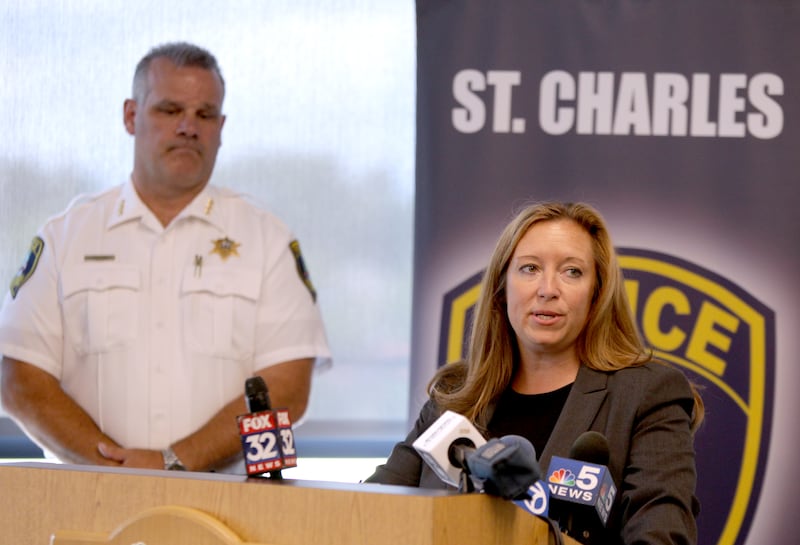
In Kane County, State’s Attorney Jamie Mosser launched the Human Exploitation Unit last year “to crack down on the rising number of human trafficking cases occurring.”
“Human trafficking is a vile crime that takes advantage of vulnerable people in our society and robs victims of their innocence, dignity and fundamental rights,” Mosser said.
:quality(70)/cloudfront-us-east-1.images.arcpublishing.com/shawmedia/LCLVXAPWWVGLLPB7BKX54BM6KQ.jpg)
The new unit “works with police departments to investigate and prosecute cases, while also offering training to those departments and educational events to the community at large,” Mosser said.
Prior to the unit’s creation, Kane County investigations led to the arrest of five people in 2023, accused of operating four brothels in Aurora, Elgin, St. Charles, and South Elgin. The group, which included one woman, also established brothels in Cook County. These arrests resulted in police rescuing seven women.
Four of the accused pleaded guilty and were sent to prison. They are accused of physically harming or threatening harm to at least one of the women, securing locations for commercial sexual activity, transporting the women to these locations and advertising that these women were available for commercial sexual activity, Mosser said.
“The defendants physically restrained the victims by confining them to a residence, intimidated the victims with threats if they did not engage in the sexual activity, and maintained financial control over the victims,” Mosser said.
A 2024 Kane County investigation led to the arrest and conviction of an Aurora man who sex trafficked six women. He used drugs, threats, and physical force to control the women, Mosser said.
Recognizing the signs
Health care workers, school employees, salon staff, trucking company workers, and hospital staff are trained – or can be taught – to recognize trafficking victims. Early identification can mean the difference between continued exploitation and freedom.
“Trafficking victims can sometimes be difficult to identify because they are trained by the traffickers to not speak to healthcare workers,” said Stacey Keller, a sexual assault nurse examiner at Northwestern Medicine McHenry, Huntley, Woodstock, and Cathy Gratz Griffin Lake Forest hospitals.
“We use a trauma-informed approach to speak to the patients if we suspect that they may be trafficked. We try to make sure that we have time alone with them so that we can ask them open-ended questions to assess the situation,” Keller said.
Keller said victims rarely show all these signs, but patterns often emerge over time. Hospital staff are instructed to look for several red flags:
• Wounds in various stages of healing, such as burns and bites
• Branding and tattoos indicating ownership (names, crowns, dollar signs, barcodes)
• Signs of drug abuse
• Poor hygiene
• Severe exhaustion
• General neglect of self-care
“There isn’t any one thing that you point out and say, ‘yep, they’re being trafficked,’” Keller said. “We look at the entire picture and ensure the patient feels safe with us so that we can get to the truth and help them.”
McHenry County schools’ Regional Superintendent Diana Hartmann said teachers are trained to understand and address the risk of students being sexually abused or sex trafficked. They are mandated to report such concerns to authorities.
:quality(70)/cloudfront-us-east-1.images.arcpublishing.com/shawmedia/DBK4BFTQANC2DNCAEPFNALV5VY.jpg)
“This training equips school personnel to recognize warning signs and grooming behaviors associated with trafficking, including manipulation, coercion, exploitation, and abuse that may be perpetrated by individuals both inside and outside the school community,” Hartmann said.
Teachers are trained so they are “prepared to protect students, respond appropriately, and collaborate with authorities when concerns of trafficking or sexual exploitation arise,” Hartmann said.
Legislative progress
Illinois lawmakers last year strengthened laws aimed at helping trafficking survivors recover and improving coordination among agencies.
Last August, several Illinois laws were strengthened to empower authorities’ ability to combat human trafficking and help survivors. Senate Bill 2323, known as the Illinois Statewide Trauma-Informed Response to Human Trafficking Act, addresses human trafficking through prevention, intervention, and the establishment of standards for survivor support.
How to help and report
If you suspect human trafficking:
• Contact local law enforcement
• Call the National Human Trafficking Hotline at 1-888-373-7888
• Text “HELP” to 233733. Available 24/7 in multiple languages
• Reach out to Refuge for Women, a faith-based nonprofit based in McHenry County that provides safe housing and support for trafficking survivors. Visit refugeforwomen.org.
Officials say awareness – by neighbors, teachers, and everyday residents – remains one of the most powerful tools in stopping trafficking.
“One of the biggest misconceptions is that trafficking means you are kidnapped by a stranger,” said Meredith Hodge, executive director of Refuge for Women. “While that does happen, most victims are walking around in plain sight and are not chained down in a basement. But they are there by manipulative, coercive tactics that keep victims silent or cause them to believe it’s their fault. Therefore, they never seek help.”
:quality(70)/s3.amazonaws.com/arc-authors/shawmedia/638ad18c-1176-4018-bcef-b5560cf36d58.png)