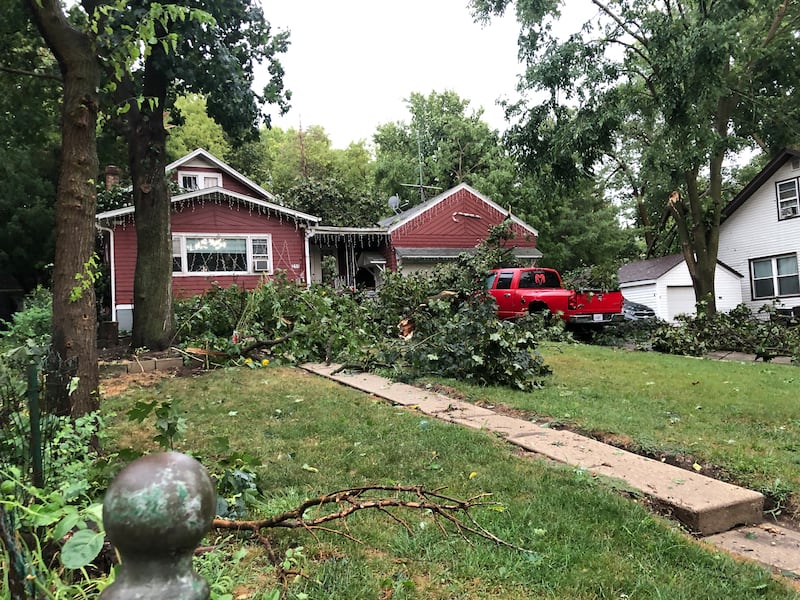
Illinois was unsuccessful in appealing the Federal Emergency Management Agency’s previous denial of a major disaster declaration following storms that caused damage around the Chicago area last August.
FEMA’s denial applies to the state’s request for individual assistance for residents in Kane, McHenry, Will, Cook and Boone counties, according to the release.
Gov. JB Pritzker called the denial politically motivated, while at least one area emergency management official said the lack of a declaration may have farther-reaching effects on Illinois residents.
“Let’s call this what this is: a politically motivated decision that punishes thousands of Illinois families in a critical moment of need. Playing politics with disaster relief funding is a new low, even for the [President Donald] Trump Administration,” Pritzker said in a prepared statement.
According to FEMA.gov, individual assistance “provides financial and direct services to eligible individuals and households affected by a disaster, who have uninsured or under-insured necessary expenses and serious needs.
“The assistance is intended to meet your basic needs and supplement disaster recovery efforts,” the website states.
That can include temporary housing aid and help in repairing both owner-occupied and rental homes, according to the federal website.
Without the FEMA declaration “people are on the hook to pay for that themselves,” said Scott Buziecki, Kane County’s emergency management director.
Storms ripped through the region between August 16 and 19, causing flooding, property damage, widespread power outages and blocked roadways. In the weeks following, teams from the affected county’s emergency management offices canvassed affected areas to collect data.
According to McHenry County EMA Director David Christensen in a release at the time those teams went out, the data collection allows municipalities to qualify for assistance and teams survey damage “to enable IEMA officials to pursue all potential forms of assistance.”
Similar teams were on the ground in Will County, assessing damage from the storms there.
:quality(70)/cloudfront-us-east-1.images.arcpublishing.com/shawmedia/X5UFQRGONRC6VI5RZRXZVK2KUQ.JPG)
FEMA had previously denied the request for a disaster declaration from those storms. The appeal was filed on Nov. 21, 2025, following “months of coordination between local, state, and federal officials, including joint Preliminary Damage Assessments and a supplemental round of assessments in early November to capture the full scope of the damage,” according to the release from the Illinois Emergency Management Agency.
Not getting the disaster declaration could mean increased insurance premiums and less help to restore properties, said Theodore Van De Sampel, emergency management coordinator for the city of Aurora, which was hit hard by the summer storms.
What Aurora was able to determine as the local impact “doesn’t really scratch the surface of the damage we received,” Van De Sampel said. Of Aurora’s 200,000 residents, only 34 responses noting damage were reported.
“We rely on people’s self-assessments of their areas, and we were coming across people who were unwilling to interact with us in some locations,” he said, adding that ICE was operating in the state at the time.
By not getting the disaster declaration for the affected counties, residents could see higher insurance costs, Van De Sampel said. “I can’t speak for insurance companies but what it tends to look like is ... probably elevated premiums.”
David Christensen, the McHenry County emergency management coordinator, said not getting the disaster declaration is less important for his county than others affected by the storms.
That, he said, is because 95% of those affected in Cary, Fox River Grove and Crystal Lake were fully insured for the damage, and no one had to be sheltered away from home until repairs were made.
“Individuals had disasters [in the county], but most of them were insured. In depressed areas of Cook County with flooding, there was more. We had wind damage,” Christensen said.
:quality(70)/s3.amazonaws.com/arc-authors/shawmedia/185fbfd8-8216-43d7-8beb-cd8992be6fe5.png)