Editor’s note: This story is the first of a two-part series about the use of automated license plate readers, commonly known as LPRS or Flock cameras, in northern Illinois. Today’s installment focuses on how cities use the cameras and the successes they have noted.
Automated license plate readers, also known as LPRS and Flock cameras, have become a powerful tool for law enforcement across northern Illinois, helping police to solve murders, locate missing persons and catch fleeing suspects.
“LPRS are probably the most impactful technology that law enforcement has added to their toolbox in years,” DeKalb Police Chief David Byrd said.
Joliet Police Chief William Evans agrees.
He said the cameras have been “instrumental in getting an arrest and a conviction” in every major crime that the police solve.
But the technology also has sparked privacy concerns, with critics warning that the cameras create a “mass surveillance infrastructure” that could be misused to track undocumented immigrants or women seeking abortions.
What are automated license plate readers?
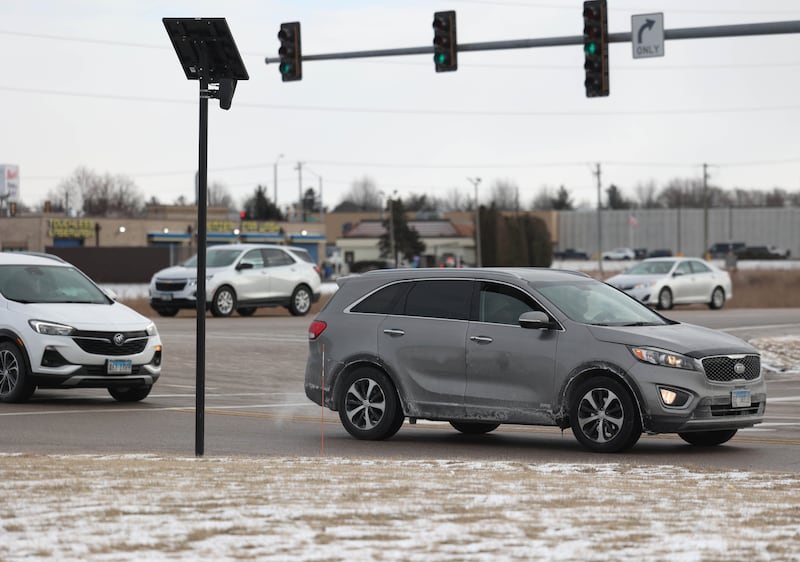
Flock Safety operates the largest automated license plate reader system in the nation. The cameras are not 24-hour surveillance devices; instead, they are activated by motion as vehicles pass and capture images of license plates, registration information and the backs of vehicles.
:quality(70)/cloudfront-us-east-1.images.arcpublishing.com/shawmedia/HOP72LAJHNGUFNNJLY5LOMDHYQ.JPG)
While not technically a surveillance camera, a license plate reader can see more than a car’s license plate. It also allows law enforcement to find out where a vehicle was at a certain time, its direction of travel, and can help identify people in the vehicle.
“The license plate readers can filter; let’s say you put in ‘tan, Chevy,’ or ‘tan passenger car vehicle,’ it’ll give you all the tan vehicles that pass through this license plate reader during that time,” Byrd said. His department has used Genetec, another license plate reader provider, since 2022.
But it goes beyond just a car’s color and license plate: Officials reviewing images collected from license plate readers can often discern a vehicle’s make and model, and other identifying details, such as damage, Byrd said.
Rapid expansion across the region
The number of northern Illinois law enforcement agencies using license plate readers has grown in recent years.
In Will County, the sheriff’s office has 47 Flock cameras installed throughout the county, with plans to add seven more, according to Undersheriff Dan Jungles. Joliet, the largest city in the county, has more than 80 cameras, and Plainfield has 16.
DeKalb has 21 LPRS in nine locations. In McHenry County, Crystal Lake installed nine fixed and three mobile readers in 2023. McHenry installed five cameras beginning in 2022.
“The fixed-location LPRS were strategically installed around the city limits to capture vehicles entering and exiting,” Crystal Lake Deputy Chief Richard Neumann said.
“With the assistance of the LPRS, the Crystal Lake Police Department has been able to locate several missing endangered people and arrest numerous offenders for violent crimes against persons and property crimes,” Neumann said.
Sycamore operates 26 LPRS under a Sycamore Police Department contract with Flock Safety. The city received little pushback when the program was expanded in March 2024.
In La Salle, Bureau and Whiteside counties, Peru and Ottawa police departments both installed Flock cameras in late 2021 and now have 10 or more each. The La Salle Police Department has six cameras in operation for about two and a half years. Mendota installed its first four cameras in 2025. Spring Valley installed three in early 2025 and Sterling installed 16 license plate readers beginning in May.
Success stories
Police departments across the region credit the cameras with solving serious crimes, including a fatal Easter Sunday shooting in Streator, located in La Salle County. Surveillance cameras in downtown Streator captured a Chevy Cruze from which shots were fired, killing 17-year-old Camryn Merritte and injuring two others. The driver was not visible in the footage, and neither survivor cooperated with the police.
However, the Cruze was repeatedly captured on surveillance systems and Flock cameras from Ottawa to Streator to Peoria. Police recovered the vehicle in Peoria, wiped clean. A breakthrough came when a camera at a Clark gas station recorded a masked man emerging from the driver’s seat. Separate footage from inside an Ottawa residence, shot the day of the incident, showed a man wearing identical clothes with a mask lowered below his chin.
The man was identified as 31-year-old Tyler Skerett of Streator. At trial in October, Skerett argued the evidence was entirely circumstantial. A jury disagreed and convicted him of first-degree murder and two counts of attempted murder. He was sentenced in December to 117 years.
Robbery and fraud: In 2024, McHenry County cameras led to the arrest of Tamir Refaie of Burbank. Police said Refaie posed as a ride-share driver and picked up a woman at O’Hare Airport who had just flown in from Germany and asked him to drive her to a hotel in McHenry.
He drove her to McHenry, but before letting her out, intimidated and detained her until she gave him $1,400, according to a criminal complaint. He drove her to an ATM at a bank in McHenry, where she withdrew the money, McHenry police public information officer Ashley O’Herron said at the time.
The woman told police the man drove a black BMW SUV. An officer reviewed Flock footage looking for the SUV the woman described and located a possible suspect vehicle traveling toward McHenry and then driving in the opposite direction about 20 minutes later during the time of the crime. Though the BMW was registered to a woman, further investigation showed she was related to Refaie. Police also learned Refaie was facing similar charges in Cook County.
The woman from Germany identified him in a lineup, and he was arrested. McHenry Police Commander Nicholas Clesen said that without the cameras, there “is no way” they could have identified Refaie.
Missing persons: In November, an elderly McHenry woman with dementia was reported missing. Police received a description of her car, and an officer used the Flock system to search for the vehicle. When he identified it passing one of the cameras, he ran the license plate and confirmed it was their missing person.
The car was captured on cameras driving on Route 31 near Rakow. McHenry police shared the information with Crystal Lake police, who also use Flock readers. The woman was found and safely reunited with her family.
In another case, McHenry officers were alerted by Flock of a stolen vehicle possibly driven by a man wanted by the Matteson Police Department for an alleged stabbing. “Officers quickly located the vehicle, took the suspect into custody and released him into the custody of the Matteson Police Department,” Clesen said.
Other successes: In Woodstock, Flock cameras were instrumental in the quick apprehension of Adilyn R. Monette, 21, of Woodstock, in connection with the Walmart fire on New Year’s Eve. Monette, charged with aggravated arson, is accused of setting baby cribs on fire inside the store, according to the complaint in McHenry County court.
Woodstock cameras also helped locate a man accused of sexual assault in Woodstock after he’d fled to Georgia. The cameras captured his plates and registration as he traveled, and when he arrived in Georgia, he was apprehended and extradited to McHenry County.
Sterling Police Chief Pat Bartel said the cameras there have helped identify vehicles used in two shots-fired incidents, located a felon from Texas wanted for multiple shootings, recovered a kidnapped individual and arrested the perpetrator and recovered three stolen vehicles.
Police defend the technology
Police chiefs across the region defend the technology as an essential investigative tool.
“They provide alerts for vehicles that might be associated with a missing or endangered person or a person who is wanted on a criminal arrest warrant,” Sycamore Police Chief Erik Mahan said. “The cameras have also assisted us in solving crimes, such as helping us to locate vehicles involved in hit-and-run crashes, including one where a police vehicle was stuck head-on.”
Spring Valley Police Chief Adam Curran said three were installed there in early 2025, and they have been instrumental in solving numerous cases. Curran acknowledged the potential for privacy violations but pointed out that the sheer volume of images captured does not readily lend to misuse. He further stated he does not share information with anyone outside law enforcement.
“I think people see the Flock cameras as ‘Big Brother’ looking over them,” he said. “Yes, they take a picture of your plate as you drive past, but honestly, there are so many plates that go by each camera that a single person could never sit down and look at every single plate over and over each and every day – nor do officers want to do that.”
Next: Part 2 examines privacy concerns, national controversies and the debate over whether current safeguards are sufficient.
:quality(70)/author-service-images-prod-us-east-1.publishing.aws.arc.pub/shawmedia/114d2561-d902-4313-913c-3ed613087b49.png)
:quality(70)/s3.amazonaws.com/arc-authors/shawmedia/7a2e8311-fc10-4849-8481-ab8459fa3039.png)
:quality(70)/s3.amazonaws.com/arc-authors/shawmedia/c957a8ff-14a0-492e-82d7-3c005b3cd732.png)
:quality(70)/s3.amazonaws.com/arc-authors/shawmedia/638ad18c-1176-4018-bcef-b5560cf36d58.png)
:quality(70)/s3.amazonaws.com/arc-authors/shawmedia/9bb5f897-be4a-42b8-9507-9193a7f43c2d.png)