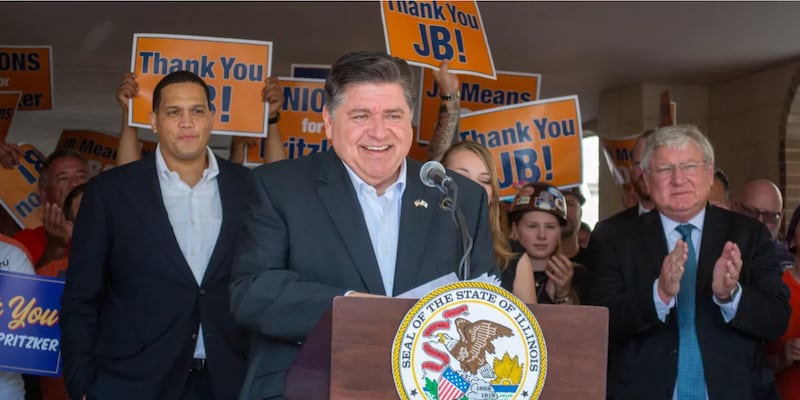
Gov. JB Pritzker is continuing to push a plan he introduced two years ago to reform Illinois pensions.
The governor announced on Monday that he is reviving a plan he introduced during his 2024 budget address that calls for fully funding pensions by 2048 and changing benefits calculations to comply with Social Security requirements. Despite years of negotiations that began even before Pritzker made his pitch, the General Assembly has not moved forward on Pritzker’s or anyone else’s pension reform plans.
The hallmark of the plan calls for fully funding pensions by 2048, rather than reaching 90% funding by 2045 as current state law calls for.
The governor also wants direct surpluses in the state fund that’s dedicated to paying out tax refunds to the pension system, once all refunds are paid to taxpayers. Surpluses in that fund after tax season otherwise go to general fund operations under current law. But Pritzker’s plan would ensure they go to pay pension debt.
Illinois is also working to pay down a series of unrelated bonds by 2030 and 2033. Once those are paid off, Pritzker wants to use the revenues that had been dedicated to bond repayment to pay down pension debt.
Pritzker also wants lawmakers to extend the state’s pension buyout program for another two years through fiscal 2028. The program has already been extended twice since it was created in 2018 and has reduced the state’s pension liability by $2.9 billion, according to the governor’s office. They predict extending the program will reduce the unfunded liability by another $1.4 billion.
The state has also run into problems providing adequate benefits for people who were hired after 2010. The benefits, known as Tier 2, have raised concerns about compliance with Social Security and fairness to public employees. Federal law requires governments to provide benefits that are at least equal to Social Security. If a pension system fails to meet that “Safe Harbor” requirement, courts could force the employer, in this case the state, to make up the difference.
That means whether or not lawmakers take immediate action on Tier 2 reform, added costs are likely on the horizon anyway.
Pritzker’s plan calls for adjusting the pensionable earnings cap to be equal to the Social Security wage base and put Tier 2 in compliance with Social Security requirements. Lawmakers allocated $75 million in this year’s budget to cover costs to help bring benefits into compliance. The state’s pension systems have told lawmakers they aren’t sure of the total cost, however.
Where it stands
It’s not clear what will move forward on pensions during the spring session, if anything. Lawmakers have vetted Pritzker’s proposal, as well as proposals from labor unions, in numerous hearings over several years.
The We Are One coalition, a group of unions asking lawmakers to reform Tier 2 to comply with “Safe Harbor” and make benefits more attractive to workers, said Pritzker’s continued push for his plan ignores “the growing recruitment and retention crisis driven by the inadequate Tier 2 pensions.”
“No pension plan will pass without the support of the public sector unions whose members are most impacted by this system,” the coalition said in a statement. “Our bill would not adversely affect the state’s credit rating, not add to the unfunded liability, and not add significant costs to the state budget – all goals the governor has previously laid out.”
A bill supported by the coalition passed a House committee in October, but lawmakers agreed to continue working on the issue this spring and its fate is unclear. The plan called for lowering the minimum retirement age for many Tier 2 employees, raising the salary cap to equal the Social Security wage base and better cost-of-living adjustments and final average salary calculations for workers.
Pritzker said last fall the bill needs “a lot more work” before it’s ready to go.
State of pensions
Illinois remains a long way off from the 2045 target, but there have been small signs of progress in recent years.
A report from the Commission on Government Forecasting and Accountability in November found the pension systems are collectively funded at 47.8%. That’s increased for four consecutive years from 43.8% in 2021.
The unfunded liability hasn’t changed significantly in recent years. It was $143.5 billion in 2025, which was down by $200 million from 2024. That was the first time it has declined in four years.
Capitol News Illinois is a nonprofit, nonpartisan news service that distributes state government coverage to hundreds of news outlets statewide. It is funded primarily by the Illinois Press Foundation and the Robert R. McCormick Foundation.
:quality(70)/author-service-images-prod-us-east-1.publishing.aws.arc.pub/shawmedia/f831fdce-695a-47fc-8b7b-234f336b1d8a.png)