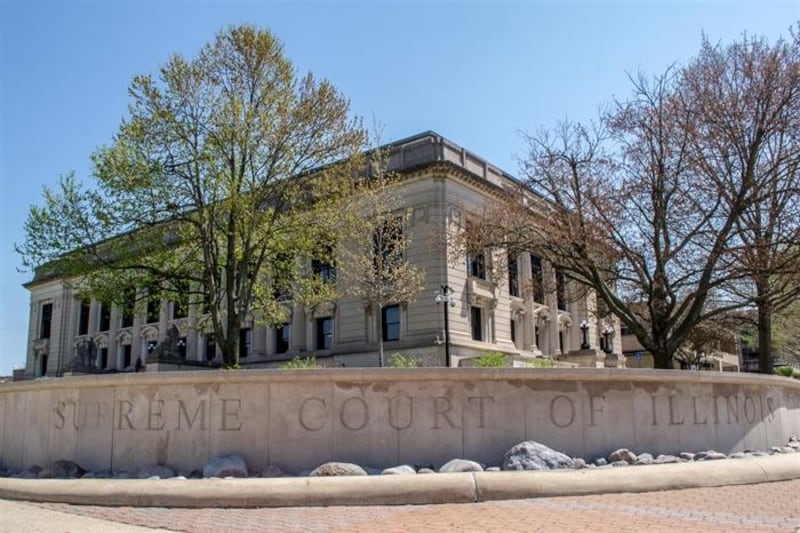
SPRINGFIELD — Developers of a proposed massive transmission line that would bring wind-generated electricity from western Kansas to Illinois and other Midwest states cleared a legal hurdle Friday when the Illinois Supreme Court rejected a challenge to their state permit.
In a 6-0 ruling, the court said Grain Belt Express LLC, also known as GBX, had met its duty under the state’s 2021 Climate and Equitable Jobs Act to show it could finance the project “without significant adverse financial consequences for the utility or its customers.”
The court made that ruling despite a decision by the Trump administration last summer to cancel a $4.9 billion federal loan guarantee that had previously been approved by the Biden administration to finance the first phase of construction of the power line across Kansas and Missouri.
That loan would have been just one part of a complex financing package that also includes private funding from multiple sources.
Friday’s decision reverses a 2024 ruling by the 5th District Court of Appeals, which said the Illinois Commerce Commission erred when it originally granted a permit, known as a “certificate of public convenience and necessity,” To GBX.“Proof of GBX’s current and present financial capability was not a condition precedent to the issuance of the CPCN,” the court said in an opinion written by Justice Mary K. O’Brien. “Instead, evidence of the industry’s method of financing the construction of large-scale energy projects, along with unrefuted evidence that such projects do not generate revenue until regulatory permits are issued and customer contracts are executed, supports the ICC’s decision to issue a CPCN to GBX.”
The project, which has been in the planning stages for years, calls for an 800-mile high-voltage direct current line that would stretch from western Kansas, across Missouri and through nine counties in Illinois, ending in Indiana, where it would connect to the MISO and PJM regional power grids.
In 2018, the Supreme Court overturned an ICC decision to grant a permit to build and operate the Illinois portion of the project, saying the company did not meet what was then the state’s definition of a public utility.
Three years later, state lawmakers addressed that issue with passage of the Climate and Equitable Jobs Act, or CEJA, a far-reaching plan to incentivize development of renewable energy in Illinois, with the goal of transitioning the state to 100% carbon-free electricity by 2045.
That act contained a provision specifically designed for Grain Belt Express that allowed ICC to issue permits to a “qualifying direct current applicant,” which the law defines in a way that specifically describes GBX and its proposed project.
After passage of the bill, GBX reapplied for the permit, which the ICC approved in March 2023.
Illinois Farm Bureau then teamed up with several landowners and opponents of the project to challenge the permit on several grounds, including a provision of the state’s Public Utilities Act that requires applicants to demonstrate they are capable of financing the proposed construction without adversely affecting the utility or its customers.
They also challenged the provision of CEJA that was specifically designed to facilitate the project, arguing it violated the Illinois Constitution’s equal protection and separation of powers clauses as well as its limits on “special legislation.”
Friday’s ruling addressed only the challenge to the statutory financing requirements. It remanded the remaining challenges back to the 5th District Court of Appeals for further consideration.
A GBX spokesperson said after the ruling that the company was pleased with the decision and that it plans to move forward as a privately financed project.
Capitol News Illinois is a nonprofit, nonpartisan news service that distributes state government coverage to hundreds of news outlets statewide. It is funded primarily by the Illinois Press Foundation and the Robert R. McCormick Foundation.