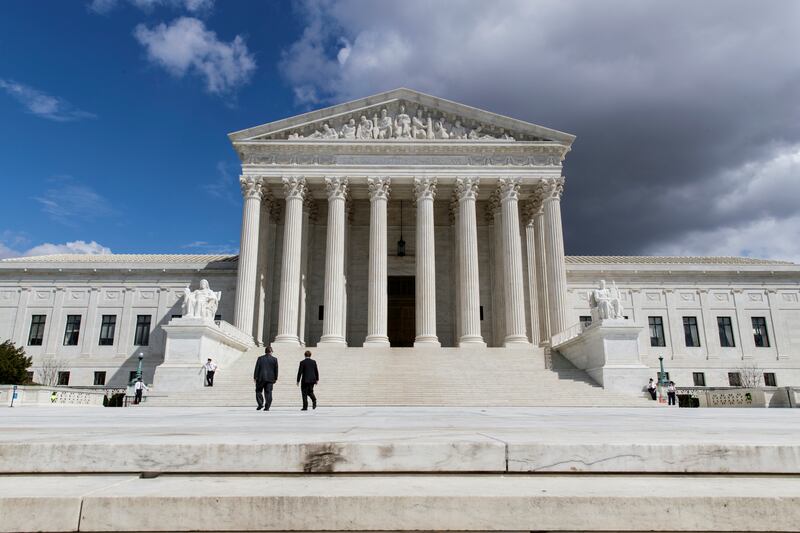
U.S. Rep. Mike Bost’s lawsuit challenging Illinois’ election laws can proceed because he is a candidate for office, the U.S. Supreme Court ruled on Wednesday.
Bost, a Republican from Murphysboro, was challenging a ruling in lower courts that he lacked legal standing to sue the state over its mail-in ballot policy. The nation’s high court ruled 7-2 that the lower courts erred and that Bost has an “obvious” stake in election laws as a candidate.
Bost and a pair of 2020 Illinois primary delegates for President Donald Trump sued the Illinois State Board of Elections in 2022, arguing that the state’s law allowing late-arriving mail-in ballots to be counted up to 14 days after the polls close violates the federal law establishing an “Election Day.” The ballots must be postmarked by Election Day.
The court’s ruling on Wednesday did not weigh in on the merits of Bost’s argument. Rather, it allowed his legal challenge to proceed at the lower level of the federal court system.
The U.S. judicial system typically requires plaintiffs to demonstrate that a law negatively affects them in order to give them standing to challenge it in court. Lower courts, including the 7th Circuit Court of Appeals in a 2-1 decision, ruled Bost was not harmed, largely because he won the 2020 election handily with 60% of the vote.
Chief Justice John Roberts wrote the majority opinion overturning the decision.
“Candidates have a concrete and particularized interest in the rules that govern the counting of votes in their election, regardless whether those rules harm their electoral prospects or increase the cost of their campaigns,” Roberts wrote. “Their interest extends to the integrity of the election – and the democratic process by which they earn or lose the support of the people they seek to represent.”
Bost had also argued he had standing because he faced the financial harm of having to pay staff to monitor ballot counting beyond Election Day.
“We have won this initial battle, but the fight for election integrity continues,” Bost said in a statement.
While Bost’s case heads back to the lower courts, another related case may be settled first. The U.S. Supreme Court has agreed to hear a case challenging Mississippi’s law that allow ballots to be counted for 14 days after Election Day. A ruling on that would likely have implications for Illinois.
Bost’s right to sue
Wednesday’s ruling rejects the state’s argument to the court in October that Illinois’ law regulates voters, rather than candidates. But Roberts, a conservative jurist, wrote Bost has an “obvious” stake in the state’s election laws as a candidate for office.
“The counting of unlawful votes – or discarding of lawful ones – erodes public confidence that the election results reflect the people’s will,” Roberts wrote. “And when public confidence in the election results falters, public confidence in the elected representative follows. To the representative, that loss of legitimacy – or its diminution – is a concrete harm.”
Roberts said elections are like a track race where a runner would be harmed by a rule-change extending the race beyond its original length.
But liberal Justice Ketanji Brown Jackson, who was joined in her dissent by Justice Sonia Sotomayor, wrote that example oversimplifies elections.
“It is far from obvious that a runner with a track record like Bost’s – who expects to win both races based on sound statistical analyses of his current and past performance” would be harmed in a way that requires the courts to get involved in his race, Jackson wrote.
Jackson argued the ruling now means candidates are no longer required to demonstrate how a law harms them in order to challenge it.
Jackson wrote the majority “complicates and destabilizes both our standing law and America’s electoral process” by “carving out a bespoke rule” granting candidate-plaintiffs standing “simply and solely because they are ‘candidates.’”
Conservative Justice Amy Coney Barrett wrote a concurring opinion in favor of Bost and was joined by Justice Elena Kagan. Barrett wrote she disagreed with Roberts that Bost had standing simply because he is a candidate for office but was sympathetic to Bost’s argument that he suffered financial harm from the law.
Both Jackson’s and Barrett’s opinions argue the majority improperly allowed candidates to challenge laws without suffering real harm.
Implications of the ruling
Justices on both sides of the ruling also disagree over how the majority’s ruling will impact the judicial system’s involvement in elections.
Roberts wrote he believes the decision will help courts avoid ruling on the merits of election laws in the immediate aftermath of an election because candidates can challenge the laws earlier in the process, rather than waiting to lose an election.
Jackson said it will have the opposite effect because it “opens the floodgates to exactly the type of troubling election-related litigation the court purportedly wants to avoid.”
She said it will allow candidates who lost their election in a landslide to file lawsuits after the election is over. Though the justices debated in October how the court should decide if any metrics should govern candidates’ standing, Roberts’ ruling did not suggest one.
“All he [any candidate] must do is assert that an election rule somehow deprived him of a fair process – even if that rule played no role in the election’s outcome or otherwise caused him harm,” Jackson wrote.
Capitol News Illinois is a nonprofit, nonpartisan news service that distributes state government coverage to hundreds of news outlets statewide. It is funded primarily by the Illinois Press Foundation and the Robert R. McCormick Foundation.
:quality(70)/author-service-images-prod-us-east-1.publishing.aws.arc.pub/shawmedia/f831fdce-695a-47fc-8b7b-234f336b1d8a.png)