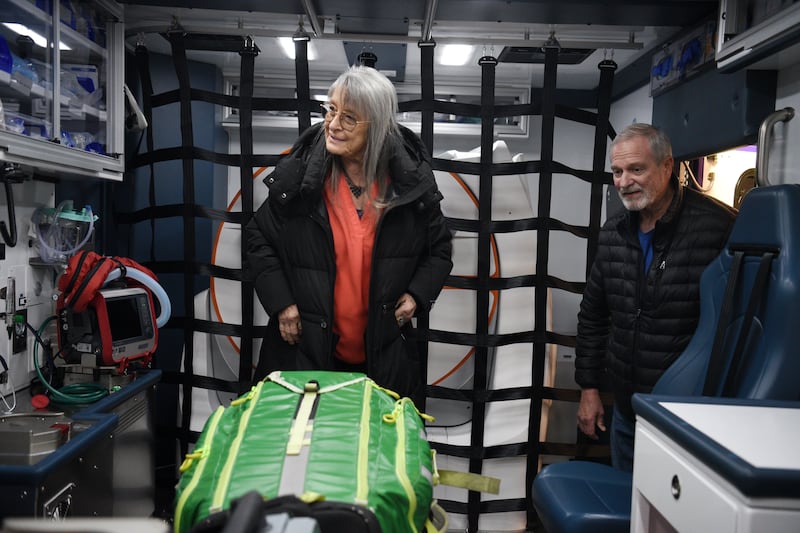
Kathy Baraban was babysitting three of her grandkids, the youngest of them only 2 years old, when she fell to the floor.
“I had lost the grip of the plates in my hand, went to pick them up, put them into the sink, and as I was putting them into the sink, I lost my balance and went down,” she said.
Baraban couldn’t flip over onto her stomach. “I couldn’t move anything,” she said.
More than a month later, you would never know she’s a stroke survivor. Had she not been at her son’s home in Winfield at the time, the outcome could have been very different. Baraban received critical care in a special ambulance from Northwestern Medicine Central DuPage Hospital.
Almost a decade after launching it — the first Mobile Stroke Unit in Illinois — the hospital has rolled out a new, sleeker rig to diagnose and begin treating stroke patients beyond the confines of its emergency department. It’s the only MSU program in the state.
“It’s got all the bells and whistles,” said Dr. Harish Shownkeen, co-medical director of the Mobile Stroke Unit and medical director of stroke and neurovascular medicine at the Winfield hospital. “It’s got a brand new CT scanner that’s 32 slice, so the images are faster. The resolution is so much better.”
:quality(70)/cloudfront-us-east-1.images.arcpublishing.com/shawmedia/WYCSXOEZC5FWTGB3NQ6ASESFMM.jpg)
The original unit had a 16-slice CT scanner.
The unit remains stationary during a CT scan to determine if the patient is having an ischemic stroke, as in Baraban’s case, caused by a blockage in blood flow to the brain, or if it’s hemorrhagic, a bleeding stroke.
“We can treat both types in the field, but more often it’s that ischemic type of stroke,” said critical care nurse Keely Buffo, the manager of the hospital’s stroke program and the Mobile Stroke Unit program.
The time it takes from dispatch to delivering a clot-busting medication in the unit averages 47 minutes, according to Northwestern. That’s approximately 35 minutes faster than the average time it takes from dispatch to administering tPA, or tissue plasminogen activator, in the hospital via a conventional ambulance.
Every one of those minutes is precious.
“Every minute, 2 million neurons are dying,” Shownkeen said.
The new unit — a Northwestern purple compared to the mostly white original — stands out on the road.
“It’s five feet shorter and more than 12,000 pounds lighter, so it’s a less bumpy ride. It’s better maneuverability,” Buffo said. “But really, we’re looking for that decrease in time to treatment.”
:quality(70)/cloudfront-us-east-1.images.arcpublishing.com/shawmedia/ZWR7GEETCNB7HBZB434NPAS2AA.jpg)
‘Time to call’
The unit is staffed by a critical care nurse, a CT technologist, an EMT driver and a critical care paramedic. It’s operating each day from 8 a.m. to 8 p.m., when most strokes happen.
“We go to homes. We go to businesses, people’s workplaces. We go to immediate cares. We go to restaurants. I mean, wherever patients are having strokes, we go,” said Lisa Loyd, a CT technologist who’s been part of the program since its inception in 2017.
The unit can be summoned by 9-1-1 dispatchers to patients within the hospital’s Emergency Medical Services, or EMS, area, encompassing the Carol Stream, Bartlett, Glen Ellyn, Glenside, Hanover Park, Roselle, Warrenville, West Chicago, Wheaton and Winfield fire departments or districts.
EMS personnel from St. Charles, Geneva, Batavia, Elburn, Big Rock, Sugar Grove, South Elgin, North Aurora, Fermilab and Fox River & Countryside also bring patients to preestablished “intercept sites” to meet the Mobile Stroke Unit.
“We’re so lucky in our area to have it. It’s such a big deal for the community to get treated faster, to raise that awareness,” Buffo said. “We do go out a lot to different places and talk about B.E.F.A.S.T., to get people to realize those symptoms — the balance, eyesight, facial droop, arm weakness, speech difficulty — means it’s time to call.”
:quality(70)/cloudfront-us-east-1.images.arcpublishing.com/shawmedia/4AOYXNQJGND5DCNKTZFZ4RUZXQ.jpg)
The mobile stroke crew is dispatched at the same time as the fire department paramedics.
“Typically, they beat us there because we’re coming from the hospital, and that’s good, though,” Buffo said.
It gives them a chance to make sure it really does look like a stroke. “And then they’re able to give us a report and start patient care,” she explained. “Then we arrive, we can assess the patient and take over patient care.”
From Northwestern Medicine, a neurologist and a teleradiologist receive the results of the CT scan, and they support the team remotely via audio and video link. During a video call, the neurologist also “can see the patient, see what symptoms we’re seeing, and then we can decide in that moment if they’re a candidate for treatment,” Buffo said.
“The older ambulance is also wonderful, but it had a jack leveling system, so we had to wait for it to level and warm up. This one self levels, so should be less warm-up time,” Buffo said, adding that the hope is “our data reflects that, and we’re able to treat our patients even faster than we already are — leading to less deficits and disabilities.”
Scott Vaughn drives the rig three days a week.
“Sometimes I see a patient that is awake but nothing else. Can’t move anything. They’re looking off to the side. I get up front, and I drive,” he said. “In the meantime, we’ve given them the clot-busting med. We show up at the hospital, I open up the back doors, and they’re looking at me and talking.”
‘Gives me chills’
During her stroke, Baraban was fortunate that she had been on the phone with her sister and dropped it. Baraban’s 5-year-old grandson, Willie, had the wherewithal to pick it up and started talking to the sister. She in turn called Baraban’s son, who alerted a neighbor and reached 9-1-1.
“It’s hard to explain, like God was watching over us … because if one thing would have changed, it might not have had the ending that I got,” the Oak Forest woman, 72, said.
Loyd was on the call in the original unit on Feb. 21 and found Baraban “had a very profound facial droop.”
They recently reunited at the hospital.
“It gives me chills, just to see how well people recover, when you know they have great outcomes,” Loyd said.
Baraban credits the mobile stroke team and their response.
“They reacted so swiftly and got me to the hospital and got me into surgery,” she said Baraban, who’s back to babysitting every week. “Without that, I don’t feel like I would have made it.”
https://www.dailyherald.com/20260412/news/all-the-bells-and-whistles-hospital-rolls-out-new-ambulance-for-stroke-patients/