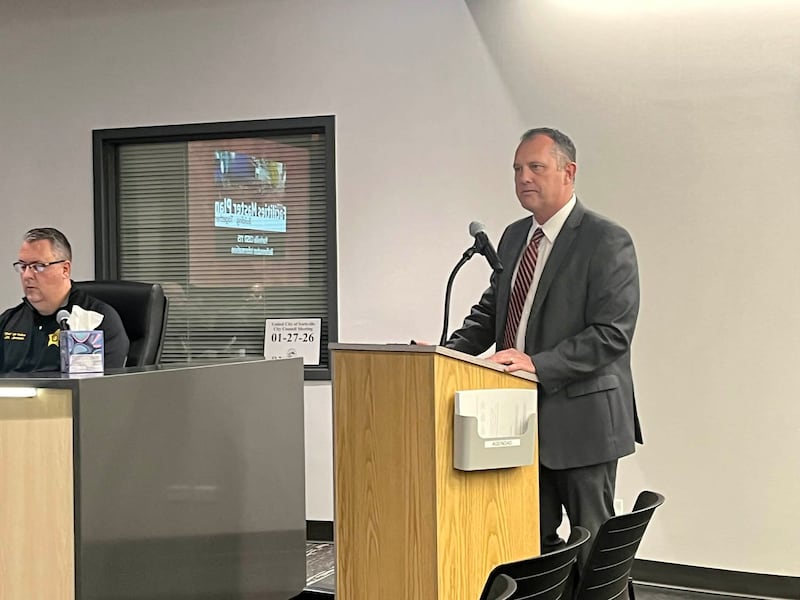
With votes still being tallied, it’s looking like voters are rejecting the $275 million bond proposal from Yorkville School District 115 for new and expanded facilities.
With 21 of 27 precincts counted in Kendall County, 67.55% of voters have voted against compared to just 32.45% voting in favor.
In Kane County, with both precincts in the district reporting, 79 residents voted yes and 76 voted no
Before the election, Yorkville 115 Superintendent Matt Zediker said if the referendum failed, the district would come back with a down-sized proposal on the November general election ballot.
This would most likely mean a similar expansion plan would be on the ballot minus the performing arts center and the athletic field house, lowering the total coast by at least $60 million.
If the new referendum passes in November, students will first be able to use the new buildings in the fall of 2029.
Zediker has said the new and expanded buildings are needed to solve the district’s “unsustainable” overcrowding. Other district officials have said classrooms are currently “bursting at the seams” from booming student enrollment growth that has far outpaced the community’s investment in new classroom space.
The March 17 referendum included a plan to combine $20 million in the district’s reserves to construct a new middle school and a new elementary school.
A new academic wing is listed for the high school, enabling all the students at the Freshman Academy to be moved into the one main high school building. The plan also converts a current elementary school into an early childhood center.
What could have been a factor for voters is the district could soon be the recipient of $68,250,000 from the city in funds collected from up-front payments from the developers of the Project Cardinal data center and the Project Steel data center.
The money is still subject to full final approval on both projects.
Zediker said the funds will “drastically reduce” the tax burden on homeowners and property owners.
For residents without students in the district, Zediker said the increased property values for everybody in the community is always a nice bonus.
Trying to solve the classroom capacity crisis
Enrollment has tripled in the past 20 years, with another 800 students expected to be added to the already squeezed classrooms, according to the district’s demographer.
“Classes are being taught in hallways and other programming is taking place in inadequate spaces,” Zediker said during the State of the District last September. “We have special ed classes held in math classrooms that don’t have proper accessibility to bathrooms. We’re not able to offer all the extracurricular activities our kids and families want.”
To help accommodate the classroom capacity crisis, the district spent $3.9 million for temporary classroom structures outside four elementary schools.
School district officials have even gone before the City Council to oppose new residential developments to help slow the rate of student enrollment growth.
“We simply do not have the resources to invest in our infrastructure to make the necessary upgrades to overcome our overcrowding challenges,” Zediker said during a City Council meeting. “It is beginning to hamper the ability for us to provide the education opportunities and experiences that our kids and families deserve.”
:quality(70)/s3.amazonaws.com/arc-authors/shawmedia/0cef0bf9-a04e-4bb4-aea0-03d8ced01c00.jpg)