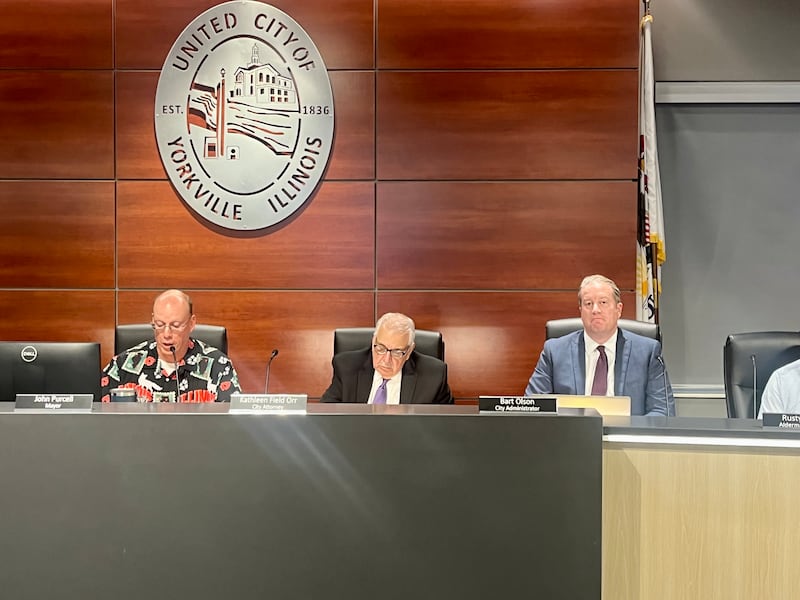
As city officials have sought to bring multiple data centers to Yorkville, several residents opposed to the warehouses “literally in [their] backyards” have been asking why Yorkville.
The quick answer is the city’s proximity to the ComEd transmission station line along the Eldamain Corridor makes the area attractive to those developers.
From a closer policy perspective, city administrator Bart Olson said the city’s pursuit of the developments underscores rapid changes within the city over the past decade. As the city’s population has grown, commercial tax revenues lagged behind residential, he said.
Olson provided equalized assessed value figures for the city during the Feb. 10 City Council meeting. He said the tax burden has been shifting from commercial and industrial to residential, “Which isn’t good, that’s not something we want.”
:quality(70)/cloudfront-us-east-1.images.arcpublishing.com/shawmedia/FPW3FT353JAC5ITDUZ3K3WUT3A.jpg)
The EAV is typically one third of a fair market value on a property. That value is then applied to the local tax rates set by local taxing bodies to determine a property owner’s tax bill.
The developers of the 502-acre, 18 building Project Steel data center told the city each one of their buildings will be worth about $26 million in taxable value.
“If [Project Steel] builds out the entire property over 15 years, they anticipate a total EAV of around $468 million,” Olson said.
Since he started working with the city, Olson said the residents’ concerns of high taxes have been a constant narrative. He said easing the tax burden on residential through the addition of data centers should be a net positive for the city.
Several residents attending the meeting disagreed with his assessment.
One resident demanded the city prove that residential property values of homes located near the data centers will not decline.
Another resident said the city should not move forward with any data center plans until independent health and environmental studies are conducted.
Former alderman Joe Besco said he will likely sell his property and move from Yorkville if the city becomes just a wave of data centers.
“I’m totally 100% against the data centers,” Besco said during the meeting. “From the research I’ve done, I see no other benefit other than dollars. Are we going to sell our souls for a dollar? I’m very concerned about what’s happening to our city.”
Expanding nonresidential tax base
In 2015, the total EAV of the city was 76.2% residential and 20.1% commercial and by 2024, that shifted to 87.2% residential and just 10.2% commercial, Olson said.
Across that same period, EAV from industrial declined from 3.1% the total to just 1.9%.
With every 1% swing from commercial to residential values, there is an extra $50-100 tax burden on the average homeowner annually, he said.
“What this means is homeowners are taking more of the property tax burden, for [the city], for the school district, for any other governmental entities that have property taxes at a rate that exceeds what I’ve seen with growth in utility building or new construction,” Olson said during the meeting.
He said home values in the area are appreciating faster than industrial and commercial property.
:quality(70)/cloudfront-us-east-1.images.arcpublishing.com/shawmedia/FO2XBNK6TFAXBPZUVEKXBOA4GQ.png)
The city has had limited success with developing commercial properties, and minimal success with industrial properties, Olson said.
Olson previously said each data center warehouse could generate between $500,000 and $1 million annually in taxes.
A cumulative noise effect
During a previous meeting, several residents asked the city why none of the sound pollution studies factored in the cumulative noise levels of so many data center projects close together.
The city required independent data center developers to only study their individual project to ensure the noise level was not in violation of the city’s noise ordinance.
The studies did not measure construction noise pollution, but the city said it will be monitored.
During his presentation Feb. 10, Olson said the city is looking into its sound engineers conducting a study with cumulative noise figures for Project Steel, Project Cardinal, the Meyer data center and the CyrusOne data center.
He said the city also is requiring the data centers to monitor for three years after operation date to prove they are not violating the city’s noise ordinance.
:quality(70)/s3.amazonaws.com/arc-authors/shawmedia/0cef0bf9-a04e-4bb4-aea0-03d8ced01c00.jpg)