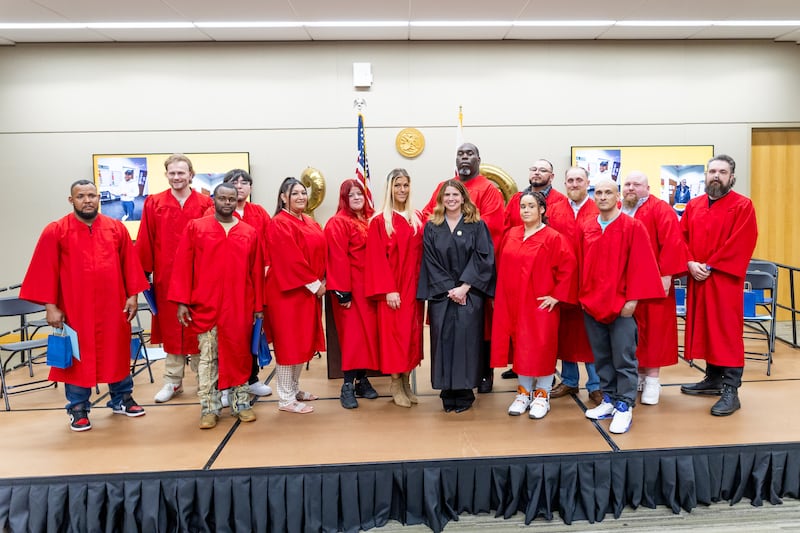
The 15 gathered outside the Kane County Branch Court in St. Charles, a cool spring breeze billowing their bright scarlet graduation gowns.
Family and friends arrived. The parking lot filled up. The doors opened.
More than 200 people filled the courtroom as the graduates stood on a small stage – parents, grandparents, cousins, spouses, children and grandchildren, aunties, uncles, cousins, brothers, sisters, friends, black-robed judges, police officers in uniform, court personnel, State’s Attorney Jamie Mosser.
This was the 26th Drug Rehabilitation Court graduation on April 29 and everyone – literally everyone – was at the party.
“Every single person on this stage chose this path,” said Associate Judge Christine Downs, who presides over the Drug Rehabilitation Court. “And for many of them, it was a harder path than if they’d simply gone to prison.”
Treatment courts reduce crime through a highly structured combination of treatment and intensive supervision, Downs said.
Eventually, the goal is to lead participants to a sober, law-abiding life.
“They admit guilt. They are ordered to pay restitution and are sentenced to the most intensive probation available,” Downs said. “And they have to choose it. No one can be sentenced to treatment court unless they consent, unless they want it.”
While on probation, they must complete all recommendations for substance use disorder and any other treatment recommendations, such as mental health, substance use disorder, anger management and trauma treatment, Downs said.
“They have to go to school, work or volunteer, pay fines, costs and restitution ... (do) community service,” Downs said. “They may have people they have to stay away from, places they’re not allowed to go back to. Whole communities they have to avoid.”
Participants also have three random drug tests per week.
“Imagine every single morning, no matter what your plans are – you have a 7 o’clock dentist appointment, you want to take your kids somewhere – you get a text message that says, ‘Drop everything, got to come to the courthouse for a drug test,’” Downs said. “A lot of these folks have driver’s licenses now, but they didn’t at the beginning. They had to navigate bus systems, train schedules, Ubers. They had to have daily contact with their probation officer at the beginning, and attend group events to learn sober socialization.”
It is all made possible by an interdisciplinary team of lawyers, treatment providers, law enforcement, forensic psychologists and court staff.
“For many, they may have nothing when they come into the program,” Downs said. “No home, no one who actually has their best interest at heart. They may need to get rid of every friend they have and not return to the area they’ve lived their whole lives. They have to change their people, places and routines in order to make real and lasting change.”
:quality(70)/cloudfront-us-east-1.images.arcpublishing.com/shawmedia/4OQYJQGWRZA67HNC5PPJTOF3EA.jpg)
One of the graduates, Marcus B. – as drug court graduates are not identified by last names – spoke of using marijuana, alcohol, pills and cocaine during a tragic time in his life.
“My grandma passed away ... my heart was heavy,” Marcus said, his voice breaking with emotion. “I felt abandoned ... She raised me. I never got a chance to make her proud of me.”
Marcus spoke of a searing hopelessness.
“I was homeless, living in a tent. ... Some nights, it was so cold, I couldn’t even cry, as though my tears was frozen,” Marcus said. “I asked God to help me, to let me go be by my mom and dad and both my grandmas. I was at the point of giving up on life.”
Marcus credited Lighthouse Recovery with providing treatment for substance abuse.
“One day, my big bro ... saw my face, tired and beat down by life,” Marcus said. “He prayed with me, and said, ‘You got this. Don’t give up.’”
Marcus thanked everyone who supported his journey to graduation.
“I can’t thank you all enough for what you all have done for me ... You are all like family to me,” Marcus said. “The journey continues as I’m looking forward to becoming a counselor and giving back to what was given to me.”
Graduate Eva S. also spoke.
“I came into drug court with my life completely out of control,” Eva said. “I was struggling with heroin, facing multiple felony charges – including aggravated battery to a police officer and another aggravated battery charge. I was chasing a high and losing myself in the process.”
She was also dealing with grief, which included losing her best friend to murder.
“I had a born-again experience that changed the way I saw myself,” Eva said. “It made me stop and really look at my life. ... Recovery was not easy. There were days I felt like I was rebuilding my life from scattered pieces and not knowing what it would look like in the end. What I lost in my past, I rebuilt in my future.”
After the program, the father of Hayden H., said this graduation “means a whole new life for my son.”
“He was on a path that was just spiraling downward and we always thought he hit rock bottom,” Hayden’s father said. “This program just made him succeed. It held him accountable and he’s better for it.”
:quality(70)/s3.amazonaws.com/arc-authors/shawmedia/60b440fb-de03-49ae-806d-b8b5464dcba0.jpeg)