Remember Flash? The dog rescued from a frozen pond Dec. 15 in St. Charles Township who now has a forever home in Woodstock?
Flash is actually a malamute, not a husky as originally described – a slightly bigger dog, but with similar coloring and features.
Fox River and Countryside Fire/Rescue District pulled him from an icy pond in sub-zero weather, after neighbors in the Crane Road Estates subdivision heard his frantic barking.
Dr. Joseph Lupo, a veterinarian with the Dundee Animal Hospital of Elgin, described how the team saved Flash’s life that cold, cold morning.
“At 7:50 a.m., we got a call on the emergency line that ... a dog was in a frozen lake for about an hour,” Lupo said.
“My certified vet technician said, ‘Come in right away.’ When we took the call, we were all hands on deck. The entire support staff were ready for this emergency.”
They had no idea of the dog’s breed, Lupo said, the only history provided was that he had been in a frigid pond for about an hour.
:quality(70)/cloudfront-us-east-1.images.arcpublishing.com/shawmedia/SAZRVUGRARF4NCNZK6CDQ3BF2E.jpg)
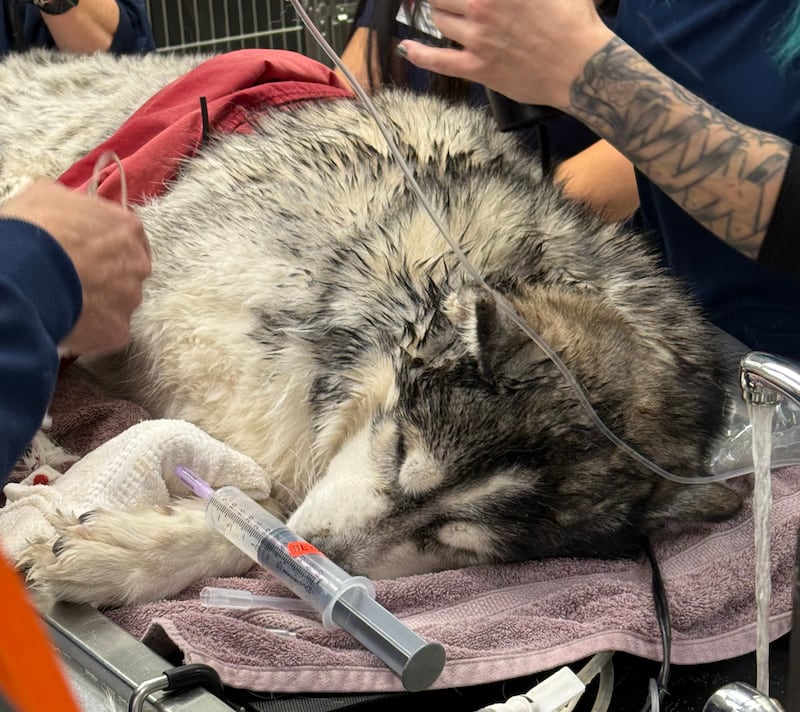
“When we have a hypothermic dog or low-body temperature dog, we have to prepare a lot of warming types of procedures,” Lupo said. “Warm fluids. Warm water enemas. We have to get oxygen ready. We have to get an intravenous catheter ready ... to get access to a vein.”
The IV was also to facilitate medications to try to get the dog out of shock.
And then Flash arrived: 100 pounds of soaking wet, frozen, Alaskan malamute.
“The fire department rushed the pet through the front door right into the [emergency] treatment area and immediately handed this pet off to us and we took over,” Lupo said.
Flash was in hypothermic shock.
“Essentially, he was frozen,” Lupo said.
“His body temperature was under 90 degrees, which cannot withstand life whatsoever,” Lupo said, as normal for a dog is 99 to 102 degrees. “My entire team came together incredibly, and we all were able to do this within a few seconds.”
Once Lupo identified the extent of Flash’s injuries, the team began re-warming him.
Every technician worked on blow-drying his coat.
:quality(70)/cloudfront-us-east-1.images.arcpublishing.com/shawmedia/AAHVGJSPIZHCDDYKGEQ432NUBA.jpg)
They gave him oxygen. They located a vein to get intravenous access. They started him on warm fluids, including a medication with concentrated salt water to help reduce brain swelling.
They also gave him sugar because his constant shivering from the cold used up all of his energy reserves.
The team began warm water enemas to slowly warm up Flash’s internal organs.
“The big thing is, when he was in shock, all of his blood vessels stopped pumping to non-vital organs,” Lupo said. “We then had to replenish fluid through his vein to kind of open up those blood vessels because of this type of shock he had ... is life-threatening to dogs and cats.”
The malamute’s coat is what kept him alive.
“His coat was so thick, it essentially acts as a waterproof coat,” Lupo said. “If this was any other breed, that breed would have succumbed to his injuries. Him being a malamute absolutely saved his life.”
Ice had formed around his back end and private parts as they began slowly warming him up, Lupo said.
“Once we started to get his body temperature from about 90 degrees to about 95 degrees, he had some signs of life,” Lupo said. “He started to blink his eyes. He started to lift up his head. And then when he got to 97 degrees, he became a malamute and started howling. It was wonderful.”
After 90 minutes, Flash showed all the neurological signs of maintaining a proper body temperature.
The cost for emergency services was $1,200. A good Samaritan stepped up and paid it, Lupo said.
“That is just another positive community experience,” Lupo said. “And that’s why this community is a wonderful place.”
Once Flash was stabilized, he went to Animal House Shelter in Huntley. Then he was adopted.
While a vet clinic can never be prepared for every possible emergency, with ongoing training, veterinarians and support staff can handle just about anything that comes through the door, he said.
“Why this was such a successful outcome was because of the staff. And the diligent work, the empathetic work for those hours is why this went so well,” Lupo said.
Veterinarians require 40 hours of additional training every two years to maintain their licenses, Lupo said.
That, plus continuing education videos for the staff resulted in a great outcome for Flash.
“It could have gone very poorly,” Lupo said. “The big thing why this outcome was positive was the breed, the quick firefighter response and all of our preparation here. If any of those were off-kilter, this pet would have perished.”
:quality(70)/s3.amazonaws.com/arc-authors/shawmedia/60b440fb-de03-49ae-806d-b8b5464dcba0.jpeg)