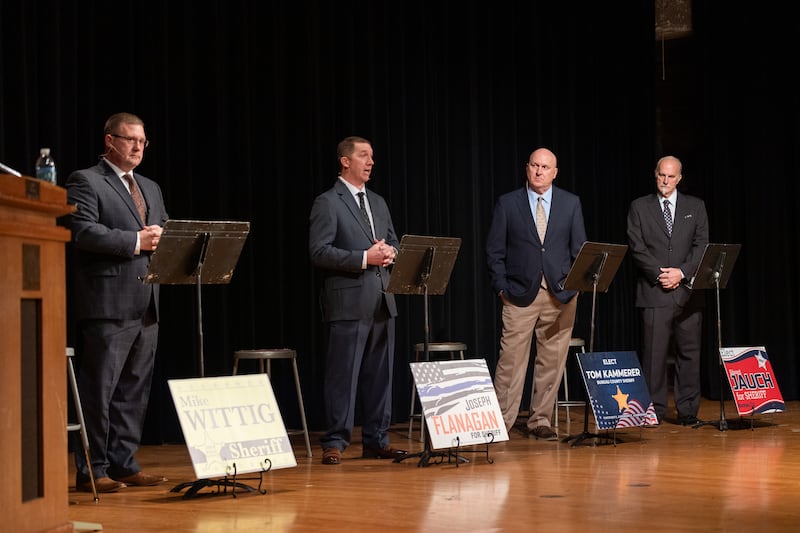
The four Bureau County Sheriff’s candidates made their case for why they’re best fit for the role on Tuesday night in Princeton. After the March 17 primary, only two will remain for the November General Election.
With over 100 Bureau County residents in attendance at Princeton High School’s auditorium, each candidate a set of questions ranging from immigration enforcement and the SAFE-T Act to drug enforcement and mental health services.
Mike Wittig
Wittig opened by talking about his background as a Princeton native and time in the military.
“I started my career in public service in 1997 when I joined the U.S. Army,” Wittig said. “All along the way, this has been a lifelong goal of mine to be able give back and serve the community of Bureau County.”
Wittig currently works with the Sheriff’s office, and made it a point of emphasis that deputies should strive to work well with the community to address mental health issues, and how mental health issues are at the core of any community’s drug and crime issues.
“That is probably the predominant call that we as deputies handle,” he said. “It’s not the burglaries. It’s not the drug cartels. It’s the mental health calls and what they eventually lead to.”
He said he would look to strengthen partnerships with local organizations that advocate for mental health awareness while being open to residents.
“We need to build that transparent, forward-facing interaction with our community so taxpayers understand what we’re doing and why,” Wittig said.
:quality(70)/cloudfront-us-east-1.images.arcpublishing.com/shawmedia/R7344QH7RFHQRLFHLHFOFCQM4M.jpeg)
Joe Flanagan
When speaking about his background and why he makes the most sense for the role, Flanagan pointed to his 17 years with the sheriff’s office and his ability to lead the younger deputies.
“I’m a field training officer. I’ve trained a lot of the current deputies that are there,” Flanagan said.
He also noted his experience running the LaMoille Police Department as its sole officer.
As he first brought up in the last community forum, Flanagan was critical of the SAFE-T Act and laws coming from Springfield.
He said if he gets a chance to be Sheriff, a top priority would be to unite with other sheriff’s offices in the state to push back on some of the legislation.
“It took our teeth away,” he said. “We go out, we arrest people for committing a crime, and they’re right back out on the streets. That’s frustrating not only for law enforcement, but for the victims who expect some level of accountability. When people see the same offenders back in their neighborhoods within hours, it makes them question whether the system is really working to protect them.”
In the next five to 10 years, Flanagan said staffing and community presence would also be prioritized.
“The more staff we have, the more involved that we can be within your communities,” he said. “I’m also a big promoter of having school resource officers within the schools.”
:quality(70)/cloudfront-us-east-1.images.arcpublishing.com/shawmedia/TP6IGTT4ENEMVMCB7S2ZH6Q3GQ.jpeg)
Tom Kammerer
A familiar face as the police chief of Princeton, Kammerer didn’t have to explain much about his background.
“For the last eight years, I’ve been leading the Princeton Police Department,” Kammerer said. “To be an effective sheriff, you need to have leadership experience and know the community you’re policing.”
He emphasized that his experience isn’t just supervisory, but administrative and operational at the same time.
“I manage budgets. I handle personnel issues. I deal with policy development and discipline,” Kammerer said. “The sheriff’s job is not just about making arrests - it’s really about running an organization.”
Building a local network over the years as chief, Kammerer also pointed to collaboration as something that separates him.
“I’ve built relationships with other chiefs, with county officials, with community organizations,” he said. “You can’t do this job in a silo. The sheriff has to work with everybody.”
“It’s not just other law enforcement or officials, I’ve given my cell phone number out to everyone who asks in this community because I want them to be able to reach out to me. That was intentional and it wouldn’t stop if I was sheriff.”
He said his focus would be on steady leadership and accountability.
“My goal is to bring consistency, professionalism and transparency to the office,” Kammerer said. “At the end of the day, the sheriff works for the people of Bureau County.”
:quality(70)/cloudfront-us-east-1.images.arcpublishing.com/shawmedia/TK4MND33V5EDHNOUKMIAJXTAYQ.jpeg)
Edward Jauch
Jauch emphasized his 35 years of law enforcement experience, starting as a correctional officer to eventually doing work with the FBI.
“I have worked everything from retail theft all the way up to numerous homicide cases,” Jauch said. “I am a state-certified lead homicide investigator.”
When asked his priorities for Bureau County if he took over, Jauch said narcotics enforcement and community involvement should be a primary focus because it influences everything.
“Most other crimes, like the burglaries we see, it’s often because that person is addicted to a drug,” he said. “If we attack it at the core problem, I think a lot of the other crimes go away.”
Jauch also pointed to reviving the Bureau County Sheriff’s Posse as an example of how he would strengthen community involvement.
“I’d like to bring back the Bureau County Posse,” Jauch said. “That’s a volunteer group that can assist with events, searches and emergencies. But really it just gives people in the community a way to be involved and support the sheriff’s office.”
He said restoring the posse would expand manpower during large-scale incidents while also rebuilding trust and visibility between deputies and residents.
:quality(70)/cloudfront-us-east-1.images.arcpublishing.com/shawmedia/YA6PK6LBUBBR7MURK5XM7CVZOE.jpeg)