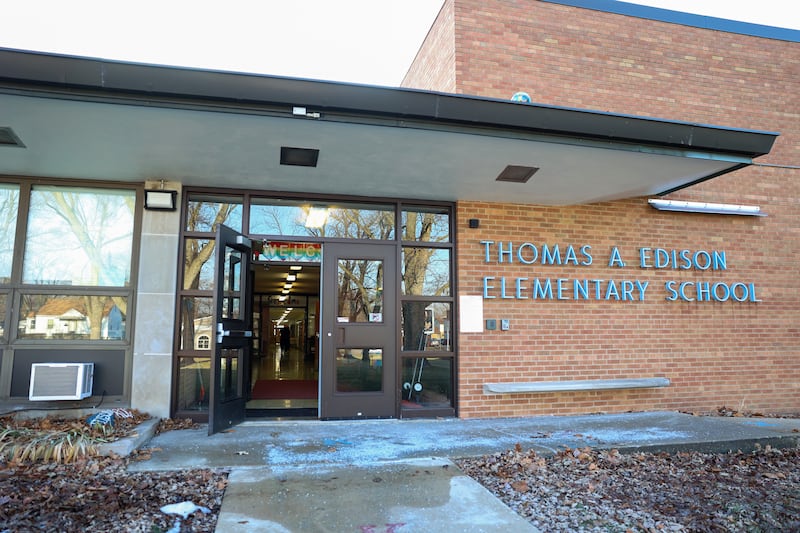
A few options have been pinned down for what to do with Edison Primary School, which was closed at the end of December due to structural issues.
The options for the Kankakee School District facility include repairing and updating infrastructure only, fully remodeling the building or demolishing it.
These three options and estimated costs were discussed during a Kankakee School Board finance committee meeting Thursday.
The 70-year-old school at 1991 E. Maple St., which had been home to 185 students in kindergarten through third grades, was vacated during winter break after an architectural assessment deemed its 1958 addition was unsafe for occupancy.
The vote to temporarily close the building happened at a Dec. 30 emergency board meeting.
At that time, the board already initiated a series of public hearings to gather feedback regarding the proposed closure of Edison by the end of the school year. The results of the Dec. 22 architectural assessment pushed the decision up sooner than expected.
After all three public hearings were completed, a requirement of state statute, the board passed a resolution Jan. 12 to permanently close Edison as of June 2, 2026.
Final engineering report
Harrison Neal, assistant superintendent of business services, said the district received a final engineering report after asbestos abatement was completed in the most structurally damaged areas of the 1958 addition.
The report indicated that the building is not in immediate danger of collapse; however, a seismic event or a strong enough windstorm could cause a collapse.
“In the main classroom that had the problem, which was that Room 119, we did see exactly what we thought we were going to see, which was we saw the tresses pulling away from the walls and the walls pulling away from the foundation,” Neal said.
“The good news is it’s not imminently going to collapse. It’s going to hold steady while we make a decision what to do.”
The report found additional problems with the building’s foundation, which were contributing to the issue of floor sloping in some classrooms, Neal said.
Looking deeper into the tunnel beneath the building, it appeared some modifications might have been made during construction which were not part of the building’s original plans.
“It’s looking to [the engineers] like some things were modified from the blueprints on site to make them fit, and so as things settled, that didn’t help,” Neal said.
“That goes back 70 years; obviously we’re not going to go looking for anybody, but that’s just something that very well could have been a part of this.”
Bill Draper, director of maintenance, said the district “did the right thing” by closing the building.
“Right now, it’s stable,” Draper said. “It’s not going anywhere now, but it could, and we don’t know exactly when that could happen. For now we are OK.
“We didn’t want to do it at that time, but we had to.”
Building options
Repairing and updating only the infrastructure of the building would cost roughly $7 million.
Stabilization and retrofitting are estimated at $600,000, and infrastructure and mechanical updates would cost an estimated $6.5 million.
Another option is to fully remodel the building. With this option, the infrastructure updates would still be needed, plus additional costs for bringing the facility in line with contemporary educational standards.
This would add millions of dollars and potentially double the total cost.
The cheapest option is demolition. This would cost an estimated $220,000 for abatement and $285,000 for the demolition, for a total of $505,000.
What’s next?
The Regional Office of Education has issued a Do Not Occupy order for the building, Neal said.
Personnel are only allowed to enter the building for repair, renovation or demolition.
At the state level, the building is set to be decommissioned as of July 1.
Board President Chris Bohlen noted that the district has begun the process of a comprehensive boundary, enrollment and capacity study.
In November, the board approved a contract with MGT Consulting Group to evaluate the district’s enrollment patterns, school boundary configurations and facility use.
“It’s clear to me at least the wing that has the problem has to be demolished, and if we have no other use for it, it ought to all be demolished, in my opinion,” Bohlen said. “But I want to make sure we have this study done and reported back before we make the decision.”
Superintendent Teresa Lance said the consultants are slated to present their findings in April.
“What we know to be true is that we have an aging population and not new births,” Lance said.
Neal said the board can resume the discussion in May or June after the enrollment study is complete. The decision doesn’t need to be made immediately, but he said he wanted to make sure the options were known.
Neal said the district has the capacity for about 6,000 students, and it currently has about 4,300 to 4,400 students.
Statewide, the trend seems to be that people are having fewer children, and therefore school enrollments are declining, he said.
If enrollment trends shift in the future, the district could potentially rebuild a school on the former Edison site, he noted.
“The fact that we were able to close a building midyear and relocate all of our staff and students without a major shift or taking on another facility ... says we have the room for the people we have,” Neal said.
When Edison closed, staff and students moved into King Middle School and Steuben Elementary School.
“Our intent from the beginning was to downsize in terms of building utilization anyway,” Lance said.