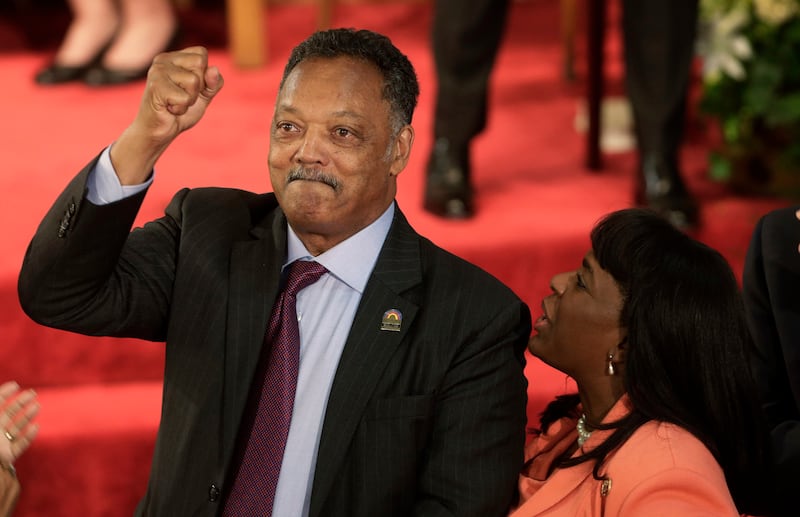
Leaders from across northern Illinois this week are mourning the loss of the late Rev. Jesse Jackson, a Civil Rights activist lauded by many for his servant leadership akin to the Rev. Dr. Martin Luther King Jr.
Jackson died Feb. 17 at his Chicago home surrounded by family who confirmed that he had been diagnosed with a rare neurological disorder, multiple reports show. He was 84.
DeKalb 5th Ward Alderman Andre Powell said Jackson will be missed.
“We lost a leader, and we’ve lost one that’s carried generations of courage,” Powell said. “He’s built a blueprint, and I believe that it’ll be carried on.”
Jackson leaves a legacy marked by his steadfast commitment to civil rights, having founded Operation PUSH, originally named People United to Save Humanity, on Chicago’s south side in 1971.
Kevin Brown, a lead community organizer for Working Family Solidarity in Chicago, said it was a tragic loss.
“Brother Jesse Jackson has been a formidable staple in the Black community, as well as, in my personal opinion, a huge reason for some of the affluential individuals that have stepped into political elected office spaces because of some of the pioneering he did back in the ’70s and ’80s,” Brown said.
In a statement, Illinois Attorney General Kwame Raoul said the words of Jackson have long moved him.
“Rev. Jackson had an impact on my life since I was a young boy, growing up a block away from PUSH headquarters,” Raoul said in a news release. “The words ‘I am somebody!’ resonated with me, giving hope of what I may one day achieve by way of service to others. As I raised my kids a block away from the PUSH headquarters, I brought them to PUSH when they were young to hear the same words.”
Raoul said Jackson pushed him to rethink the way he demonstrates leadership.
“He was always a strong advocate for Haiti and challenged me to be the same,” Roul said. “He never hesitated to call to challenge me, unapologetically, to do better in my service to others. I am a better public servant because of Rev. Jesse Jackson.”
Many likened Jackson to a protege of King. Jackson was with King on April 4, 1968, the day he was assassinated.
Powell gave Jackson his kudos, saying he’s earned his peace.
“I hope his work is remembered,” Powell said. “Even in the role I serve in the community and being an African American male in politics, he paved the way for many of us and for our voices to be heard. ... I hope that’s remembered for it and I hope that it’s carried on.”
In a statement, Alexandra Sossa, bilingual chief executive officer for the Farmworker and Landscaper Advocacy Project (FLAP) in Chicago, said she remembers Jackson always joining FLAP in uplifting workers in the food supply chain, as a longtime champion for low-wage farmworkers and rural communities.
“... Reverend Jesse emphasized that dignity on the job is inseparable from civil rights, advocating for fair wages and safe working conditions for those who feed us,” Sossa said in a statement. “FLAP will continue with his legacy improving working conditions and opportunities, free of charge, for low-wage workers and their households in the cannery, farming, greenhouse, landscaping, meat, nursery, packinghouse, poultry, restaurants, and snow plowing industries through advocacy, community outreach and education, economic mobility and empowerment, health, legal services and community legal education.”
When asked if he feels there’s a void to be filled in Jackson’s absence, Northern Illinois University history professor Stanley Arnold said no.
“He created a template, a blueprint for organizing, communicating, articulating needs and demands to the political sphere,” Arnold said. “And obviously, he was a candidate for president several times and certainly, you know, that has to be taken into account.”
Jackson twice ran unsuccessfully for president.
His legacy was complicated by a share of criticism from both within and outside the Black community. Some believed that Jackson was a grandstander, too eager for the spotlight, The Associated Press reported.
A staunch advocate for the poor and underrepresented, Jackson stood for making the U.S. a more equitable society, calling for voting rights, job opportunities, education and health care.
In a statement, Illinois Secretary of State Alexi Giannoulias expressed his admiration for Jackson and the legacy he had.
“His legacy reminds us that progress is possible when we speak truth to power and stand up for what’s right,” Giannoulias said in a news release. “As we mourn his passing, we honor his unwavering commitment and many years of service advocating for civil rights and social justice, and we recommit ourselves to continuing that fight.
DeKalb 7th Ward Alderman John Walker expressed some optimism about the fight for equality in the nation.
“It’s always a little void right now, but we have so many up-and-coming African American males and females these days that I don’t think we’ll lose too much steam,” Walker said. “We’re going to keep fighting for what needs to be fought for.”
Jackson’s life and legacy will be remembered at several services in the coming weeks, multiple reports show.
Brown said he believes Jackson’s impact will continue to be felt by many long after his death.
“There are already groups, like ourselves, organizing because they’re trying to emphasize the things that he’s been pushing for years and years and years, trying to emphasize the importance of why now is the reason to fight more,” Brown said. “It’s the reason to fight harder. It’s the reason to join the fight, if you haven’t already been in the fight. And that alone, that’s going to carry for generations long after he’s been gone.”
:quality(70)/author-service-images-prod-us-east-1.publishing.aws.arc.pub/shawmedia/670e1b81-921a-4140-9c50-69b66cad217c.jpg)