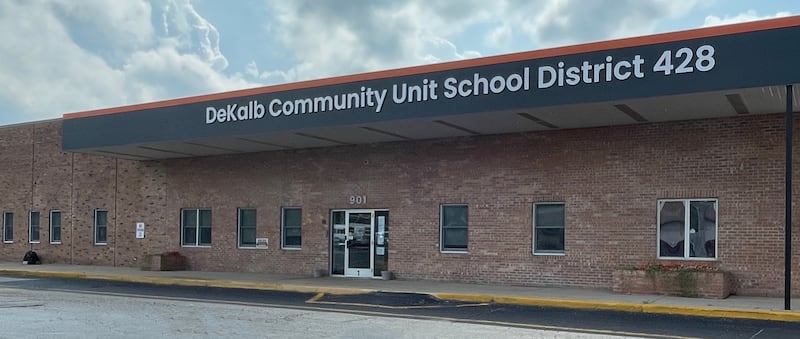
When local homeowners get their tax bills in 2026, they could find themselves owing about $350 more to DeKalb School District 428.
At a recent public meeting, officials for DeKalb schools were briefed on the district’s tax levy options for 2025.
A tax levy is a tool that units of government use to calculate how much homeowners will pay in property taxes for the next year.
The mechanism takes into consideration several factors. They include existing property growth and the Property Tax Extension Limitation Law (PTELL). The latter is a tax cap limiting the amount by which schools can levy to increase by the Consumer Price Index (CPI), or the rate of inflation, or 5%, whichever is less, plus any new construction.
On Dec. 16, the district invites the public to take part in a public hearing on the tax levy. At that time, residents may come with questions and comments.
For tax year 2025, the district is working under the assumption that CPI is 2.9%. In addition, there is $272.7 million in total new construction and about $2 million in total equalized assessed valuation.
Officials said they anticipate the tax rate remaining flat over the prior year.
Armir Doka, the district’s director of business and finance, said the numbers may change between now and March 2026 as the county assessor needs to finalize the assessment base.
District staff has prepared a series of tax levy scenarios, and with it comes one recommendation for the board’s consideration.
The district is proposing to levy for about $85.3 million in total property taxes for 2025, school board documents show. This figure takes into account the $206 million in known abatements or up to $300,000,000 expected to come off the tax rolls in addition to that.
The other scenarios resort to underlevying, which district staff said would have permanent financial implications for revenue losses.
Board member Nick Atwood expressed optimism about district staff’s recommendation to the board.
He said any alternative tax levy option may not be safe in his view.
“If we severely underlevy and we’re starting at that lower levy the next year, by the time new taxes can come online, we’ve had to increase annually just to be able to recapture where we were five years earlier,” Atwood said.
Unlike in years past, the district won’t have the state’s contribution to property tax relief grants to help ease the burden on taxpayers.
At the same time, the district has noted decreases in its reliance on local property taxes used to support the district’s budget since 2019, school board documents show.
In 2019, residents’ tax bills accounted for 31.4% of the district’s budget, school board documents show. Last year, the district relied on local tax bills for 20% of its budget.
The district is also supported by, among other things, state and federal funding and local property taxes from commercial and industrial properties.
Doka acknowledged that DeKalb schools make up the largest share of a homeowner’s tax bill.
“We are the largest footprint,” Doka said. “As a school tax, this is very comparable with every other school district in the state of Illinois. We are also the third largest employer.”
Doka said most of the local taxes levied by the district go to the education fund to pay for its day-to-day operations.
Ultimately, a majority of the school board reached a consensus to support the recommended tax levy scenario.
Officials will put the district’s final tax levy to a vote at their Dec. 16 regular meeting. The district has until the last Tuesday in December to file a certificate of tax levy.
:quality(70)/author-service-images-prod-us-east-1.publishing.aws.arc.pub/shawmedia/670e1b81-921a-4140-9c50-69b66cad217c.jpg)