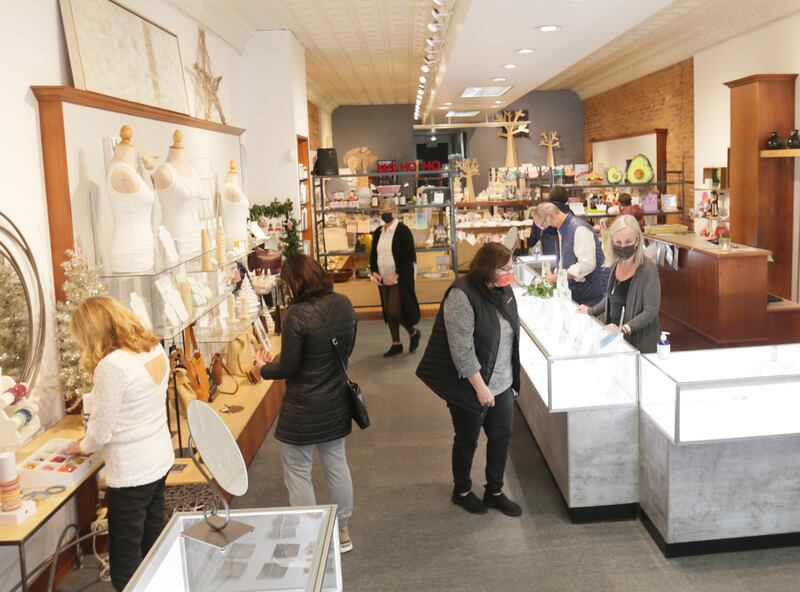
Tom Argubright looked at Oglesby’s soaring retail figures and asked around town: How come we’re making so much money?
One of the answers was tourism. Pandemic-weary visitors stormed into nearby Starved Rock and Matthiessen state parks and the wallets flew open. Oglesby’s restaurants and motels all got a shot in the arm.
That’s not all, however. Oglesby is on pace to blast by last year’s retail total by 31% and tourism alone doesn’t explain that. The state parks have had record crowds before, but none that spent this much. Argubright is Oglesby’s commissioner of finance and he has a theory, albeit one he can’t prove:
“I think it’s Amazon,” Argubright said.
Cities across Starved Rock Country are all having a banner year in retail sales and, yes, it’s partly a bounce-back after infection controls kept shoppers and visitors home much of 2020. But the totals have climbed well past what city officials saw coming. They think the records are busting because cities now get a slice of online sales, too.
The U.S. Supreme Court handed down a decision in 2018, South Dakota vs. Wayfair, Inc., that lets the states collect sales tax from out-of-state vendors that sell over the internet. It took a while for Springfield to work it out, but cities now are getting their share of online sales, too.
Ottawa, Princeton and Spring Valley have set monthly sales records, every month, since the first of the year. In June alone, La Salle and Peru brought in more retail money than they did last Christmas. It’s a good year when Utica gets a retail share of $250,000; the village blew past that mark by Labor Day.
How much of the influx is because of Amazon? Justin Miller wishes he could say.
Miller is finance director for the city of Peru and he said the problem is pinpointing which factor is most responsible for the influx of cash.
Online retailers have surely given Peru a boost, but they don’t get all the credit. Stuck-at-home shoppers were handed federal stimulus money that they happily went out and spent. Revenue spokeswoman Maura Kownacki cited a shift in spending during the pandemic: Money that would have been used on services [hair salons, restaurants] went to consumer goods, which boosted sales tax receipts.
For those reasons, Miller said, it’s tough to nail down exactly why Peru City Hall awaits remittances of nearly $7 million by year’s end, dwarfing the previous yearly total of $6.3 million.
“Obviously, we’re very, very happy,” Miller said, “but also you kind of get into a situation where you want to understand it better from a forecasting standpoint.”
Could the Department of Revenue provide the numbers to show just where the new money is coming from? The short answer is no.
Kownacki explained the new law pumping online sales into city coffers [the Leveling the Playing Field Retail Act] took effect Jan. 1 and implemented a series of structural changes to collect from remote retailers. Distinguishing internet sales from brick-and-mortar sales no longer is apples to apples.
“All brick and mortar and online sales are filed with IDOR on the same form,” Kownacki said. “As a result, tax disbursements made to local governments all come from the same bucket and no definitive distinction can be made.
“There is no way to break down which sales are online when they are all reported the same way.”
And cities have never been given line-item data showing what individual businesses pay in sales taxes. Argubright and Miller can analyze their city shares to get a rough handle on how businesses as a whole are doing; but whether mom-and-pop stores are thriving or failing is a well-guarded secret.
Nevertheless, published reports have attempted to estimate how much new money has come in. Don Harris is city treasurer of Ottawa and he recalled reading of an estimated increase of 17% due mostly to online sales. That’s notable because Ottawa presently exceeds the state estimate, with a year-over-year increase of 21%, and could join Peru in drawing a retails-sales share of $7 million.
“We can’t pinpoint it, either,” Harris said of this year’s influx, though he was quick to add Ottawa’s business community had been doing well, anyway. “In general, our economy in Ottawa has been somewhat stable overall, certainly aided by the stimulus money and grant programs.
“In general, under very different circumstances, I think overall the retailers have been able to sustain their businesses and maintain some stability in the local economy.”
:quality(70)/cloudfront-us-east-1.images.arcpublishing.com/shawmedia/7TKEO3SKENAPPJYMBWGB2RUQHU.jpg)
:quality(70)/s3.amazonaws.com/arc-authors/shawmedia/638ad18c-1176-4018-bcef-b5560cf36d58.png)