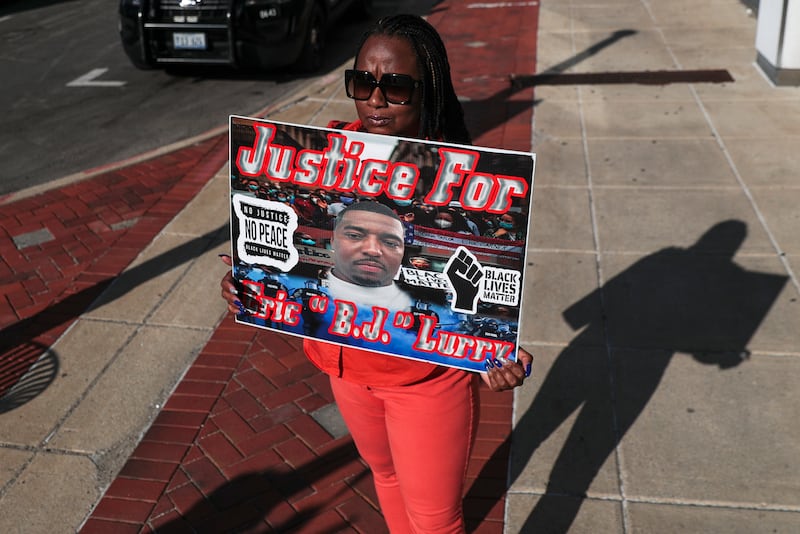
The city of Joliet has agreed to a $2.15 million settlement in a federal lawsuit case over the 2020 death of a man who died after ingesting drugs while in police custody.
On Friday, city officials released the settlement agreement in the case regarding the Jan. 29, 2020, death of Eric Lurry Jr., 37, in response to a Freedom Of Information Act request from Shaw Local.
The city will cover up to $1 million of the $2.15 million settlement amount while the rest is covered by insurance, according to the city.
The Aug. 3, 2020 lawsuit alleged several officers caused Lurry to die while he was in their custody by failing to provide him prompt medical care and subjecting him to excessive force.
Nicole Lurry, Eric Lurry’s widow, is the plaintiff in the case.
The agreement said Nicole Lurry acknowledges the settlement is “not an admission of liability of unconstitutional or illegal conduct” by the city and its officers involved in the incident.
The settlement was made after a mediation in which “both sides made compromises” to avoid the uncertainty and expenses of further litigation and “for the purpose of judicial economy,” according to the agreement.
:quality(70)/cloudfront-us-east-1.images.arcpublishing.com/shawmedia/BKVDAARHPZRBPLEYRGYUT2ZXJY.jpg)
The settlement included confidentiality and non-disparagement provisions but also exceptions to those provisions.
Nicole Lurry and the beneficiaries of Eric Lurry’s estate are not required to make a public statement, according to the agreement. But the agreement included a statement that would not violate its terms.
“While no legal resolution can ever reflect the depth of our loss, we have chosen to bring this case to a close and to focus on healing and honoring Eric’s life and legacy. We remain united as a family in love, remembrance and gratitude for the support we have received,” according to part of the statement.
Eric Lurry had a passion for cutting hair, he aspired to become a barber instructor and he also had a passion for mentoring young adults, according to his obituary.
The officers in the Lurry incident were cleared of wrongdoing by Will County State’s Attorney James Glasgow after the coroner’s office ruled Lurry died from an overdose of “fatal amounts of heroin, fentanyl and cocaine in his system.”
But Nicole Lurrys’ attorneys said in a 2023 court filing that officers “squandered multiple opportunities” to save Eric Lurry’s life, which included administering anti-overdose medication and calling for an ambulance sooner.
“These officers failed Mr. Lurry at every turn, wholly disregarding their duty to treat Mr. Lurry with dignity and respect and act in a manner to ensure his safety and well-being. It was their actions and inactions that ensured Mr. Lurry’s death,” according to Nicole Lurry’s attorneys.
On May 7, 2025, U.S. District Judge Jeffrey Cummings issued a ruling that found there was sufficient evidence for a trial on whether the officers’ delay in seeking medical care for Lurry caused him harm and whether officers’ unlawful force toward Lurry was recklessly unsafe.
Cummings denied city attorneys’ summary judgment motion for dismissal of the case. The judge’s ruling cleared the way for either a trial or a settlement.
Traffic stop and overdose
The incident leading to Lurry’s death began with a traffic stop on Jan. 28, 2020 in Joliet. Lurry was a passenger in a vehicle that police suspected was connected to a drug transaction. The driver was Kenan Kinney, 38, of Joliet.
At the time, Lurry and Kinney had been out on bond in unrelated 2019 felony drug cases.
Officers searched Kinney’s vehicle, found baggies of suspected drugs in the driver’s side and arrested Kinney, according to police reports. Kinney later plead guilty to possession of heroin with intent to deliver.
:quality(70)/cloudfront-us-east-1.images.arcpublishing.com/shawmedia/ISI3DXPBGJCEKXXGA2XCVLT22A.jpg)
During Kinney’s arrest, Lurry was allowed to leave the scene after an initial pat-down, police reports show.
But officers approached Lurry again because he apparently had Kinney’s cellphone and they were asked by another officer to confiscate the “large quantity of money” in Lurry’s pockets, police reports show.
Joliet Police Officer Jose Tellez patted Lurry down and felt a “plastic baggie containing a soft pliable substance,” police reports show.
After Lurry was told to get his hands out of his pants, Lurry turned around, fell on the ground and Tellez saw Lurry “bury his face towards his hands,” police reports show.
Around that time, Tellez suspected Lurry had already put into his mouth the drugs he felt during the pat-down, according to Cummings’ May 7, 2025, ruling.
Tellez understood there was a possibility that Lurry “may overdose on the drugs he put in his mouth and then die,” Cummings said.
“It is undisputed that quicker medical treatment is better than delayed medical treatment for people overdosing on drugs. Had effective and aggressive medical care been provided, Lurry’s death was not inevitable,” Cummings said.
Tellez and then-officer Andrew McCue left Lurry handcuffed alone in the backseat of the squad vehicle and no one monitored Lurry or checked on him while he was in the back of the squad vehicle, Cummings said.
Tellez was disciplined for failing to conduct a search of Lurry in accordance with departmental policy, Cummings said. Tellez understood swallowing drugs could lead to a fatal overdose, he said.
“Yet Tellez never suggested calling 911, going to the hospital instead of to the jail, or providing Lurry with Narcan. Neither did McCue,” Cummings said.
During the drive to the police station, Lurry intermittently chewed through the package of drugs in his mouth and began ingesting them through the mucus membranes of his mouth, Cummings said.
:quality(70)/cloudfront-us-east-1.images.arcpublishing.com/shawmedia/FKXDFX5QHZVCDZPPAUZXTJMHQU.jpg)
Video showed Lurry becoming drowsy but neither Tellez nor McCue attempted to talk to Lurry even though Tellez saw Lurry making chewing motions with his mouth, Cummings said.
When Lurry, Tellez and McCue arrived at the police station, Lurry’s “state of consciousness was not normal” and he was not responding to sternum rubs, Cummings said.
Joliet Police Sgt. Doug May was at the police station and he slapped Lurry in the face while shouting, “Wake up [expletive]!” according to squad video.
May admitted the strike was “unwarranted,” and he was disciplined for the strike and profanity, Cummings said.
Tellez “intentionally turned off the squad car’s dash camera” after seeing the strike because he knew it “was inappropriate to strike somebody in handcuffs,” Cummings said.
In a 2022 deposition in an unrelated federal case, Joliet Deputy Police Chief Chris Botzum said the department was still able to restore hours of video. He said if the camera in the vehicle is turned off, the cameras are still running but the audio is turned off.
“That same day we, as a department, went historically back into our squad camera system and pulled over three hours of video in regards to that incident, including the back seat outside squad cameras showing what occurred to Mr. Lurry. The video was not destroyed,” Botzum said.
During the incident, May had pinched Lurry’s nose shut for about 90 seconds “with the intention of restricting” his ability to breath to force his mouth open, Cummings said.
McCue followed Joliet Police Lt. Jeremy Harrison’s order to shove a baton in Lurry’s mouth to keep it open to retrieve the bags of drugs, Cummings said.
Harrison did not call for an ambulance until he realized Lurry had stopped breathing, Cummings said. Several officers administered CPR and first aid to Lurry, he said.
“Lurry coughed up a portion of a baggie during CPR and ‘immediately caught his breath and gasped’ during CPR ‘almost like he had something jammed in his airway and it was released,’” Cummings said.
Lurry was taken to Saint Joseph Medical Center in Joliet, where he died from a mixed overdose of cocaine, heroin, fentanyl and asphyxia, Cummings said.
:quality(70)/s3.amazonaws.com/arc-authors/shawmedia/7a2e8311-fc10-4849-8481-ab8459fa3039.png)