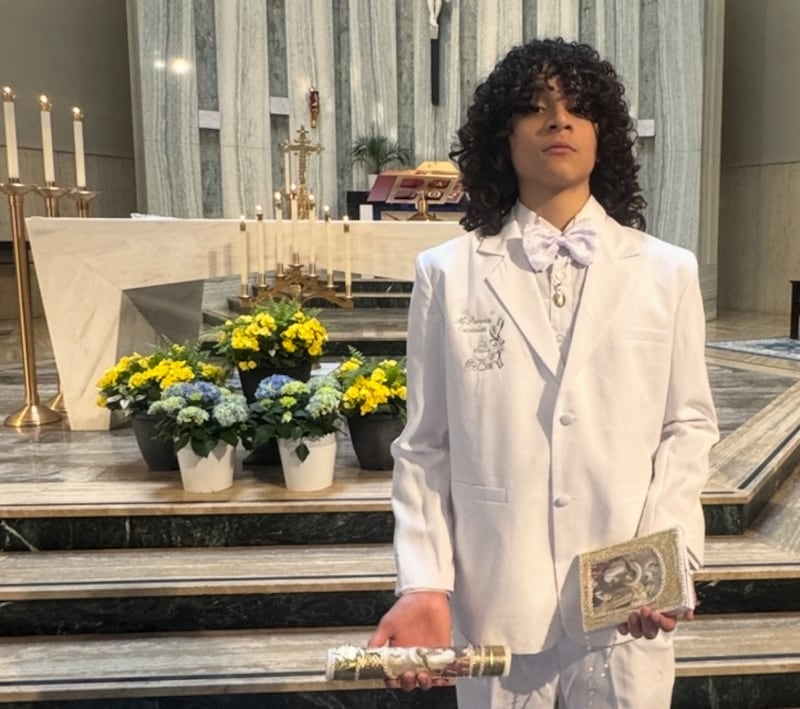
A judge decided a Joliet murder case involving the fatal shooting of a 13-year-old boy will stay in juvenile court, instead of transferring to adult court where the teen defendant would have faced harsher penalties.
Will County Judge Carmen Goodman rendered her decision on Tuesday after two days of testimony in the case against a 15-year-old boy who is charged with the June 2, 2025 first-degree murder of Manuel Mejia Perez, 13, of Joliet.
Goodman has barred Shaw Local from naming the teen, who has not yet gone to trial on the charges.
If the teen’s case had been transferred to adult court, he would face a minimum of 45 years in prison. As of now, the teen would have to stay in a juvenile facility for five years or until he turns 21 if he’s found guilty of the charges.
Prosecutors wanted the case transferred to adult court for more serious consequences because they said it involves a premeditated and “cold-blooded” murder.
The shooting of Perez was captured on video and later found by police on the teen’s cellphone, according to the testimony of Joliet Police Detective Benjamin Koepke.
:quality(70)/cloudfront-us-east-1.images.arcpublishing.com/shawmedia/KCUD6VR46BDDBF6J7AZ4DRYNYE.jpg)
Perez was shot twice in broad daylight and his body was found by police in an alley across the street from Water’s Edge townhomes, according to Joliet police officials.
A video of a cellphone, which played the video of Perez’s shooting, was shown in court on Monday. Koepke testified some witnesses in the case claimed the teen defendant had shown them the video.
“You saw the video. It doesn’t get any more cold-blooded than that,” a prosecutor told Goodman.
During the teen’s time at River Valley Juvenile Detention Center, he wrote a letter to his stepfather detailing an escape plan and requested his assistance, according to court testimony.
The teen’s attorney argued her client is capable of rehabilitation within the juvenile system based on a report from a psychologist and testimony from the teen’s counselor.
The attorney argued her client has a lack of maturity that makes him vulnerable to negative influences. She said her client has also witnessed domestic violence.
The teen’s attorney said her client suffered from “adverse factors he couldn’t control” and he “slipped through the cracks” in his home life and through the school system.
Goodman said the teen is charged with the “most serious of crimes” and testimony showed his “whole household was negative.”
Goodman said since the teen’s arrest, he has attended numerous mental health sessions and demonstrated full cooperation and consistent engagement during those sessions. She said the teen’s life has become more stable while incarcerated.
She said she must consider the seriousness of the charges but she must also “balance” that with the interests of the teen as well.
“You can’t predict the future but you can weigh the factors,” Goodman said.
Goodman referred to several factors outlined in state law that a judge must consider for a discretionary transfer of a juvenile case to adult court.
Some of those factors include a minor’s willingness to participate meaningfully in available services and reasonable likelihood of rehabilitation.
:quality(70)/cloudfront-us-east-1.images.arcpublishing.com/shawmedia/MI434S737NEAZFSHH74DMLYENI.jpg)
:quality(70)/s3.amazonaws.com/arc-authors/shawmedia/7a2e8311-fc10-4849-8481-ab8459fa3039.png)