In part one, I told the amazing story of Horace G. Reynolds, who came to Dixon in 1894 and built a successful wire screen manufacturing company known as Reynolds Wire. His factories stretched from today’s Commerce Towers out to the former Beier Bag factory on River Road.
His huge tombstone at Oakwood Cemetery includes two other names: Harvey and Ralston. This is their story.
Harvey of Yale
Douglas Gray Harvey initially came to Dixon to take a management position at the town’s new cement plant in 1906. At age 24, the young man brought impressive credentials. As a distinguished graduate of Yale University, he was described as a “cultured gentleman.”
Within 9 months, Reynolds became aware of Harvey’s “splendid mind, inventive genius and his great executive ability.” Reynolds then persuaded Harvey to take an executive position at the Reynolds Wire company in 1907.
Ralston of Princeton
John Gould Ralston also came to Dixon from a prestigious Ivy League school. Ralston graduated from Princeton in 1899. After he proved his management skills elsewhere, Reynolds hired him to a management position in 1914 at age 37.
Ralston was known for his “keen business ability, his thoroughness and his friendship for the employees of the industry.”
Marrying well
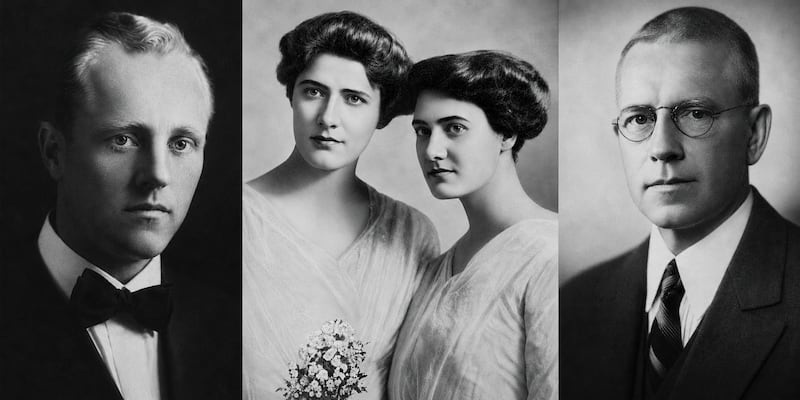
Horace G. Reynolds clearly valued a prestigious education, refinement and social standing. He sent his two daughters, Pauline and Lucile, to East Coast finishing schools, hired vocal training with prominent music instructors and ensured they traveled widely— advantages that made them attractive to affluent bachelors.
:quality(70)/cloudfront-us-east-1.images.arcpublishing.com/shawmedia/FMWRQAI7OFD43MVXTLWYRW4EDI.png)
In 1907, Pauline was 23 and back in Dixon, where she met 25-year-old Douglas Gray Harvey, probably at a social event. The Telegraph described her as “a young woman well-loved for her charming personality and manner.”
Four years later, in 1911, Horace’s strategy paid off. In “one of the prettiest weddings witnessed in Dixon,” Pauline Reynolds married Douglas Harvey at St. Luke’s Episcopal Church in Dixon.
Three years later, sister Lucile’s “gracious and pleasant personality” caught the eye of John Gould Ralston. They married at St. Luke’s in 1915 in a ceremony described as one of “regal splendor.”
One death after another
For the next 8 years, Reynolds watched his company thrive while his daughters became mothers in stable and secure marriages. But in 1923, Horace Reynolds died, leaving big shoes to fill. He had no sons, but he had two distinguished and accomplished sons-in-law.
The company helm transferred to Douglas Gray Harvey, the eldest daughter’s husband. But after 7 years, Harvey, 47, died suddenly of a heart attack while attending a Yale reunion in Connecticut in 1930.
So, the other son-in-law, John Gould Ralston, replaced Harvey as president. Like Harvey before him, Ralston was a highly effective leader. But 7 years later, Ralston died of pneumonia in 1937 at age 59.
Reynoldswood
Push pause. It’s time to talk about Reynoldswood.
When Harvey died in 1930 and Ralston died in 1937, they were living in the “Reynoldswood” mansion just west of Dixon along the north side of the river. Horace Reynolds purchased this property back in 1922.
He intended to use the property “both as a park for the people of Dixon and as a home for himself and family.” Reynolds hired renowned landscape architect O. C. Simonds to develop the property and design the manor house.
Sadly, Reynolds died before he could live there. The Harveys and Ralstons finally moved into the new mansion just before Christmas of 1927. The Harveys lived in one wing, while the Ralstons lived in the other.
The Reynoldswoode Farm
The Harveys and Ralstons devoted several acres to an active farm called “Reynoldswoode.” The upscale farm came to be known for its premium milk and hay, along with purebred cattle, hogs, horses and turkeys. It continued to operate into the 1950s.
The Harvey and Ralston families often hosted company picnics and community events on the grounds. In the 1930s, the Walgreen family at Hazelwood and the Reynolds’ families at Reynoldswood, Dixon’s two elite families, even got together to socialize at their properties.
Reynolds Field
The Harvey and Ralston families increasingly integrated with the community, serving on local boards, advancing local organizations and donating to local causes. One good example took place during the Great Depression in 1933.
Wanting to do “something of lasting benefit for the city and in memory of Mr. Reynolds,” the families partnered with a federal work-relief program to make “a beautifying and recreational” donation to the city.
Two city blocks
The result was Reynolds Athletic Field. The Harveys and Ralstons purchased two entire city blocks (600 feet by 340 feet) on the southwest end at Sheridan Avenue and Second Street. As a bonus for the city, the Civil Works Administration put unemployed people to work in grading and paving the property, eventually creating two quality baseball diamonds.
Responding to the huge gift, the Telegraph said, “There has never been a movement for the betterment of Dixon in which the members of the Reynolds family were not the leaders in that movement.”
Six years later, in July 1940, the city erected a bronze plaque at the field’s Sheridan Avenue entrance, so that future generations would never forget the Reynolds’ generosity. Then, 10 years later, in August 1950, actor Ronald Reagan returned to Dixon to formally dedicate Reynolds Field before a “record-setting crowd.”
Today, Reynolds Field is almost 100 years old, and it continues as a favorite venue for Dixon sports lovers.
Camp Ralston
Another major donation came in December 1937, when Lucile, the widow of John Gould Ralston, donated 50 acres of woodland to Dixon Girls Scouts. Since her husband had just died that year, the scout property was named Camp Ralston in his memory.
In 1942, sister Pauline donated the camp’s Harvey Hall in memory of her husband, Douglas Gray Harvey. Much of Harvey Hall’s rustic wood construction comes from Reynoldswood’s white oak trees stripped of bark.
The Harveys and Ralstons had long been supporters of scouting locally and nationally, and they had frequently hosted Boy Scout and Girl Scout activities at Reynoldswood.
Camp Ralston, located on Clear Creek, borders today’s Lost Nation Golf Club, 8 miles northeast of Dixon. The Girl Scout camp survived for many decades, but the property is now gaining attention as the East of Yellowstone Lodge and Retreat Center.
Ironically, at Camp Ralston in 1942, the three names of Reynolds, Harvey and Ralston came together again, just as they had worked together for so many years at the Reynolds Wire mill. But now, the three men, Horace Reynolds, Douglas Harvey and John Ralston, were gone.
Who took over the company when Ralston died? Why did Reynolds Wire eventually leave Dixon? I will reveal the eye-opening answers in our next column, on June 12.
- Dixon native Tom Wadsworth, PhD, is an author, speaker and occasional historian. His popular new book, “Distinctive Dixon: Fascinating Stories of Dixon’s Rich History,” is available at Books on First in Dixon.