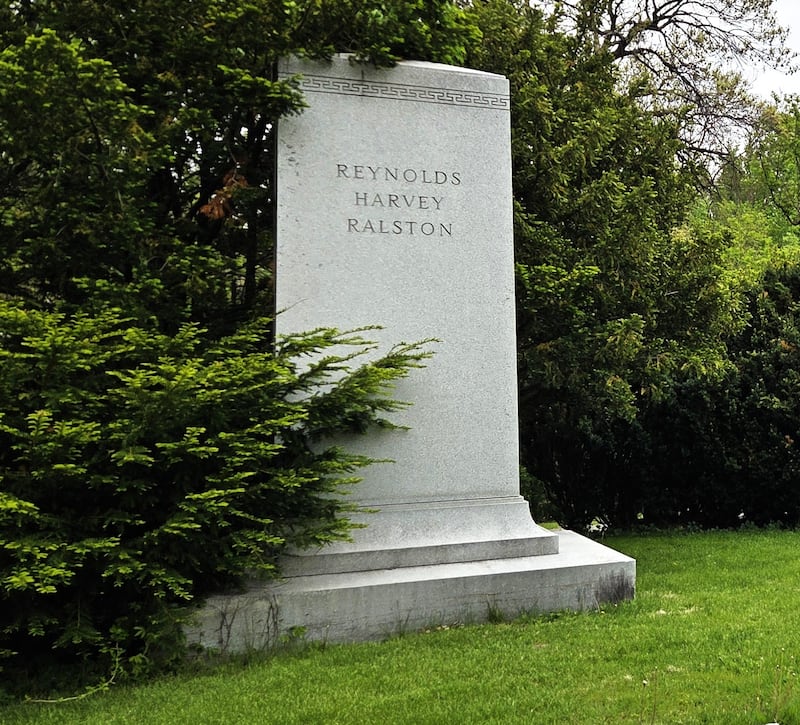
In the quiet rear section of Oakwood Cemetery stands a towering 12-foot monument bearing three names: Reynolds, Harvey and Ralston.
The stone is striking. So is the story behind it.
Those three names show up all over the Dixon area: Reynolds Field, Camp Ralston and its Harvey Hall, Reynoldswood and the former Reynolds Wire Mill, known today as Commerce Towers. They all trace back to one person: Horace G. Reynolds.
:quality(70)/cloudfront-us-east-1.images.arcpublishing.com/shawmedia/MWUWCFZJ4ND2LHFSMAVDKPSPYY.png)
He has been gone for over a century. But his impact throughout the city lives on.
The appeal of Dixon
Born in 1854 in New York, Reynolds came to Dixon in 1894 at age 40, seeking a promising place to manufacture his invention of wire screen, also known as wire cloth. At that time, no one manufactured this product west of Buffalo, New York.
Wire screen was then enormously popular. Air conditioning did not exist. Homes and businesses just opened their doors and windows. Screen doors and windows allowed airflow while blocking bugs and pests.
At first, Reynolds considered building his factory in Sterling. But thanks to the persuasive efforts of Charles H. Hughes, Reynolds chose Dixon. Hughes went on to build a reputation as an advocate for Dixon, serving as Dixon mayor, county treasurer, state representative and state senator.
Reynolds located his factory on River Road in Dixon for two key reasons. The riverside location enabled him to harvest water power directly from the river, and the railroad spur on River Road enabled easy shipping of incoming raw materials and outgoing finished products.
Best in the West
Being the first wire screen produced west of Buffalo, Reynolds advertised his Dixon product with the slogan, “Western Made for Western Trade.” In 1894, Dixon was considered part of “the West.”
For America’s greatly expanding frontier, Reynolds’s slogan appealed to western customers who wanted faster shipment. In another smart marketing strategy, Reynolds created his wire screen with a distinctive red border called “Red Edge” screening.
The Reynolds screen product was often called “Dixon wire cloth” or “Dixon wire screen” in newspaper ads from New York to Oklahoma between the 1890s and the 1950s. Since his screen was considered “heavier than any other” and “best wire made,” customers learned to identify the red edge on Dixon wire cloth as a mark of quality.
Huge Dixon footprint
The Reynolds factories eventually spread along River Road, including a four-story factory at Crawford Avenue, now known as Commerce Towers. Erected in 1911, Reynolds required its thick walls of concrete to come from Dixon’s new cement plant.
The Telegraph praised the new structure as so solid it “will not become out of date any more than the pyramids.”
Desiring to create “the finest factory building in northern Illinois,” Reynolds included a recreation room, a gymnasium, a cafeteria, dressing rooms and baths for employees. Its four floors provided the equivalent of four football fields for the manufacture of wire screen, as employees enjoyed a constant wash of natural light from huge windows on all floors.
Competing with the Telegraph
Before Horace came to Dixon in 1894, he had 20 years of experience as the editor and proprietor of a weekly newspaper in Gouvernour, New York. In 1914 in Dixon, he rekindled his journalistic fires by starting the Dixon Evening Leader in competition with the Dixon Evening Telegraph.
Knowing that the Telegraph tended to support Republicans, Reynolds wanted a paper that would vigorously support the Progressive Party led by Theodore Roosevelt. But five years later, Roosevelt died, and the party died with him. So, Horace sold his paper in 1919 to the Telegraph, acknowledging his support for the Republican Party.
Even though his Leader paper was successful and growing, Reynolds said that two newspapers in one small town created a “grievous burden on the entire community” because of “duplications of advertisements and subscriptions.” He also noted that his wire mill was rapidly expanding, demanding his time.
Hundreds of employees
Indeed, it was. The Reynolds factories included a complex of buildings on the eastern end of River Road, where the now vacant Beier Bag company eventually located.
Much of the factory labor was performed by loom machines that meshed the wire together. For employees, the work was said to require more mental effort than physical. For decades, the factories ran “night and day an average of 22 hours out of 24.”
In 1948, the company built a modern brick office building on Second Street near Ravine, now occupied by Willett & Hofmann. By 1950, the Reynolds Wire workforce included 450 employees.
The peak of success
By 1923, Horace Reynolds was 69 and at the peak of his success. But on Sunday, Oct. 21, 1923, the inexhaustible and inventive entrepreneur died at his home at 607 N. Galena Ave., now the site of Dixon Dell Apartments. Dixon employees served as his pallbearers, escorting his coffin to its final resting place at Oakwood Cemetery.
Horace G. Reynolds had left his New York homeland in 1894. But here in Dixon, he raised his family, fulfilled his dreams and became a successful manufacturer with a market to the nation and beyond. The Telegraph then estimated his fortune “at a million and more,” about $20 million in today’s dollars.
He loved Dixon. Only four years earlier, Reynolds urged his fellow citizens to heighten their “enthusiasm about our Rock River scenery, our climate, our natural resources, our men and our women.”
“Let us so act,” he concluded, “that people will come to know there is no better place than little old Dixon, in little old Lee County, in the big old U.S.A.”
But what about Harvey and Ralston? What about Reynoldswood and Reynolds Field? And whatever happened to the Reynolds Wire company?
Read our next column on May 29.
- Dixon native Tom Wadsworth, PhD, is an author, speaker, and occasional historian. His popular new book, “Distinctive Dixon: Fascinating Stories of Dixon’s Rich History,” is available at Books on First in Dixon.