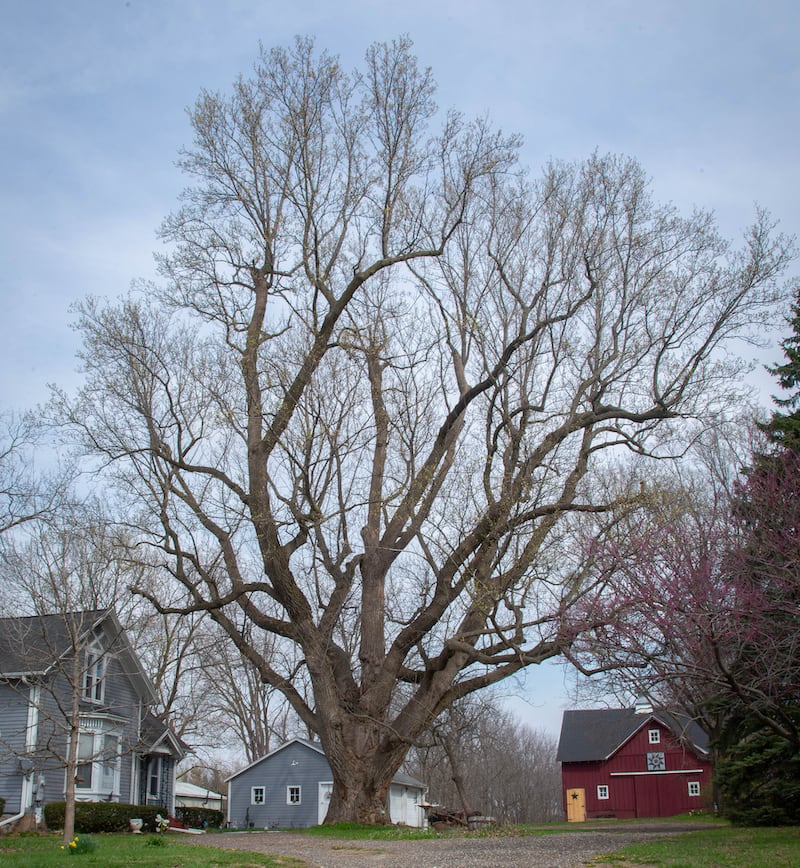
The National Land Institute’s Legacy Tree Program has announced that the May Tree of the Month is a tulip tree on private property in Sterling.
It is 65 feet tall, has an average crown spread of 85 feet and a circumference of 18.25 feet.
This tree was nominated by Carolyn Keller, who said, “Both daughters agreed that the tulip tree has been a major part of our lives and a special spot for photos of special times in our lives.”
Keller’s five grandchildren admire it, as well.
“Since we moved here in 1971, the tree has never failed to bloom by Memorial Day,” she said. “Its lovely flower is one of the things that has amazed people the first time they saw its unique colors.
“It was, however, the lovely golden color of the fall leaves one month after we had moved here that made me first realize I was truly home.”
In 1990, Carolyn and her late husband, Tim, were recognized in the Whiteside County Soil & Water Conservation District Natural Area Guardians Biggest Tree Contest for locating the largest tulip tree in the county.
It has certainly grown since then and is extremely large now, but it isn’t quite big enough to beat the current Illinois state champion tulip tree, according to a National Land Institute news release.
Tulip trees are in the Magnolia family and are the tallest nonconifer tree native to Eastern North America (Eastern White Pines grow taller). Trees readily top 100 feet in their native range and are known to grow to almost 175 feet.
They are found growing wild from southern New England to northern Florida and west to easternmost Texas, southeast Missouri and lower Michigan. That makes their pre-settlement native range as close as the southern tip of Lake Michigan, where the massive lake moderates the climate.
They are the state tree of Indiana, but originally didn’t cross into Illinois anywhere but the southern fourth of the state.
Tulip trees are beloved for their lovely flowers, which open after the leaves fully emerge in May.
The flowers are tulip-shaped with a central “cone” – the base of each petal is a flame of orange showing pollinators where the sweets are, and each flower has a third of a teaspoon of nectar.
Baltimore orioles, ruby-throated hummingbirds and bees are eager to drink up this treat. The drippings from all the nectar can create a sticky landscape under the tree. The flowers are often high in the tree, rarely with a low branch within reach, for easy viewing.
The leaves are iconic, with a distinctive tulip shape of four lobed leaves. Tulip trees turn a lovely golden yellow in the fall, and the flowers form straw-colored fruits that are cone-like clusters of seeds adorning the higher branches. A feast for squirrels and some songbirds. The seeds disperse in winter, with a papery wing and can sail a great distance to a new location for a new tree to grow.
Tulip trees are occasionally planted as large shade trees wherever they are hardy, which includes northern Illinois. They grow very fast with a straight trunk, often growing together in a grove that forms a living cathedral of trees, but open-grown trees develop a wide crown with age.
The Keller tree’s origin is unknown and possibly tied to the original settlers of the farm. As an open-grown tree, its branches spread far and wide, and it is not forced to grow so tall.
“Because of our changing climate, tulip tree seedlings and saplings have started to show up in regional parks such as Rock Cut State Park, Hononegah, Kishwaukee Gorge North, and Klehm Forest Preserves and NLI’s Foss Farm northeast of Roscoe, said Alan Branhagen, executive director.
“Now, I often see seedlings in my neighborhood, but never when I lived there 30 years ago,” he said. “Back then, only Klehm Arboretum had naturalizing tulip trees. They have become a new member of our local flora. The tallest one measured at 81 feet, but none as big as this stately tree gracing the Keller’s home landscape.”
:quality(70)/s3.amazonaws.com/arc-authors/shawmedia/b945ae41-e0fd-42fd-805a-feca8401d740.png)