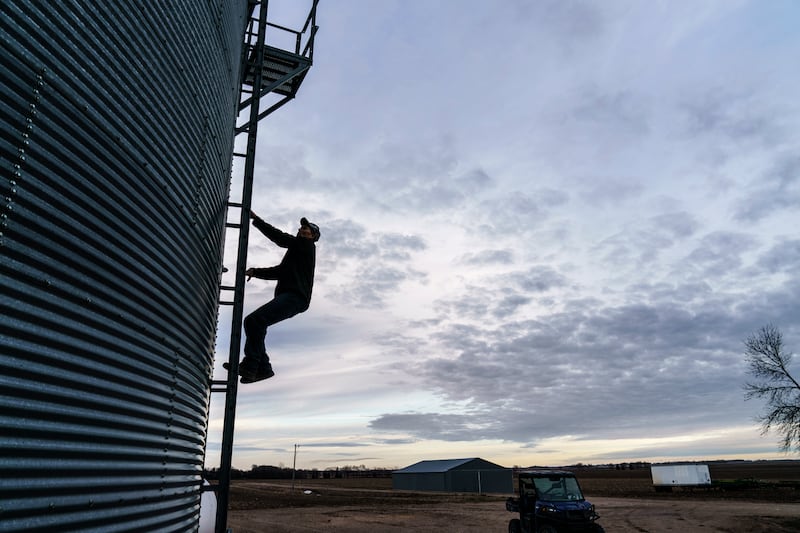
After two decades of steady grain storage capacity growth that matched production increases, on-farm and off-farm expansion has become stagnant.
Joe Janzen, University of Illinois agricultural economist, examined the significant shift and its potential ramifications in a recent farmdoc video and article.
“Our grain storage capacity has stopped growing. Storage infrastructure — bins, elevators and sheds used to keep grain in good marketing condition — is an important part of the U.S. grain supply chain. It helps facilitate efficient, low-cost movement of commodities from producer to end-user, helping to ensure that farmers receive the best price for their crops,” he said.
Storage infrastructure consolidated in the 1980s and 1990s following the end of government policies that encouraged large grain stockpiles.
That was followed by a steady growth that matched production increases nearly bushel for bushel in the first two decades of the 2000s.
“Storage capacity grew by about 350 million bushels per year, and production of all crops, while fluctuating from year to year with changes in weather and crop yields, grew by an average of 340 million bushels per year,” Janzen noted of the growth from 2000 to 2019.
“But something changed around 2020. Production continues its upward trend, but capacity growth has slowed considerably. In the six years since 2020, we’ve only added 337 million bushels of storage capacity — less than what we typically added in a single year during the prior period. Storage capacity has remained essentially flat while production continues to grow.
“Based on the prior trend from 2000 to 2019, we would have had 27.5 billion bushels of capacity today. Instead, we’re at about 25.5 billion bushels of storage capacity.
“In December 2025, the most recent data point, production came within 5% of total storage capacity. That’s the tightest margin we’ve seen in the data.”
Across Regions
Janzen’s research looked at the capacity growth halt by regions and for on-farm and off-farm storage. He found storage capacity growth flatlined everywhere, a pattern affecting both farmers and commercial grain handlers.
“I looked at off-farm storage — that’s commercial elevators and terminals — and on-farm storage, the bins on farmers’ properties, in four regions where most of the grain production and storage capacity exists. They are the Eastern Corn Belt, Western Corn Belt, Northern Great Plains and Southern Plains,” he said.
“Some of the regions have more storage than others, and the mix of on-farm and off-farm storage varies. There’s more storage capacity in the Corn Belt where big corn yields generate a great volume of grain. More than 13.5 billion bushels of capacity lie in the states between Ohio and Nebraska.
“The Western Corn Belt and Northern Great Plains regions that are generally farther from ports and end-uses have proportionately more on-farm storage. Farmers in those areas typically need to store grain for longer.”
Near Maximum
A result of the slower capacity growth while production continues to increase is farmers and others use existing storage capacity more intensively.
Janzen calculated a measure of capacity utilization, the proportion of storage capacity being used to hold grain inventories by the U.S. Department of Agriculture in its quarterly grain stocks reports for Dec. 1, March 1, June 1 and Sept. 1.
:quality(70)/cloudfront-us-east-1.images.arcpublishing.com/shawmedia/WELVQTZGTJE3VJYM7KKZATOCXU.jpg)
Storage use follows the marketing year for corn and soybeans. December is right after harvest, so storage utilization is highest then.
By the following September, just before the next corn and soybean harvest, utilization has declined as grain moves to end-users.
“While storage use varies from year to year with changes in crop size, the longer-run trends is toward greater capacity utilization,” Janzen said.
“Comparing December storage capacity use across four sub-periods, I find for the 1988 to 2005 period, average post-harvest utilization was about 60% of capacity. Since 2014, it’s been closer to 70% of storage capacity.
“In the past five years, U.S. farmers have been using their space more intensively, filling their bins more and drawing them down to lower levels. December capacity utilization was roughly 70% on-farm, compared to just over 60% off-farm.”
The most recent data suggests this trend has continued. As of Dec. 1, 2025, farmers held large inventories relative to storage capacity, with a capacity utilization rate of 80% on-farm compared to 65% off-farm.
“Why does this matter? Storage capacity is infrastructure that facilitates grain movement through the supply chain. When utilization rates increase, there is less flexibility in the system,” Janzen said.
“We’ve seen this in other contexts like the Mississippi River transportation constraints of a few years ago, how infrastructure limitations can affect local prices and farmer marketing options.
“At current utilization levels, it’s worth asking whether we’re approaching a point where the capacity constraints could affect market function, particularly in specific locations, with higher storage utilization rates.”
Potential Impacts
Janzen said his analysis raised several questions worth considering.
First, at what level of utilization might capacity constraints begin to affect supply chain efficiency and price relationships?
Second, what factors are driving farmers’ and grain handlers’ recent decisions about investments in grain storage?
“Understanding why capacity growth has slowed could help us anticipate future trends,” Janzen said.
In his farmdoc article, he noted it’s unclear why investment in grain storage capacity has dropped, but there are some possible relevant factors including increased construction costs and higher interest rates in the post-2020, post-COVID economy, concerns about future production growth and the irregular and unpredictable nature of grain storage demand.
“It may be difficult to justify investment in storage capacity when the timing and magnitude of benefits are uncertain,” he said.
“Storage capacity may earn low returns in typical market conditions, but become much more valuable in the aftermath of specific supply or demand changes. It takes time and effort for farmers and other firms to consistently generate revenue from storage capacity.
“In the aggregate, it is difficult to determine if a current U.S. storage capacity is sufficient for efficient operation along grain supply chains. At what level of capacity utilization do bottlenecks form and capacity constraints begin to materially affect basis relationships, price volatility and farmer marketing flexibility?
“The grain industry, from the farmer outward, will need to consider these questions as it addresses the continually shifting geography of global grain production and consumption in the years ahead.”
:quality(70)/s3.amazonaws.com/arc-authors/shawmedia/ed197490-54d0-4d57-8027-b878c9f46789.jpg)