This is part two of the story about the 1904 battle between Dixon’s ministerial association and Thomas Young, the owner of the Nachusa House.
For the upcoming 1905 Billy Sunday revival, the ministers wanted to build a large temporary tabernacle on the park next to the Nachusa House (where the Post House now stands).
Young argued that the all-wood tabernacle would create a fire hazard and destroy the park’s trees. But liquor was likely the main issue. The Nachusa House had a popular saloon, and Billy Sunday was known to rail against booze and saloons wherever he went.
The debate at the city council
At a special session of the city council on Nov. 21, attorney A. C. Bardwell argued for the ministerial association, urging that tabernacle work be allowed to continue on the park site. He assured the council that the revival “gatherings will be orderly and commendable in every respect.”
The ministerial association, he said, would also provide additional police and fire protection and pay any additional insurance costs for the hotel. Noting that he had the utmost regard for Thomas Young, Bardwell described the controversy as “one citizen (Young) against hundreds and perhaps thousands.”
Young, accompanied by U.S. Attorney Solomon Bethea, defended himself to council members. “I am not against the churches or against this movement by the ministers,” he said. “I have always helped the churches in every way possible … and granted them many privileges.”
He repeated his concern about the fire hazard of the all-wood tabernacle, noting that the Nachusa House had no large buildings near it. Because of “disastrous hotel fires,” he said, “it is hard to get guests to go above the first or second floors.”
Young feared that, when guests see “that inflammable structure within 20 feet of the hotel, they will go to Sterling or Freeport or other cities for hotel accommodations.”
The ‘narrow escape’
Throughout the battle, Thomas Young actively sought to help the ministers find a new lot. He even offered to pay for preparing another lot.
But the matter was settled, not by the city council, Thomas Young or the ministers. On Nov. 22, H. A. Taylor, the assistant secretary of the U.S. Treasury, sent a dispatch to the Dixon post office with this order: “Stop destruction of trees on post office site at once.”
The ministers immediately petitioned for a reversal of Taylor’s order. However, H. C. Higgins, the owner of the new interurban trolley, stepped forward on Nov. 29 to offer a better tabernacle location.
Higgins proposed his vacant lot on West First Street between Highland and Madison (where Kitzman’s Lumber now stands), conveniently located next to the central station of the interurban trolley. This location provided trolley transportation direct to the tabernacle doors.
Anyone could come to the Sunday revival by boarding the trolley in Sterling, around Dixon and from the railroad depots in Dement Town. The Telegraph described the new solution as a “narrow escape” from an escalating conflict.
Preaching at the preachers
Even though the matter was resolved on Nov. 29, some unfortunate words had been spilled while the controversy raged. On the one hand, the Telegraph noted that Thomas Young “displayed a spirit of humility … honesty, charity and liberality.” However, “at least two pulpits of Dixon” attacked Young unjustly during their Sunday sermons on Nov. 27.
The Baptist minister’s sermon, which was published in the papers, alleged that Young would “rather save two trees than two souls.” The Lutheran pastor’s sermon compared Young to Demetrius of Acts 19, the money-grubbing idol-making silversmith who sought to protect his business by inciting a riot against the apostle Paul’s righteous campaign.
Opposing these inflammatory remarks, the Telegraph editor said, “A little preaching at the preachers will not be out of place at this time.” Noting the forgiveness and kindness displayed by Jesus, the Telegraph said, “We marvel that His followers have so little of the charity of our Savior.”
The preachers’ attacks, said the editor, occurred “on a bright Sabbath morning, a most appropriate time for prayers for the unrighteous instead of censure.” The Sterling Evening Gazette, in a rare show of support for the Dixon paper, published the entirety of the Telegraph’s editorial against the harsh preaching of the preachers.
The rest of the story
In the end, Billy Sunday packed the First Street tabernacle for five weeks in February and March of 1905. His revival meetings attracted more than 150,000 attendees, resulting in more than 1,300 conversions. Yes, as expected, Billy railed away at booze and the saloons.
Revival attendees poured in donations that not only covered all expenses but also contributed $8,400 to build a permanent building for the Young Men’s Christian Association. That money – the equivalent of $275,000 today – seeded a $35,000 fund drive that resulted in a new three-story brick YMCA, featuring 39 rooms, two bowling alleys, a pool and a gymnasium.
Here’s the kicker. The fund drive chairman, leading a committee of 80-plus leading citizens, was Thomas Young.
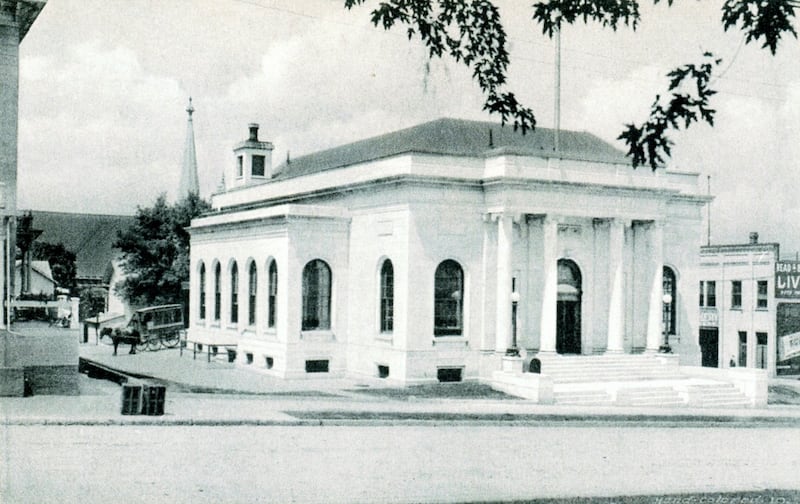
The other kicker is the location of the new YMCA. It was erected in 1907 at Third and Galena next door to the Nachusa House. The new Post House was built in 1911 on the north side of the hotel, on the embattled park site.
The lesson of the story? Demonizing the opposition only diminishes your reputation. If you treat your opponent with respect, you can make progress together.
- Dixon native Tom Wadsworth is a writer, speaker and occasional historian. He holds a Ph.D. in New Testament.