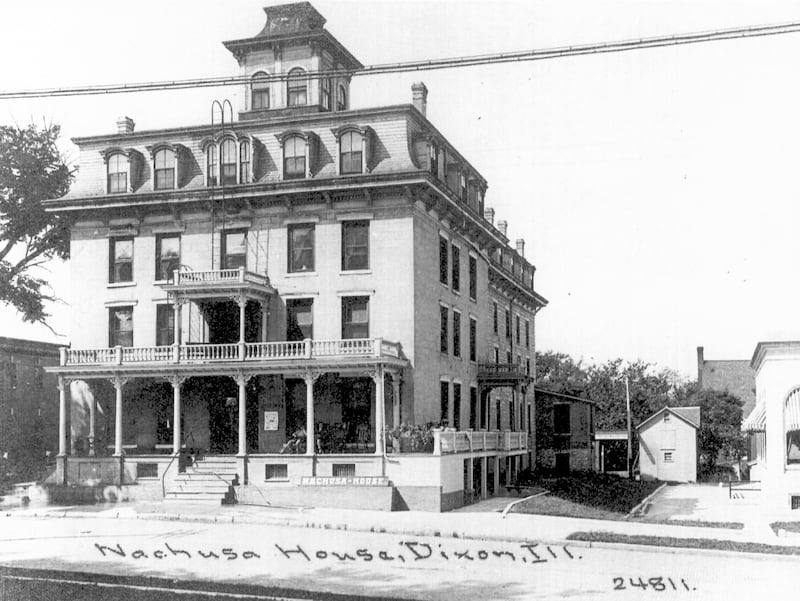
I’ve never heard anyone talk about this fascinating Nachusa House story from 1904. But it captures a unique moment in Dixon history when state, religion and business collided in a raging controversy. The story reveals how communities can work through conflict for the common good.
It started in November 1904 when the U.S. government granted a permit to the Dixon ministerial association to build a special “tabernacle” for the upcoming Billy Sunday evangelistic revival on the lot just north of the Nachusa House. The lot, today occupied by the Post House and the Senior Center, was sometimes called “Nachusa House Park” or “Government Park.”
The U.S. government acquired the lot in 1903 for the future site of the Dixon post office. At that time, the lot was a park-like lawn with trees. Nachusa House patrons enjoyed the lot’s natural beauty, while politicians and speakers occasionally spoke from the hotel’s north porch, addressing crowds gathered in the park below.
Stopping construction
As soon as work began to prepare the lot, hotel owner and manager Thomas Young strongly objected to the tabernacle’s location. With a long history in Dixon as a leading citizen and hotelier, he also had managed the Waverly Hotel in Dement Town and the hotel at the northside Assembly Park.
Knowing that the huge 126-by-96-foot tabernacle would be temporary, Young still claimed that the removal of trees and sod on the lot would “spoil the neat park adjoining the hotel.”
Young further asserted that the all-wood tabernacle would create a fire hazard, increase the hotel’s insurance rates and damage his business. At that time, the lot was just outside the city’s fire limits, where new buildings could not be made of wood.
The town’s ministers rejected Young’s arguments about trees and fire, assuming that he had ulterior motives for opposing the tabernacle. The battle lines were drawn. As the Telegraph reported, “The controversy stirred up considerable interest about the city.”
The elephant in the room
The issue of liquor was likely the elephant in the room. At the time, the local temperance movement opposed all “saloonists” like the Nachusa House. Whenever Lee County voted to be “wet” or “dry,” the powerful pro-dry anti-alcohol faction had amassed nearly 50% of the vote.
The alcohol issue was becoming a national firestorm. In 1900, Carrie Nation of Kansas incited anti-saloon activism by entering Topeka saloons with a hatchet. For the next 10 years, she claimed that God supported her crusade as she burst into taverns, hacking away at bars, kegs and bottles, undeterred by arrests and jail time.
In 1902, Carrie brought her campaign to Dixon, preaching her anti-booze gospel at the Dixon Opera House and to 1,000 students at the Dixon College chapel. Between 1900 and 1904, the Telegraph published more than 100 stories about her violent raids, including five stories in the two months prior to the tabernacle controversy.
‘The real issue is not trees’
In 1904, the Nachusa House held one of the city’s 25 liquor licenses, having operated a saloon for decades. Thomas Young had to know that, if Billy Sunday – right next door –loudly condemned saloons for five straight weeks, his business would quickly become a target for the inspired masses entering and leaving the tabernacle every night.
Indeed, Billy Sunday’s No. 1 target was booze, as he railed against alcohol wherever he went. He often said, “The combined force of hell could not bring forth any more hellish institution than the open saloon.”
One citizen summarized the tabernacle controversy in a letter to the editor of the Telegraph, saying, “The real issue is not trees.”
In part two on Feb. 20, we’ll reveal how the debate raged at the City Council and in the city’s pulpits and how the issue was finally resolved to the betterment of the community.
- Dixon native Tom Wadsworth is a writer, speaker and occasional historian. He holds a Ph.D. in New Testament.