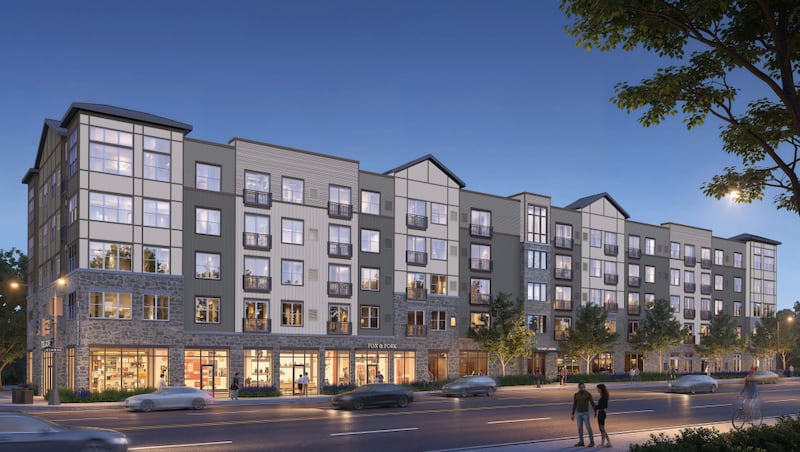
The mixed-use development planned for the vacant block along Route 14 in Fox River Grove is one step closer to breaking ground after planning and zoning commissioners gave the plan a thumbs-up.
Developers Harlem Irving Companies, Hamilton Partners and Zeller are proposing to construct a five-story building with about 6,000 square feet of commercial space and about 97 apartments.
The plan calls for studio, one- and two-bedroom units with ground-floor tenant amenities, including a gym and a workspace.
Block B is described by the village as a 2-acre downtown area between Illinois Street and Lincoln Avenue that extends from Northwest Highway to Opatrny Drive, excluding the municipal center. It has been a grassy, vacant lot since 2024, after the village demolished older buildings on the property facing Route 14.
The village has been seeking a development for the property for over 10 years, Village Administrator Derek Soderholm said. An initial agreement with a previous developer with a similar plan fell apart in 2024. The village first announced the new developers’ plans last year.
:quality(70)/cloudfront-us-east-1.images.arcpublishing.com/shawmedia/ZQHOMQYKX5EHLANVEX6AHBK6UY.png)
Called Fox River Landing, the building will have a “boutique hotel” feel with a “very active social area,” Harlem Irving Companies President Rick Filler said.
Along with ground-floor amenities, the plan also has an outdoor space for residents with grills, seating, a pergola and a dog run, Todd Berlinghof of Hamilton Partners said.
The 6,000 square feet of retail space has the potential to be split into two. Although exactly what would occupy the space is unknown, developers envision a restaurant.
Planning and Zoning commissioners unanimously agreed Wednesday to recommend the plan. The Village Board could take the final vote as early as April 21, Soderholm said.
Apartment units in the proposal range from 568 square feet to 1,223 square feet, with Juliet balconies in units at the front of the building facing Route 14 and hanging balconies on the back of the building.
According to village documents, developers estimate the building will bring in 166 occupants, with eight being school-aged.
One of the variances developers are seeking is to install fewer parking spaces than what the village code requires.
Currently, the plan calls for a total of 170 parking spots, while the village code requires a range of 185 to 215 spaces, depending on retail use, Tim Beechick of Hamilton Partners said. The lot at the back of the building plans for 126 spaces and another 44 to be placed in diagonal spaces along adjacent streets.
Soderholm said the target is to have one space per bedroom. If overflow parking is needed, supplemental options nearby include the Metra train station across Route 14, at the Village Hall and across Lincoln Avenue, Beechick said.
Some residents and commissioners expressed concerns over the limited number of parking spaces.
“The parking does look tight,” Commissioner Devin Bright said. “Nobody is going to be moving in here without a car. It’s not urban, it’s suburban.”
As it happens, though, new state legislation – passed as part of a sweeping public transit bill last year – set to go into effect June 1 would prohibit parking minimums for housing within a half-mile of a transit hub, like the Metra station across the street from Block B. Suburban leaders including Mayor Mark Kownick in neighboring Cary have criticized the legislation as a loss on local control.
As for the Block B development, it’s projected to increase the daily traffic volumes on Route 14 by less than 2%, according to a traffic study. It also says the 170 parking spaces will be adequate for the demand.
Overall, commissioners had positive feedback for the proposal. Commissioner Keith Bloom said he has confidence in the developers, given their reputable portfolio. He contrasted that with the long-abandoned apartment complex at 401 Algonquin Road, over which lawsuits among contractors and the developer continue. The village demolished the unfinished building late last year.
“I’m familiar with a lot of [the Block B developers’] past projects. I think they’re tried and true,” Commissioner Warren Weaver said. “This town needs something to keep it going. We’re staring at a bare block.”
:quality(70)/cloudfront-us-east-1.images.arcpublishing.com/shawmedia/VJYRXADWIRGARAEBKQZEDWWHAY.jpeg)
The team of developers created downtown Crystal Lake’s Enclave apartment and townhome complex, located at 111 E. Crystal Lake Ave., along with multiple developments in Mount Prospect.
Developers estimate the project will have a stabilized Equalized Assessed Value of approximately $6.17 million, and bring in nearly $68,000 in non-property tax revenues annually, according to village documents.
The village established a downtown tax-increment financing district in February to incentivize redevelopment.
If approved, developers estimate construction will take about 18 months and aim for completion by 2028, according to village documents.
“As a lifelong resident of this town, I can tell you I can think back to the days when I was a kid, when Route 14 was a two-lane road and we had one stop light in town,” Commissioner Dan Celske said.
“You never would have imagined anything more than a two-story building in our downtown area, let alone something of this size and scale, something that takes a little getting used to, in terms of concept,” he said. “But I think we’re – as everybody indicated – excited to see this go forward and see how this plays out.”