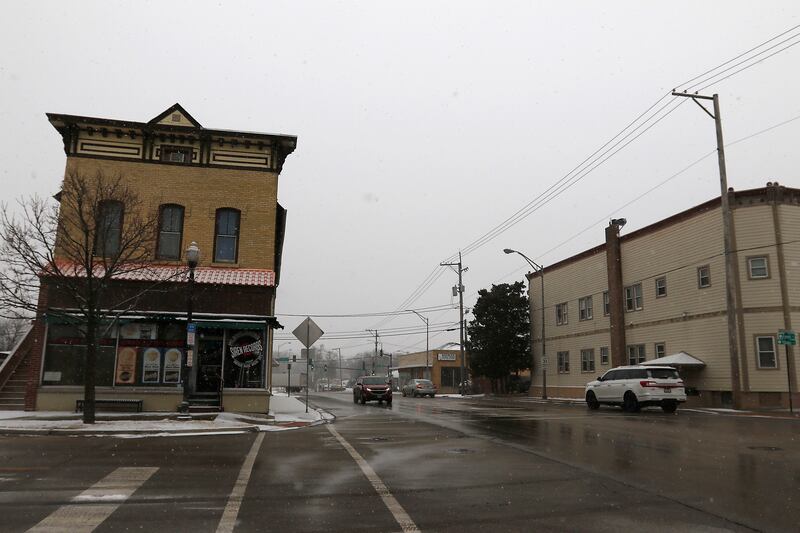
If McHenry creates a Tax Increment Finance district for the Richmond/McCullom Lake road corridor, that district would have to extend into the existing downtown TIF to make it eligible, according to state rules and the city’s consultant, Teska Associates, Inc.
In addition to the Main Street downtown area, a TIF district for Route 120 west of Route 31 would need to include “vacant land subject to chronic flooding” to meet the state’s TIF criteria, Pete Iosue of Teska told the McHenry City Council recently.
With that information in hand, the Council agreed in a 5-2 vote to move forward with the next step to create those districts – a not-to-exceed, Phase 2 $25,000 contract with Chicago-based Teska.
“The question tonight is do you want to move on to phase 2” and a redevelopment plan, Iosue said. “In the redevelopment plan, that is where we will identify potential redevelopment opportunity sites ... impacts on taxing districts ... and the potential increment generated over the life of the TIF.”
Second Ward Alderman Andy Glab and Fourth Ward Alderwoman Chris Bassi voted no on the Teska contract.
A TIF district is a tax subsidy that allows the new, higher property taxes generated by redevelopment within the district to be channeled back into the property rather than distributing those dollars to property tax-collecting bodies for 23 years. Excess moneys in the TIF can be used for public improvements, including demolition of existing structures. The TIFs can also be renewed once, according to state law.
McHenry began looking at a TIF as a tool to redevelop the two corridors last year.
McHenry‘s existing TIF district runs, roughly, from Green Street to Riverside Drive and Waukegan Road to Pearl Street. First approved in 2002, it’s been extended by the state and now is set to end in 2037. Excess funds in the downtown TIF have paid for McHenry’s Riverwalk construction.
Both areas the city is now looking at are eligible for the “conservation” TIF designation, but not the “blighted” standard, Iosue said.
One criterion – out of the three needed – for the “conservation” standard is that 50% of the buildings in the TIF must be 35 years of age or older. The ”blighted" standard, he said, is more stringent, with five factors needed to get state approval.
That, Iosue said, is why “parcels south of Pearl Street are currently within the existing Downtown TIF District ... will need to be removed prior to inclusion in the proposed Richmond Road and McCullom Lake Road TIF District.”
The map provided by Teska includes the former First Midwest Bank location at 3510 W. Elm St., the city-owned land between Elm and Green streets, the old City Hall building at 1111 N. Green Street, and Landmark School in the updated TIF.
Adding those properties helps McHenry meet the “50% over 35 years of age″ threshold, Iosue said.
The benefit of moving those properties out of the existing and into a new TIF is it also restarts the development clock.
“If they City Council elects to do that as part of this process ... we save the time, money and effort [of doing] that at a later date ... and closer to development with the full 23-year clock,” City Administrator Suzanne Ostrovsky said.
For the West Route 120 district, parcels south and west of 120 along Boone Creek were added to the proposed TIF map to allow for recreation trails – and funding construction for trails – in the area, Iosue said.
:quality(70)/cloudfront-us-east-1.images.arcpublishing.com/shawmedia/I36E5TN26ZAX3FVTMLCXJAANAM.jpg)
:quality(70)/s3.amazonaws.com/arc-authors/shawmedia/185fbfd8-8216-43d7-8beb-cd8992be6fe5.png)