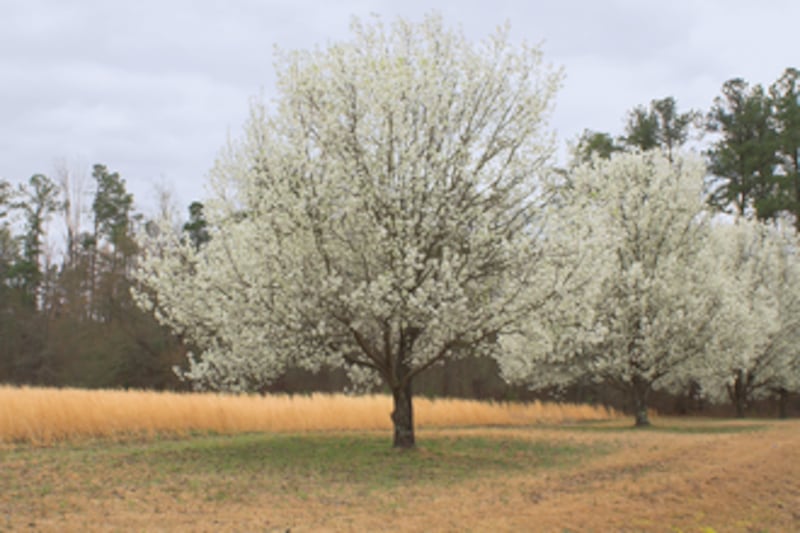
Dave Kitz has a meme showing how to trim a Bradford pear tree. The photo, passed around by arborists, shows a chainsaw cutting a towering, white-flowered tree off at the trunk “for the best results.”
Kitz is an arborist with the tree service company Davey Tree, based out of Lombard. As a person who loves trees, he doesn’t like the Bradford so much.
“If you need to eradicate it from a woodlot, it becomes dangerous. It is hand-to-hand combat” because of the large, hazardous thorns grown by a tree gone wild, Kitz said. “It punctures the tires on the equipment they use to mow it down.”
It’s the growing wild part that has caused problems. In addition to the thorns, the trees have cross-pollinated with other pear trees and now bear fruit. Birds and other animals eat the small, marble-sized fruit and spread it outside of yards. As it spreads, it can choke out native trees.
Last fall, the Illinois Department of Natural Resources added the Bradford pear – also known as the callery pear – to its list of invasive plants covered by the state’s Exotic Weeds Act. As of Jan. 1, 2028, it will be illegal to sell the trees in Illinois. The later date gives tree nurseries time to sell off their existing stock.
At the Perricone Garden Center near Volo, they have about two years’ worth of the tree in stock, general manager Richard Peterson said. “We should be on target with limitations” as they sell about 50 a year, he added.
It’s been a popular tree for the 30 years they’ve carried it because it can grow to 25 feet high with a 15-foot canopy, is triangular in shape, and has white flowers in the spring, Peterson said.
In autumn, its leaves are deep red to burgundy. “And, they don’t lose their leaves until November,” Peterson said.
As Kitz said, “It was very pretty in the spring, with beautiful white flowers. Some enjoyed the fragrance, and it was a survivor – it tolerates our soils and climate."
The Bradford pear is a cultivar of the callery pear, explained Sharon Yiesla of the Morton Arboretum. “They are from the same species, and all show the same problems.”
They “fell out of grace” as an ornamental landscaping tree, Yiesla said, because the trees are weak-wooded. When storms came through, the pear tree can split and come down.
As a cultivar, the Bradford pear was also supposed to be sterile. “Somewhere along the line, the ornamental trees have cross-pollinated with edible pears,” Yiesla said. “Now they are producing fruit in abundant quantities.”
Bradford and callery pear trees – native to Eastern Asia – have been in the U.S. for 100 years, Yiesla said. The problem with them fruiting and spreading has only been in the last 20 to 30 years.
She remembers seeing her first fruit on a Bradford tree in 1988. “At the time it was one, isolated pear. The trees were figuring it out. It happens with plants that are sterile – the figure out how to cross-pollinate with cousins," Yiesla said.
At the McHenry County Conservation District, the first wild Bradford pear was found on one of their sites in 1999, plant ecologist Laurie Ryan said. “Then there was one in 2009.”
In 2025, 15 trees were found on eight of the district’s sites. When they are found, the land managers “go ahead and control it,” Ryan said – taking the tree down.
The district also asks residents using the wildlife areas to let them know if they see a Bradford - or other invasive species – inside their parks, Ryan said.
With the state’s upcoming ban on sales, homeowners do not have to remove existing trees. “Typically, they last 40 years in a home landscape,” Peterson said.
If a homeowner wants to remove it – because of the ban or if it has started to fruit – they can pay to take the tree down, Peterson said, adding “it is something you hate to see, to eliminate a tree as a landscape designer.”
What can, or should, the invasive pear trees be replaced by?
If the homeowner is looking for a flowering tree that produces fruit for wildlife, Ryan suggests wild plum, native serviceberries, or native crabapples.
The wild plum “has a delightful smell,” Ryan said, adding she knows naturalists who say they look forward to its scent in the spring.
Peterson also agreed with serviceberry trees as an option. “The serviceberry has a similar shape, but less of a fire-engine red leaf,” adding that it’s more of a ketchup color in the fall.
Other options suggested by Kitz are the redbud tree – another native plant – or magnolias, dogwoods, lilacs, and again, crabapple.
It used to be that crabapple would get diseases, but new cultivars have bred out those traits, Kitz said. Some may not like the fruit, which are small, very tart, and fall onto lawns.
The idea of cutting down any tree just to remove it is abhorrent to him, Kitz said. But he’s also seen the drawbacks of having too many of the same trees in the same area, creating a monoculture.
That, he said, is why Dutch elm disease wiped out elms in the U.S., and the emerald ash borer is decimating ash trees – too many of the same species planted means easier spread of pests and disease.
Yiesla suggested that homeowners who want to know more about what not to plant use the Midwest Invasive Plant Network website, mipn.org. The site can tell users not only what plants are being legislatively removed from your own state, but also how neighboring states are dealing with potentially invasive species.
“It can give food for thought, to make an informed decision on where I would have it in my yard or not,” Yiesla said.
The arboretum’s website, mortonarb.org, also offers information on plants and trees to help decide what to plant.
“It is like going online and shopping for plants you can consider for the place you are in,” Yiesla said.
:quality(70)/s3.amazonaws.com/arc-authors/shawmedia/185fbfd8-8216-43d7-8beb-cd8992be6fe5.png)