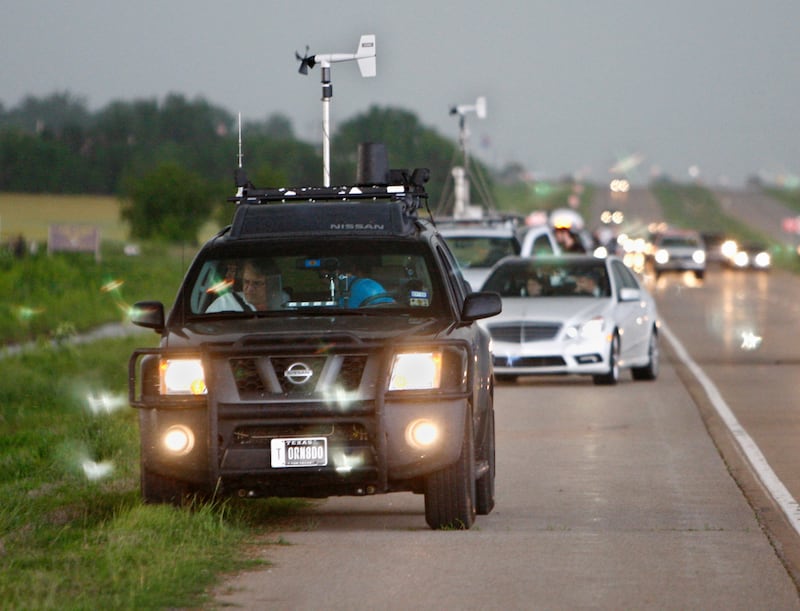
For weather YouTubers such as Ryan Hall and Max Schuster, the tornado that tore through Kankakee on March 10 wasn’t a surprise; they had been telling their audiences to take heed of that storm long before it reached Kankakee.
When storms hit northern Illinois, a growing number of residents are turning to these YouTubers. As of April 17, Schuster has 1.85 million subscribers on YouTube, Hall has 3.26 million.
Hall and Schuster – the men behind competing YouTube channels, @RyanHallYall and @MaxVelocityWX, respectively – have become among the most-watched weather streamers. They and other nationally focused YouTube live-streamers like them have increasingly changed how many people seek information when they see storms brewing on their horizon.
What makes them different from traditional newscasts? Unlike TV and radio stations that begin coverage when storms enter their area, online streamers aren’t tied to a region. This allows people like Hall and Schuster to broadcast radar and potentially life-saving information about severe weather across the country.
Both men spent hours on April 17 narrating a livestream for thousands of viewers across the Midwest. Severe storms and tornadoes, including an EF-2 tornado that caused extensive damage in Stephenson County, ripped through northern Illinois on Friday, leaving a trail of destruction across rural communities.
:quality(70)/cloudfront-us-east-1.images.arcpublishing.com/shawmedia/KKQHTZTOC5FAJKHKQ6ZQZELH5M.jpg)
Days before the Kankakee tornado, Schuster said he may have saved a child in Michigan.
“Apparently, there was a 12-year-old kid that was watching our stream that had no clue about the storm coming, and it was producing a large tornado,” said Schuster, who holds a degree in meteorology. “They ended up getting hit by it. And they would have never taken shelter, and they might not have been here today if it wasn’t for our livestream.”
Hall was streaming on Dec. 10, 2021, when an EF-4 tornado, commonly known as the Mayfield tornado, formed. The tornado killed 57 people and injured more than 500 in western Kentucky, according to the National Weather Service.
“A lot of people from that town were tuning in, and they were dependent on our broadcast,” Hall said. “When that happened, that’s when I kind of realized like ‘Oh wow, this is serious, like people are dependent on this and we’ve got an opportunity here to do this right and make a big difference.’”
What happened in Mayfield isn’t a foreign concept in northern Illinois. On Aug. 28, 1990, an EF-5 ripped through Oswego, Plainfield and Joliet, killing 29 people and injuring 350.
Since 1950, at least 57 people have been killed by tornadoes across several northern Illinois counties, according to NWS data. No one has died from a tornado in DuPage, Grundy, Kane, Kendall, Lee and Whiteside counties over that same time period, data shows.
Hall and Schuster have each created their own weather notification system that sends an alert to a phone when the National Weather Service issues a warning for a given location.
YALLCALL, Hall’s weather notification service, provides a phone call to people who pay to have the service notify them when severe weather threatens their area.
Hall said he decided to focus on automated phone calls because of the demographics of his YouTube audience.
“A good chunk of our audience is [older than 65],” Hall said. “A lot of them just don’t like apps. They don’t like – we use a lot of high-tech stuff, and we just found that over time, the easiest way to reach a lot of these people, and the way they want to be reached, is through a phone call."
Schuster’s service, called Max Alert, provides a similar product. He said he likes that the alert is a phone call because few people wake up from push notifications on their phone.
Chris Maier, NWS national warning coordination meteorologist, said the NWS recommends everyone have a National Oceanic and Atmospheric Administration weather radio in their home to be alerted to severe weather. The recommendation came with a caveat, however.
“It’s important to have multiple ways to receive weather alerts,” Maier said. “Text alerts, email alerts, Wireless Emergency Alerts, smart phone alerting apps, the Emergency Alert System, and NOAA Weather Radio are all examples of other ways to get weather warnings.”
Hall thinks of his phone alert system as “complementary” to NOAA weather radios. Despite believing most people don’t want to buy weather radios, he said the number one way for someone to get weather alerts is through that radio system.
“It’s an archaic technology,” Hall said. “But everybody has a phone. So it’s not meant to replace it, it’s just like another tool in the toolbox to help people stay prepared.”
Although online weather content and phone alerts have transformed how many people get weather information, the shifting paradigm hasn’t changed the way everyone collects information.
:quality(70)/cloudfront-us-east-1.images.arcpublishing.com/shawmedia/FZ2IMEC3SJBZ7C7V6TASDIIYOM.jpg)
DeKalb County Sheriff Andy Sullivan said his office uses the same methods to monitor hazardous weather as it did on April 9, 2015, when an EF-4 tornado obliterated much of Fairdale in northwest DeKalb County.
Geraldine Schultz, 67, and Jacklyn K. Klosa, 69, of Fairdale, were killed. The tornado also struck neighboring Rochelle, less than 20 miles south of Fairdale, but it wasn’t as severe.
“Miraculously ... there was entire houses missing from their foundations, but nothing was on fire, nobody was missing [in Rochelle],” said Rochelle Fire Chief David Sawlsville, who was working that day.
Most people in Rochelle and Fairdale 11 years ago would have been warned of severe weather through their TVs or storm sirens.
First responders use NWS and other resources, too, sometimes sharing alerts on social media.
“We monitor the weather through the IEMA [Illinois Emergency Management Agency] and other online sources too, to stay up to date on forecasted weather,” Sullivan wrote.
Sawlsville also relies heavily on the NWS to give him real-time radar when severe weather approaches.
“They have a pretty sophisticated radar system, so if we are looking for real-time radar, that’s where we go,” Sawlsville said. “But also, they are very proactive at giving us predictions.”
:quality(70)/cloudfront-us-east-1.images.arcpublishing.com/shawmedia/4KVXLUVRFSXURHVVBNFDPU5XEY.jpg)
In 2020, the primary greenhouse for Rooted For Good in Kirkland sustained heavy damage during a thunderstorm that may have spawned a tornado.
Executive Director Heather Edwards said she makes sure Rooted for Good staff and volunteers have a safe place for inclement weather during business hours. She said the organization monitors traditional news outlets, the Weather Channel and radar apps when severe weather crops up.
Audra Bruschi, NWS national impact-based decision support services program manager, said, “trustworthy information can be presented from a variety of sources, including our partners in the media.”
She also said evolving online weather alerting isn’t a bad thing when it comes to keeping people safe.
“Digital content creators present an opportunity to serve as force multipliers to help amplify NWS’s hazardous weather messaging to support public safety, keeping more American citizens safe and informed,” Bruschi said.
Schuster said he didn’t expect the way many people consume weather coverage “to go the direction it’s gone,” this decade.
“Over the last five, six years, cable has been kind of going out the door,” Schuster said. “And social media, in terms of everything, but weather especially, has just exploded. The amount of people that now only rely on social media for weather is incredibly high.”
:quality(70)/author-service-images-prod-us-east-1.publishing.aws.arc.pub/shawmedia/114d2561-d902-4313-913c-3ed613087b49.png)