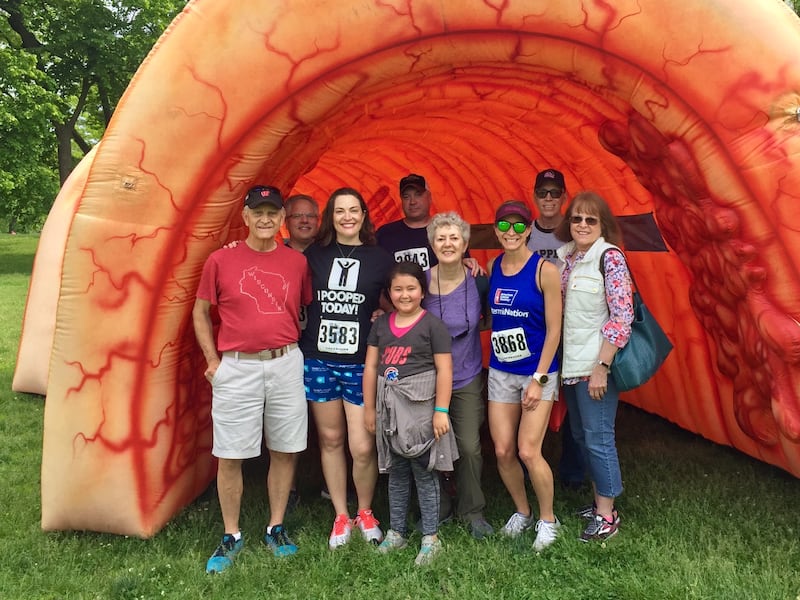
On July 1, 2016, Jessica Catlin, 39, was on a train to see Guns N’ Roses play at Soldier Field when her intermittent rectal bleeding escalated.
Unfortunately, Catlin, formerly of St. Charles and now Chicago, was still several weeks away from the colonoscopy she’d fought to schedule because she was “too young” - despite a family history of rectal cancer, she said.
“Too young” doesn’t cut it anymore.
Colorectal cancer is now the leading cause of cancer death in people younger than 50, according to the American Cancer Society.
In fact, people born in 1990 have double the risk of colon cancer and quadruple the risk of rectal cancer than people born in 1950, the American Cancer Society also said.
In 2025, Lincoln-Way East teacher Jason Berg shared on the Silver Cross Hospital video “Beating Colorectal Cancer: The Power of Early Detection” his colorectal cancer diagnosis at the age of 42.
Dana Borror, 44, of Crystal Lake, said she was 38 when her symptoms began: constipation and anemia.
:quality(70)/cloudfront-us-east-1.images.arcpublishing.com/shawmedia/HKEK2DEUS5HERN5X3EN4WVKY3M.jpg)
Nick French, 41, of Rockford, said he had narrow stools shortly before experiencing “Montezuma’s Revenge” after a trip to Cancún, which progressed to constipation and bleeding.
Wenora Johnson of Joliet was lucky. In 2011, Johnson’s doctor ordered a fecal occult blood test since Johnson, 45 and asymptomatic, was too young for a colonoscopy.
In 2021, the recommended screening age for colonoscopy was lowered from 50 to 45.
Johnson was subsequently diagnosed with 3B colon cancer and Lynch Syndrome, a genetic condition that can cause colon and other cancers.
“In 2016, I had a total hysterectomy,” Johnson said in a 2020 interview, “only to find out I was already at stage 1 endometrial cancer. It [the genetic test] was spot on.”
And then in 2017, Johnson’s dermatologist “wound up cutting out two inches of basal cell carcinoma,” Johnson said.
:quality(70)/cloudfront-us-east-1.images.arcpublishing.com/shawmedia/Y53SCIXLULW5MKA5OM6BZANBWE.jpg)
But Catlin, Borror and French all heard their bleeding was likely due to hemorrhoids, they said.
Symptoms no one should ignore
According to GI Partners of Illinois, people should call their doctor if they have
• Bathroom habits that have quietly changed and stayed that way
• Persistent abdominal discomfort, cramps, gas, pain
• Feeling like your bowel doesn’t fully empty
• Unexplained weight loss
• Fatigue that doesn’t improve with rest
• Narrow or pencil-thin stools
“If you have symptoms, don’t mess around,” said Dr. Manish Bhuva, a board-certified gastroenterologist and board president of GI Partners of Illinois.
:quality(70)/cloudfront-us-east-1.images.arcpublishing.com/shawmedia/T5HOU5R4WJHT5LBVJA4ZB257H4.png)
Doctors don’t fully know why cases are rising, but lifestyle and diet are key suspects, Bhuva said.
But risk factors include a diet high in ultra-processed foods, red meat, processed meats, sugary drinks, added sugars, and low in fiber (which increases inflammation in the colon) – with lack of exercise, obesity and disruption of the gut microbiome adding to the risk, Bhuva said.
Colonoscopy remains the gold-standard screening test for colon cancer because it finds and removes polyps, Bhuva said. Stool-based tests are good at detecting colon cancer but less effective at detecting cancer precursors, he added.
Bhuva understands why people avoid colonoscopies.
“It’s not like going on vacation; it’s not a pleasant thing,” Bhuva said. “You’re not eating for a day, the prep. But it’s not like you’re doing it every month.”
‘Can I please get a colonoscopy?’
When multiple doctors didn’t take her rectal bleeding seriously, Catlin said she finally “pulled out the family history card.”
“My grandmother died of this. Can I please get a colonoscopy?” Catlin pleaded.
The colonoscopy found a 2-inch lesion in Catlin’s rectum. Catlin had stage 3 rectal cancer.
:quality(70)/cloudfront-us-east-1.images.arcpublishing.com/shawmedia/GRPBA6LZ4ZEVFM7PM6A4TSKKLY.jpg)
Catlin had surgery, chemotherapy, radiation and a temporary ostomy. She turned 40 between radiation, which caused intense burns and instant menopause, and surgery, she said.
To update loved ones, Catlin blogged about her experiences, which she published in a book: "Full Circle: How Politics, Depression, and Yoga Helped Me Crush Colorectal Cancer and Crisis."
‘Eat more fiber’
For two years, health care providers told Borror to “eat more fiber and drink more water,” Borror said.
When Borror also developed anemia (attributed to her menstrual cycle), she was told to “take more iron,” she said.
“Which causes constipation,” Borror said. “The constipation – it was never-ending.”
Two years later, Borror began passing small amounts of “hardly noticeable” blood, which was blamed on “probably internal hemorrhoids” caused by constipation, she said.
In late 2022, Borror finally received a referral to see Bhuva, who worked with her insurance company to approve a colonoscopy, she said.
Borror was subsequently diagnosed with stage 3 colon cancer at 41.
She had surgery to remove “a lot” of her colon, a colectomy and six months of chemotherapy.
“Chemo is a beast,” Borror said. “It’s rough. And I had kids. I was working full-time. It was very challenging. But I had a great circle of friends and family; they were bringing me dinners and all those things.”
:quality(70)/cloudfront-us-east-1.images.arcpublishing.com/shawmedia/YZ4POHA3XFCSXHTYTZPTOAXSIE.jpg)
Borror said she takes a ctDNA (circulating tumor DNA) blood test every three months to check for cancer DNA in her body. Because ctDNA is an emerging technology, private insurance and Medicare don’t always pay for the test.
‘I had a tumor blocking ¾ of my colon’
French also sought several opinions before a colonoscopy was scheduled six months out.
French said it was “a gigantic shock” to learn – post-colonoscopy – he had “a tumor blocking ¾ of my colon.”
The diagnosis? Stage 3 colon cancer – at 38 and subsequent treatment at OSF Saint Anthony Medical Center’s cancer center.
French underwent chemotherapy, radiation, then surgery (“They took my entire colon,” he said) and then the ileostomy.
“I was freaking out for a few days: ‘What is life going to be like, life with this bag? Poor, poor me,’” French said. “But I had the surgery and within a couple of months, it’s normal.”
Survivors and advocates
Johnson, a staunch advocate for colorectal cancer awareness, appeared at the March 3 Joliet City Council meeting to thank the council for issuing a proclamation recognizing March as Colorectal Cancer Awareness Month for the third year in a row.
:quality(70)/cloudfront-us-east-1.images.arcpublishing.com/shawmedia/PQ4ABI5WGFCFDMMYV7CHVIMED4.png)
“As a three-time cancer survivor, patient, and research advocate, I know firsthand proclamations like this are more than words on paper. They are a call to action,” Johnson said to Joliet City Council members. “And sometimes they are the push someone needs to make a lifesaving appointment.”
Borror volunteers in the buddy program of the Colorectal Cancer Alliance (Blue Hope Bash Chicago is May 1) and was paired with a 41-year-old woman who also had stage 3 colon cancer, who recently died, she said.
French had one message: “Get your colonoscopy.”
Borror said people should insist doctors take symptoms seriously and push for answers.
Catlin agreed.
“I would rather be alive than polite,” Catlin said.
:quality(70)/s3.amazonaws.com/arc-authors/shawmedia/59304215-cb18-46db-bced-9941d9413236.jpg)