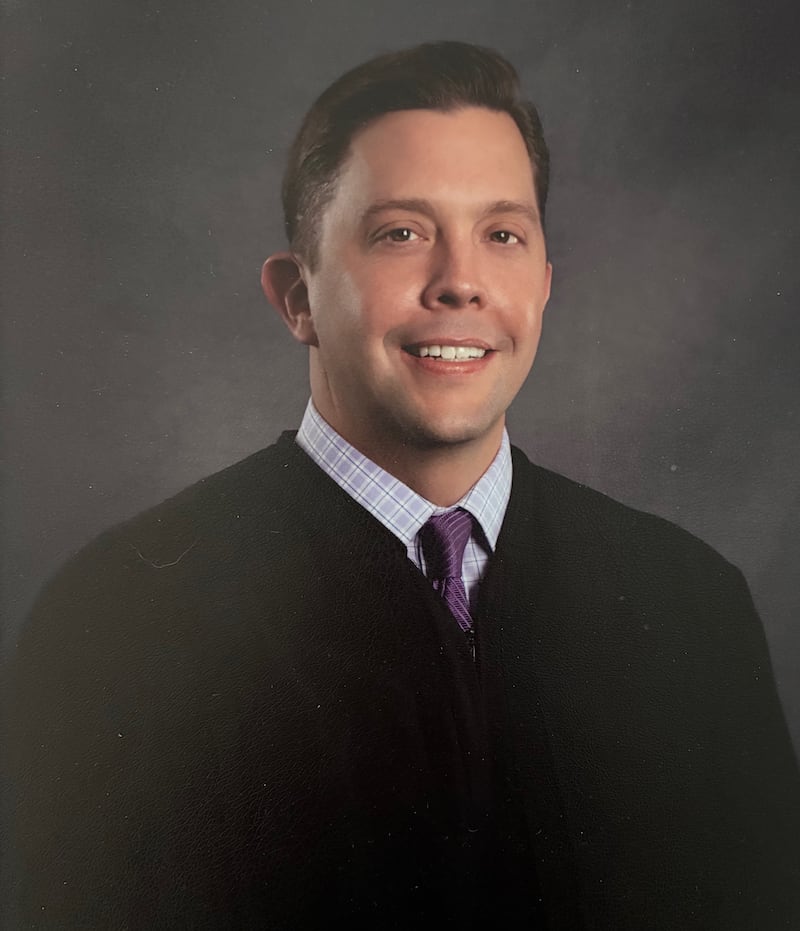
Name: John Pavich
What office are you seeking: Justice for the Illinois Appellate Court 3rd District.
What is your political party? Democrat
What is your current age? 49
Occupation and employer: I am currently an Associate Circuit Judge for the 12th Judicial Circuit of Illinois.
What offices, if any, have you previously held? Associate Circuit Judge
City: Frankfort, Illinois
Campaign website: www.pavichforjustice.com
Education: I received my B.A. in International Studies and a minor in Russian from St. Norbert College. I received a certificate in Russian language and culture from Kharkiv Polytechnic University in Kharkiv, Ukraine. I received my J.D. with a concentration in International Law from Loyola University Chicago School of Law.
Community involvement: My family and I actively support the charitable organizations Care for Friends and Bridges from School to Work. Additionally, I have volunteered in my sons’ ice hockey programs over the years.
Marital status/Immediate family: I am married to my wife, Kelly, and we have two sons, Andrew and Matthew.
What professional experiences best prepare you for the appellate bench?
I firmly believe that I possess the professional and personal qualifications and experience necessary to be an effective member of the Illinois Appellate Court. Prior to my appointment to the judiciary in February of 2019, I practiced law for 14 years. The focus of my practice was complex civil litigation, often touching on areas of international law. I routinely brought cases under the Foreign Sovereign Immunities Act and the Alien Tort Claims Act. As such, I practiced before multiple courts in numerous jurisdictions, including the U.S. Supreme Court. Additionally, I represented clients in federal immigration criminal cases, with fact patterns involving allegations of international law violations. The nature of my practice involved a heavy amount of motion practice. As a result, I further developed excellent research and writing skills, skills which are essential to an appellate court justice.
In addition to my private practice, I have now been a sitting judge for nearly 7 years. While on the bench, I have presided over numerous courtrooms, including criminal, probate, guardianship and the juvenile abuse and neglect courtrooms. This varied courtroom experience will serve me well as an appellate judge who will be required to address cases across the legal spectrum.
On this point, I have actively requested assignments to courtrooms in which I had little to no prior experience. I have done so because I possess a true love of exploring and learning new areas of the law. This love of learning will be an asset on the appellate court, where I will regularly encounter cases involving areas of the law in which I am unfamiliar.
I also have non-legal experience which has prepared me well for the appellate court. As an undercover staff operations officer with the CIA, I was required to utilize critical thinking skills and to operate well under high-pressure situations. These skills will allow me to be a more efficient appellate court judge.
How will you ensure fairness and impartiality in your decisions?
I submit that the public may be confident that, as an Appellate Court Judge, I will do everything within my power to ensure fairness and impartiality in my decisions. The incredible responsibility of the office to which I have been appointed is never lost on me. I strive each day to make the best decisions possible, within the law and the facts as presented. As part of this commitment, I always make these decisions without regard to my personal beliefs. I believe, and hope, that I have been successful in this endeavor on more days than not.
How would you describe your judicial philosophy?
My judicial philosophy is centered around an absolute commitment to the rule of law. I believe everyone is entitled to an equal opportunity to be heard, equal justice in the courts and an absolute guarantee of certain due process rights. I endeavor to approach each case to which I am assigned with this understanding.
What is the proper role of an appellate judge in Illinois?
The role of an appellate judge within our judicial system is to thoroughly review the record of the case on appeal, digest and analyze the legal arguments and cited case law and determine whether the issues on appeal warrant the reversal of the trial court on any issue raised or if the trial court’s decision should be affirmed. Of course, all judges must perform these obligations with an unbiased and neutral perspective and, also, with an absolute fidelity to the rule of law.
How will you manage caseloads and reduce backlog?
On the Appellate Court, as I have at the trial court, I will work tirelessly to manage my cases in an effective way to reduce any backlog but also to arrive at the best possible decisions in a thoughtful and well reasoned manner. Toward this end, on the Appellate Court, I will supervise my clerks in a respectful manner to ensure that we do everything possible to move our cases forward.
What is your approach to writing clear, accessible opinions?
Through my private practice, I have developed very effective legal writing skills, specifically at the appellate level. At the appellate level, I will utilize these skills in writing clear and accessible opinions. With each case, I will first assess the legal questions presented. I will then read and digest the parties’ briefing. I will then read the cases cited by the parties in the briefs. At this point, I will begin my own independent research in the question. With this research in hand, I will begin drafting the opinions. I will do so as I drafted my appellate briefs as a private practitioner, with a goal of being clear, concise and persuasive.
What is your opinion on the SAFE-T Act?
I believe that the SAFE-T Act was a well intentioned law meant to address serious inequities within our legal system. All too often, under the previous cash bail system, whether a Defendant was released pending trial depended on his or her access to significant funds. The SAFE-T Act changed this and centered the pre-trial release question more on an overall assessment of the individual’s threat to the community and the individual’s likelihood to refuse to appear in court for future hearings. That being said, it is also important to ensure that judges have the greatest discretion possible in making decisions on pre-trial release.
Do you believe the role of the courts is changing in any way?
As with any institution, the courts are constantly evolving. In recent years, the courts have been forced to adapt to new technologies and methods, such as Zoom court proceedings and electronic filing. Additionally, the courts have adapted to the increase in the number of self-represented litigants. The courts have done so by making certain legal forms more accessible and understandable.
With this said, the primary purpose of the courts within our legal system is to facilitate the search for truth within the law. On this point, the role of the courts remains unchanged.