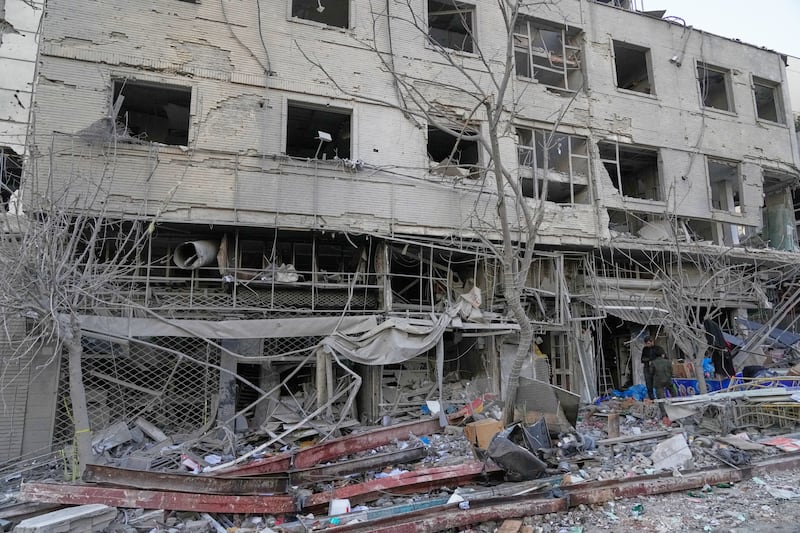
A U.S. strike that killed Iran’s supreme leader and sparked a growing war was years in the making, said a Northern Illinois University expert who has studied U.S.–Iran tensions.
The death toll, which includes six American servicemen and 555 Iranians, includes Iranian Supreme Leader Ayatollah Ali Khamenei, according to The Associated Press.
What led to the conflict?
Ches Thurber, an associate professor of International Relations at Northern Illinois University, said the U.S.-Iran relationship has had serious issues for a long time, and the U.S. has had concerns about Iran’s nuclear program, its support for terrorism throughout the Middle East, and its repression of protesters earlier this year.
The Associated Press reported in a Jan. 15 story that nationwide protesters were sparked by Iran’s ailing economy, putting pressure on its theocracy. The Iranian government responded with a deadly crackdown. It also shut down the internet. More than 600 protests sprang up across Iran’s 31 provinces, which led to 2,615 dead and 18,470 arrests.
“What we haven’t seen from President Trump yet is kind of a coherent case for why these amounted to a situation in which it was necessary to use force immediately, especially coming off of last year, where we used force to take out these nuclear sites,” Thurber said. “At the time, President Trump seemed to indicate that he solved the nuclear problem for the foreseeable future.”
:quality(70)/cloudfront-us-east-1.images.arcpublishing.com/shawmedia/A4OAAA6ZGVDGJKLQYBBLHTXN74.jpg)
Thurber said the operation in Venezuela that saw the removal of Nicolás Maduro from power was, in Trump’s eyes, successful, and that made him more bullish on his ability to take out foreign leaders.
“You have these protests happening in Iran, and he’s thinking, well, I should do the same thing here,” Thurber said. “This is the chance to do it. The problem was, at the time, the US didn’t have the military assets in place in the region in order to do what President Trump wanted to do effectively.”
Over the past couple of months, Thurber said, the US has moved assets to the Middle East so it could conduct sustained strikes.
Thurber said Iran’s nuclear program had the capabilities to enrich uranium to the levels that could be used for a nuclear weapon, and they wanted to keep that on the table.
“They put everything on hold while we had this agreement with Iran, the nuclear deal that Obama struck, and then President Trump ended that nuclear deal in his first term,” Thurber said. “After that, we saw the Iranians return to enriching uranium.”
Reactions at home
The response to the attack on Iran, which was not approved by Congress, has been swift, with many democratic lawmakers condemning the strikes.
Republicans voiced support.
U.S. Rep. Darin LaHood, R-Peoria, whose 16 District spreads through La Salle County and into Grundy County, posted a statement on X in support of the attacks on Saturday morning.
“Rather than engage in good-faith negotiations, the Iranian regime has continued to fund terrorist organizations, destabilize the Middle East, murder its own citizens, and threaten the security of the U.S. and our allies,” LaHood said.
“Last night’s Operation “Epic Fury” was a direct consequence of Iran’s actions and its refusal to pursue a peaceful path forward,” LaHood continued. “President Trump and his team made every effort to provide the regime with a diplomatic off-ramp, but the safety and security of the American people must always remain our top priority.”
U.S. Rep. Lauren Underwood, D-Naperville, is set to issue a statement later this week on the issue.
The Council on American-Islamic Relations also has condemned the bombings. On Saturday, calling the Trump Administration’s actions the start of “another unnecessary, unjustified, and unconstitutional regime-change war in the Middle East.”
“We call on the American people to vocally oppose this illegal war before American soldiers and more people across the Middle East lose their lives,” CAIR said in a statement condemning the war. “We call on Congress – especially Democratic leaders – to reject the demands of AIPAC, listen to the American people, and take every action possible to stop this war of choice, including by supporting the Massie-Khanna War Powers Resolution.”
The Massie-Khanna War Powers Resolution refers to a bill Kentucky Republican Thomas Massie and California Democrat Ro Khanna plan to introduce in the House of Representatives this week to restrain the attacks without approval from Congress.
Additionally, on Sunday, CAIR issued a second statement calling for an investigation into the American-Israeli bombing that reportedly left more than 140 people dead, including dozens of students, at an all-girls elementary school in southern Iran.
“We strongly condemn the massacre of Iranian schoolgirls and teachers at an elementary school perpetrated during the U.S.-Israel bombing of Iran,” the civil rights group said in a statement, which referred to the bombing as a war crime.
“Relevant congressional committees must conduct a swift, transparent, and independent investigation into this war crime,” the statement continued. “If the U.S. did indeed commit this massacre, Pete Hegseth and any U.S. military officials involved in ordering the attack must be removed from their posts... We need answers. We need accountability. Most importantly, we need an end to this illegal war before more people die.”
CAIR has urged Americans to contact their local members of Congress and the White House to demand an end to the war.
:quality(70)/cloudfront-us-east-1.images.arcpublishing.com/shawmedia/2SQR2YOKXFFMTLT7XDN2IKUDBY.jpg)
Thurber said these conflicts have a massive humanitarian cost.
“One is remembering just how brutal the Iranian regime has been to civilians,” Thurber said. “Thousands, by some estimates, potentially 10s of thousands of protesters that were killed earlier this year, but then also in the current war and the current strikes.”
Defense Secretary Pete Hegseth said Monday that “this is not Iraq. This is not endless,” but he also said more American deaths are likely in the weeks ahead.
President Donald Trump said strikes on Iran could last several weeks, though he said the US is prepared to go on for longer.
How could this end?
Thurber said how the conflict in Iran plays out depends on decisions that Trump hasn’t made yet.
“I think he saw an opportunity to take out the leaders of Iran, some senior leaders, and then he wanted to see how things played out, how they played out in the country in terms of what kind of new leadership emerged in Iran, with maybe a long-shot chance that there would be some type of uprising and change in regime, but also to see how things played out domestically,” Thurber said.
In the past, Thurber said, Americans have rallied around wars once they begin. That has not seemed to be the case this time: A Reuters poll from Monday shows that 43% of Americans disapprove of the attack on Iran.
“We’ve seen a number of polls come out today that show a surprising lack of support for this military operation,” Thurber said.
• Eric Schelkopf contributed to this story
:quality(70)/s3.amazonaws.com/arc-authors/shawmedia/744709d3-0d08-4f13-a8f2-47f3f8ea9de6.png)
:quality(70)/s3.amazonaws.com/arc-authors/shawmedia/c957a8ff-14a0-492e-82d7-3c005b3cd732.png)