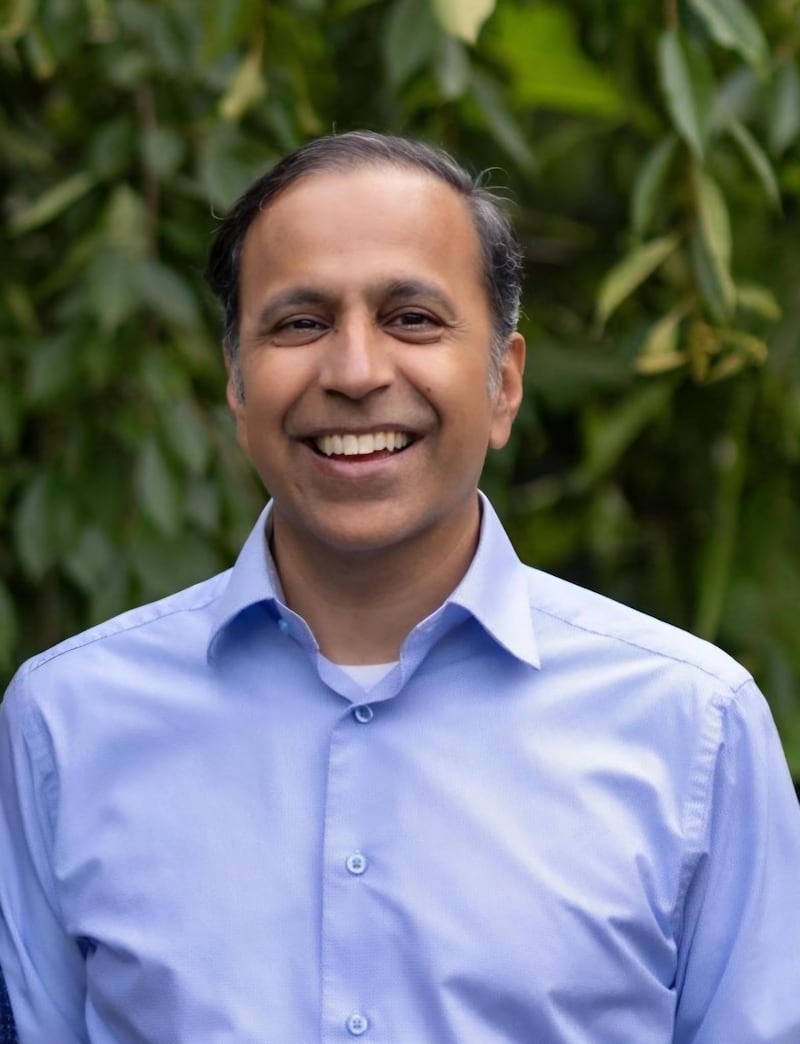
Name: Raja Krishnamoorthi
What office are you seeking: U.S. Senate
What is your political party? Democrat
What is your current age? 52
Occupation and employer: U.S. Congressman representing Illinois’ 8th District, U.S. House of Representatives
What offices, if any, have you previously held? * Deputy State Treasurer under Illinois Treasurer Alexi Giannoulias
- Special Assistant Attorney General under Illinois Attorney General Lisa Madigan
- Vice Chairman of the Illinois Innovation Council
- Board of the Illinois Housing Development Authority
City: Schaumburg
Campaign website: https://rajaforil.com/
Education: * Richwoods High School - High School Diploma, Valedictorian
- Princeton University - Class of 1995, Bachelor of Science in Mechanical Engineering, Summa Cum Laude
- Harvard Law School - Class of 2000, Juris Doctor, Honors
Community involvement: In Illinois 8th Congressional District I am an active participant in the community groups that organize and support local Democrats in Chicago’s Northwest Suburbs, including the Schaumburg Democrats.
Marital status/Immediate family: My wife, Priya, and I are raising three children together.
What are your top three legislative priorities for your first year in the U.S. Senate?
I intend to address the affordability crisis head-on. President Trump and his Administration have hurt working families through reckless policies like blanket tariffs that have fueled rising prices. The increased cost of living, substandard wages, and lack of economic opportunity have left the American Dream out of reach for millions of Americans. We must address the affordability crisis, especially for necessities like housing, healthcare, education, and food
We must end the Trump Administration’s endless abuses of power. Donald Trump has pushed the limits of presidential power to the brink, expanding power for himself and his allies while undercutting the rights, freedoms, and due process of Americans. He has deported citizens and violated our data privacy. He has targeted his political enemies and pardoned insurrectionists. He has profited off of the presidency. And now he is threatening our Constitution by hinting at pursuing a third term. As Illinois’ next U.S. Senator, I’ll use every tool in my toolbox to limit the damage he can do to this country and its citizens while making sure a Trump-like White House – without deference for the rule of law, due process, and civil rights – never happens again.
As our next U.S. Senator, I will continue fighting to protect and expand healthcare for everyone because healthcare is not a privilege, it’s a right. Medicaid is at risk due to heartless cuts by the Trump Administration, and I will continue to fight to protect its existence for the millions of Americans who rely on this program for life-saving healthcare with my Bringing Back Benefits Act. I will also fight to extend the tax credits under the Affordable Care Act, also known as Obamacare, which make health coverage affordable for millions of American families.
Should the Senate eliminate the filibuster? Do you support term limits for senators, and if so, what limits?
I support eliminating the filibuster to pass essential legislation to protect the rights of Americans, including voting and abortion rights.
I am also the only candidate in this race to support term limits and age limits for members of Congress. These guardrails would preserve institutional knowledge while preventing permanent incumbency. They would also help restore confidence in a Congress perceived as disconnected from the public it serves. But we need to go further and implement measures to restore trust in the institution as well, including banning Members of Congress from trading individual stocks. I have spearheaded this effort in Congress by introducing my ETHICS Act.
How do you plan to work with or oppose the Trump administration? What’s your approach to bipartisanship?
Cooperation remains possible on policies that lower costs, protect jobs, and strengthen American security. Opposition becomes necessary when power serves bad actors over the interests of the American people. I will never hesitate to confront President Trump directly when his administration advances policies that hurt workers, undermine democratic norms, and reward special interests.
I remain willing to work with anyone, regardless of party lines, to deliver real results for working families. As the top Democrat on the House Select Committee on Competition with the Chinese Communist Party, I helped lead one of the very few bipartisan successes in the recent Congress. Our work addressed America’s greatest external challenge through serious work rather than performative partisanship, offering a model for how Congress can function effectively with bipartisan cooperation.
On domestic issues, I authored with Rep. Glenn “GT” Thompson (R-PA) the bipartisan Strengthening Career and Technical Education for the 21st Century Act to modernize our skills-based education system for the first time in more than a decade. This legislation provided nearly $1.4 billion annually to programs across Illinois and around the country to help roughly 13 million students obtain a higher-quality, skills-based education. For the 64 percent of Americans without a four-year college degree, skills-based education is often transformative and an entry into the middle class.
Along with Rep. David McKinley (R-WV), I introduced the bipartisan Dr. Lorna Breen Act to provide mental health services for the first time to healthcare professionals. It is named after Dr. Lorna Breen, a New York City emergency room physician who tragically died by suicide after enduring the trauma and burnout of working on the frontlines of the COVID-19 pandemic.
This legislation established training and other mental health resources for medical professionals and increased awareness of mental health concerns among health care workers. I am proud that, out of the partisan rancor surrounding the federal response to the pandemic, we were able to forge this bipartisan law that will continue to help those on the frontlines of providing health care across America.
How would you address inflation and rising costs for Illinois families?
As Illinois’s next U.S. Senator, I will work tirelessly to address the affordability crisis, fighting to lower costs for working families, expand job opportunities that fuel economic growth, and restore critical social safety-net programs that have been cut by the Trump administration.
First, I have introduced the Bringing Back Benefits Act to reverse recent cuts in lifesaving programs such as SNAP, Medicaid, and Social Security. With the expiration of the Affordable Care Act tax credits last year, healthcare costs are rising substantially for millions of Americans. My legislation would restore those tax credits as well.
Second, my Restore the American Dream Plan would greatly expand the federal investment in career and technical education for the nearly two-thirds of Americans who don’t pursue a four-year college degree. This would greatly strengthen the American workforce and economy for the future while providing good-paying jobs to support a middle-class life for millions of American families.
Third, my Restore the American Dream Plan would make life more affordable for millions of senior citizens on fixed-incomes by eliminating federal taxes on their Social Security benefits. It would also lower their prescription drug costs by accelerating the number of drugs subject to price negotiation under Medicare and cracking down on Pharmacy Benefit Managers (PBMs), who have served to increase drug prices rather than reduce them for consumers.
What federal actions should Congress take to improve health care affordability?
I believe that healthcare is a right, not a privilege. Yet, today, millions of hardworking families who did nothing wrong are being priced out of lifesaving care. The Medicaid cuts in the so-called Big Beautiful Bill, along with the expiring ACA tax credits, have left millions of Americans in the lurch.
During this campaign, I have toured safety-net hospitals across Illinois where I’ve heard first-hand from hospital staff how Trump’s cruel cuts will force bed closures, staff reductions, and longer waits for families seeking care. It’s unacceptable — and entirely unnecessary.
As Senator, I’ll build on the work I’ve led in Congress to reverse Republican cuts to Medicaid and the Affordable Care Act, accelerate Medicare prescription drug negotiations to bring down prices, and crack down on Pharmacy Benefit Managers (PBMs) that drive up drug costs. These concrete steps will make health care more accessible and affordable.
Do you support changes to Social Security or Medicare to ensure long-term solvency?
After a lifetime of hard work and paying into Social Security, Illinois seniors are struggling to retire with dignity due to rising costs on essentials, looming cuts to Medicare, sky-high prescription drug prices, and even threats to their hard-earned Social Security. As the top Democrat on the House Oversight Committee’s health care panel, I was proud to vote for the most comprehensive prescription drug pricing reform in a generation, giving Medicare the power to negotiate the price of prescriptions.
I have taken on Medicare fraudsters, held Congressional hearings to hold scammers accountable for illegally accessing benefits from seniors, and taken on the Trump Administration for threatening Social Security and Medicare. I have taken Elon Musk and DOGE to task for stealing seniors’ personal data and have introduced legislation to reduce the cost of prescription drugs by cutting out the predatory middlemen.
Currently, I am cosponsoring the You Earned It, You Keep It Act to eliminate federal taxes on Social Security benefits – putting money back in Illinois seniors’ pockets. The bill will also address a loophole that helps the ultra-wealthy avoid paying taxes on their full income by raising the payroll tax cap — a move that would ensure the program’s solvency for years to come.
In the U.S. Senate I will fight to make sure the Social Security Administration is adequately staffed and able to serve seniors properly. I will also introduce legislation to lift the cap on the annual number of new drugs selected to be subject to Medicare negotiation. A simple legislative change would allow CMS to accelerate drug pricing negotiations, expanding the list of covered drugs and lowering costs for seniors.
The administration has described the $12 billion aid package to farmers as a “bridge payment” to offset losses from the trade war and tariffs. What changes, if any, would you make to U.S. trade policy to address the challenges facing farmers?
As we are seeing in the aftermath of Trump’s tariff chaos, short-term aid does little to actually address the underlying economic conditions hurting Illinois farmers. The cost of inputs is rising and the price of crops is falling due to horrible trade policies and trade wars initiated by Donald Trump. Farmers emphatically tell me across Illinois that they want trade, not “aid.”
Over the last year, I’ve traveled to corn and soybean farms across the state. Everywhere I go – from Kindred Farms in Atlanta, Illinois, to Jim Bohnsack’s farm in Taylor Ridge – farmers tell me the same thing: they are getting wrecked by Trump’s tariffs. Illinois farmers are being unfairly subjected to an exorbitant degree of uncertainty by these tariffs, above and beyond the factors farmers already have to plan for. And the lost business that farmers experience as buyers dry up has put a significant strain on their finances.
To actually support Illinois farmers and stop surging food prices, I will spearhead an effort in the U.S. Senate to amend the International Emergency Economic Powers Act– the legislation Trump cites to institute his blanket tariffs. My proposed changes would clarify that trade deficits, currency values, or general economic competition cannot constitute “unusual and extraordinary threats” justifying emergency action. In addition to lowering prices on everyday goods and driving down the skyrocketing cost of building new homes, it will help Illinois farmers recover from the chaos and uncertainty created by Trump’s reckless approach to trade.
I’ve also proposed a low-interest loan program, targeted to family farm operations, to help Illinois farmers get back on their feet. The potential benefit would extend well beyond our farms and fields; when Illinois farmers succeed, our rural communities, small businesses and consumers do, too.
How should the U.S. balance border security with comprehensive immigration reform?
Immigration policy succeeds only through secure borders paired with a real pathway to citizenship that allows people to come here legally, work, and support their families. America’s attraction for legal immigrants is our greatest natural advantage. They fuel our economy, drive innovation, and help keep the U.S. competitive on the global stage. That’s why I’ve fought to fix our broken immigration system — because building the jobs and industries of tomorrow requires both investing in our domestic workforce and welcoming top talent from around the world.
Fixing our broken immigration system will not result from chaos or cruelty. Donald Trump has weaponized DHS, ICE & Customs and Border Patrol (CBP) in ways that terrorize communities and tear families apart. That approach is morally indefensible and incompatible with the rule of law. Our legal immigration system has been broken for far too long. I am fighting for solutions, which will only be accomplished through bipartisan cooperation and a commitment to putting progress ahead of politics.
Do you believe the President should have the constitutional authority to order military strikes and detain a foreign head of state without prior Congressional authorization? Why or why not, and where should Congress draw the line between executive action and its own constitutional war powers?
I absolutely do not support President Trump’s unconstitutional and unilateral actions abroad, including his actions in Venezuela. This occurred without Congressional notice or approval as required under the Constitution and the War Powers Act. At a time when families are struggling with the rising cost-of-living, Trump is dragging America into overseas military adventures he has no authority to undertake.
The Constitution is clear: Congress controls the purse-strings, and Congress has not approved the U.S. occupying or “running” Venezuela. I have introduced the No Occupation of Venezuela Act (NOVA) to prohibit the use of federal funds to further the occupation or internal administration of Venezuela. Americans don’t want another endless entanglement abroad or their tax dollars going to subsidize foreign oil production, especially while health care and food assistance are on the chopping block here at home.
What is your position on U.S. intervention, specifically Ukraine, Israel and Venezuela?
I believe that the United States should remain unwavering in defense of democratic partners and firm in opposition to authoritarian threats. American foreign policy must be a force for peace and security, not chaos. When this country pushes away friends, partners, and allies who have worked with us for global stability, it weakens our own national security.
Staunch support for democratic allies is essential. Ukraine faces unprovoked aggression from Russia, a direct threat to the international rules-based order. Israel faces persistent security threats in a volatile region. We must use the fragile ceasefire in Gaza to push for a two-state solution that guarantees security and self-determination for Israelis and Palestinians.
Assisting democratic partners under threat strengthens global stability and protects American interests. However, that commitment does not authorize unconstitutional action elsewhere. The American people do not support a military adventure in Venezuela. Congress did not receive notice and did not approve such action. Any effort to occupy or “run” another nation without legal authorization violates the Constitution and undermines democratic accountability.
Since taking office, the President has alienated nearly every international partner and ally we have. This leaves us isolated in a dangerous world as Russia, North Korea, Iran, and China work together. We need to work in tandem with our partners and allies to effectively address the multitude of national security threats we face. Yet, Trump has shown more alignment with Vladimir Putin and other dictators who threaten the international, rules-based order than with our long-standing partners and allies such as those who belong to NATO, which has preserved the peace for 80 years.
Where do you stand on federal legislation regarding abortion access and reproductive rights?
The Supreme Court’s decision to overturn Roe v. Wade was a tragic, devastating rollback of nearly half a century of progress and precedent in protecting reproductive rights, bodily autonomy, the right to privacy, and the rights of women. Now, 53 years after the original landmark case, millions of American women live in states where they are denied the fundamental right to make their own health care decisions.
This decision did not merely reverse precedent; it has triggered a nationwide erosion of reproductive freedom. A woman’s fundamental right to make her own health decisions, in consultation with her doctor, must be protected. That’s why I will continue to work tirelessly with my colleagues to enshrine Roe v. Wade into law. I remain committed to fighting vigorously until reproductive freedom is once again the law of the land.
Should federal law protect same-sex marriage rights? What’s your position on LGBTQ+ protections?
Ten years ago, the Supreme Court affirmed marriage equality in this country after decades of protest and persistence. It was an excellent advancement, but it did not complete the work of full equality under the law, especially as the Trump Administration threatens LGBTQ+ rights at every turn.
The fight continues for a future where every American can live openly and move through the world with safety, dignity, and respect. As Vice Chair of the Congressional Equality Caucus, I remain steadfast in my commitment to advancing policies that protect fundamental rights for the LGBTQ+ community.
In 2022, I voted for the Respect for Marriage Act to reaffirm the fundamental right to marry and to ensure that LGBTQ+ and interracial couples never again face uncertainty about legal recognition. Throughout my time in Congress, I have worked to protect the LGBTQ+ community by fighting to end workplace discrimination, protect gay and transgender youth, and expand access to critical healthcare. When the Trump Administration canceled funding for the 988 LGBTQ+ Suicide & Crisis Lifeline, I introduced the bipartisan 988 LGBTQ+ Youth Access Act to restore funding and ensure dedicated, trained support remains available to LGBTQ+ youth. Last month, Congress provided $33.1 million in federal funding for the 988 LGBTQ+ suicide crisis line after I led more than 100 Democrats in urging the Appropriations Committee to restore funding in July 2025, following the Trump Administration’s cuts that jeopardized suicide prevention and youth mental health. We also successfully passed legislation to explicitly encourage the Substance Abuse and Mental Health Services Administration (SAMHSA) to coordinate the publication of the 988 Lifeline on student ID cards for high school and college students.
Is systemic racism still an issue in the United States? What role should the federal government play in addressing it?
Systemic racism remains embedded in our systems of education and employment that determine who advances in our economy and who is left behind. The indisputable harm of these systems hurts communities of color when it comes to educational outcomes, economic mobility, and health disparities. As the son of Indian immigrants, I have seen firsthand how bias still limits opportunity. Regardless of the color of your skin or the number of letters of your name — there are 29 in mine — we need a government that promotes opportunity for everyone to succeed through their own talents and hard work.
The Trump Administration’s agenda targets programs promoting wider opportunity for those who have suffered historical bias and discrimination. At the same time, it seeks to undermine voting access and civil rights enforcement. This reflects a vision of government that protects privilege rather than promoting opportunity. Our nation is stronger when our government works to open up doors of opportunity for those trying to make it, rather than serving those who have it made.
What climate and energy policies should Illinois prioritize at the federal level?
I believe that we have a solemn obligation to protect our environment and take a sustainable approach to managing our natural resources. As Co-Chair of the bipartisan Congressional Solar Caucus, I know firsthand that the preservation of our air, water, and wildlife for future generations is not only a moral imperative but also an economic necessity.
Throughout my time in Congress, I have consistently supported efforts to clean up the Great Lakes and safeguard our air and water. I oppose any attempt to weaken the Environmental Protection Agency or roll back protections under the Clean Air and Clean Water Acts.
I have advocated for increased federal investment in renewable energy and led a request to the U.S. Energy Information Administration to review fossil fuel subsidies in the wake of record oil company profits. I have consistently held the Trump Administration accountable for slowdowns and rollbacks of clean energy projects. As Co-Chair of the Solar Caucus, I am leading the fight to expand clean energy investment and lower costs for families and small businesses.
Today, working families, farms, and businesses are paying the price ofPresident Trump’s reckless decision to kill clean energy projects and reduce our energy supply. These actions have driven up electricity bills and cost Illinois good-paying jobs. In the U.S. Senate, I will fight to restore these clean energy projects, build a resilient grid, lower utility costs, and ensure that Illinois families can count on reliable, affordable power.
How should Congress regulate artificial intelligence, if at all?
Like any new technology, AI can help and it can hurt. It can help our workers and businesses become more productive, and our country to be more competitive and prosperous in the years ahead. But it needs guardrails to provide transparency and disclosure so that workers and consumers are protected. We also need to be sure that humans actually control AI. Most of all, AI needs to be democratized. It should be available to every student, worker, and entrepreneur to enhance their opportunities for success. It shouldn’t be the purview of a handful of giant corporations and special interests.
Congress has a responsibility to establish clear federal policy that protects workers, consumers, and national security. Without comprehensive action, regulation defaults to a patchwork, state-by-state approach that leaves Americans vulnerable to algorithmic harms, bias, and unchecked corporate power. Federal policy must ensure that labor standards remain high, unions have a seat at the table, and productivity gains translate into prosperity. AI must enhance the effectiveness of workers, not displace them without recourse.
Do you support the proposed elimination of the Department of Education?
I strongly oppose Donald Trump’s proposed elimination of the Department of Education. As a proud product of Peoria District 150 public schools, I know firsthand how important it is for working families and children of all backgrounds to have access to an affordable, high-quality education. The Department of Education plays a critical role in supporting students, strengthening the workforce, and ensuring that opportunity is not determined by zip code.
The Trump Administration’s reckless attempt to eliminate the Department of Education would hurt students of all backgrounds and upend the foundation of our economy. Weakening public education undermines our competitiveness at a moment when our global competitors are expanding their investments in education and workforce development. In Congress, I have fought to increase resources for public schools because our children and our economy depend on it.
Is the CDC a trustworthy, qualified source of information under RFK Jr.?
The CDC’s credibility rests on science, independence, and professional expertise. Under RFK Jr., those foundations have been severely damaged. He has no medical training and no scientific background. He has spent years peddling dangerous conspiracy theories about public health, saying that vaccinating our children is “a holocaust.” These lies are driving states like Florida to roll back school vaccination mandates and endangering the health and wellbeing of all our children, since diseases don’t recognize state borders.
RFK Jr. has damaged our country’s public health efforts. He fired the world-class scientists at the CDC responsible for protecting Americans from infectious disease outbreaks. These nonpartisan experts safeguarded the nation from measles, HIV, and tuberculosis. Their removal has coincided with the return of diseases like measles that were previously eradicated in the United States.
I am pleased that the State of Illinois is looking outside the Trump/RFK Jr. CDC to help it set standards for child immunizations. In the U.S. Senate, I will fight the Trump administration’s actions that put our nation’s health at risk and work to restore the CDC to its former role as the gold standard for science-based public health information and advice.
How do states’ autonomy balance with federal policy, for example, with abortion rights vs. Immigration enforcement?
The U.S. Constitution establishes a balance between state authority and federal responsibility. Federal policy should set a national floor of fundamental rights and protections while allowing states the ability to implement and expand on them. States are the “laboratories of democracy,” as U.S Supreme Court Justice Louis Brandeis once said.
However, fundamental rights do not disappear at state borders. A woman’s right to control her health and reproductive decisions is a basic liberty that should not be revoked by state legislative fiat. And states overstep when they seek to enforce their laws on other states, such as prohibiting travel to obtain certain health services or prohibiting the mailing of medications across state lines.
Similarly, immigration policy is generally a federal matter. However the Trump Administration is engaged in unlawful and unconstitutional actions to enforce its mass deportation policy. Under these circumstances, states and localities are fully justified in passing laws and bringing lawsuits to protect the rights of their residents, businesses, and communities from the resulting violence and chaos. As Senator, I will work to bring the federal government back into an appropriate balance regarding immigration and other issues on which it has overstepped.
Should private equity and hedge funds be allowed to purchase so many homes?
In order to make home ownership possible for working families across Illinois, we need to limit private interests from boxing people out of the market.Across the nation, too many communities face a housing supply crisis, which is often worsened by buying up the housing market. As these private interests acquire an ever-larger supply of homes for profit, many first-time homebuyers are finding themselves boxed out private financial interests of purchasing a home they intend to actually inhabit. As Senator, I will work to ensure that the needs of everyday families take priority over special interests’ pursuit of ever-greater profits.
Do you support or oppose the expansion of work requirements for SNAP recipients? Why?
The paperwork requirements for SNAP recipients included in President Trump’s so-called “Big, Beautiful Bill” are ineffective, expensive, and harmful. They prioritize bureaucracy over basic human needs, forcing millions of vulnerable Americans to navigate complex reporting systems simply to keep food on the table. The vast majority of SNAP recipients are working. Those who are not are often disabled or providing care for a dependent family member.
These new work requirements will do one thing reliably: they will force families to go hungry. We have already seen the results. In Georgia, similar work requirements have cost taxpayers hundreds of millions of dollars in administrative expenses while cutting eligible families from the food assistance they needed. Families lost benefits despite working, caregiving, or actively seeking jobs.
Already, food pantries and other food assistance programs in Cook County and neighboring counties are seeing an increase in demand for food assistance as a result of the Big Beautiful Bill. They warn that they will not be able to offer the amount of food assistance that only the federal government is capable of providing. I will work in the U.S. Senate to reverse these cruel policies that are designed to punish the poor while the same bill benefited the privileged with huge tax cuts they didn’t need.
Who are your top five donors? How do you ensure donor influence doesn’t compromise your independence?
I am proud that more than 80,000 individuals have contributed to my campaign. This makes up by far the largest percentage of my contributions. Under current laws and regulations, individual contributions are limited to $3,500 per election – although the vast majority of my contributors have given less than that.
Also, under current law, political action committees or PACs are limited to $5,000 per election. I have received several such contributions from various PACs, including many from unions representing workers in Illinois. These include AFGE, IBEW 124, Teamsters Joint Council 25, and the UFCW. I am proud to have received the support of 14 labor unions – by far the most of any candidate in this race.
I believe this strong labor support is the result of my record in Congress of standing up to corporations and special interests on behalf of everyday families and consumers. For example, I’ve been called by Time Magazine the leading opponent in Congress of the tobacco and vaping industry, which has illegally marketed its products to children and teens. I fought against a merger of giant grocery corporations that would have reduced competition, raised food prices, and hurt workers. And I investigated large food manufacturers who have allowed the presence of dangerous levels of toxic metals in baby food.
I have long called for comprehensive campaign finance reform. U.S. Supreme Court decisions, including Citizens United, have left our country with a campaign finance system that has undermined fairness and public confidence in our democracy. As an original cosponsor of H.R. 1, also known as the For The People Act, I’m committed to reforms that restore balance, strengthen trust, and ensure that everyday Americans have a real voice in our elections.